Helping Families Restore Stability After the Park Fire
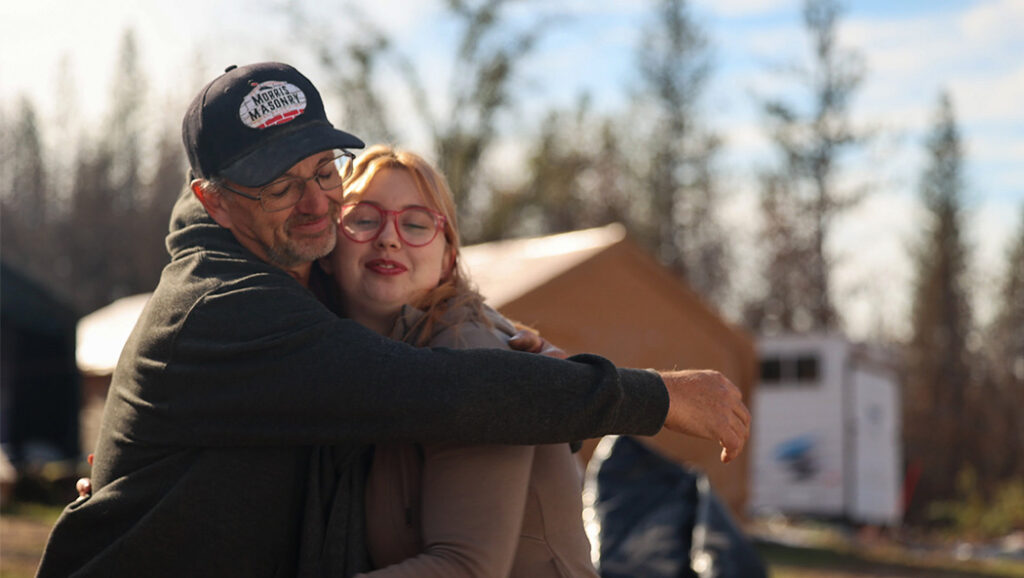
Havyn Morris hugs Bobbie Rae Jones, a disaster case manager at Tzu Chi USA’s Chico Recovery Center, after Jones helped secure a trailer that will soon be Havyn’s home in Cohasset, California, following months of displacement since the 2024 Park Fire. Photo/Kitty Lu
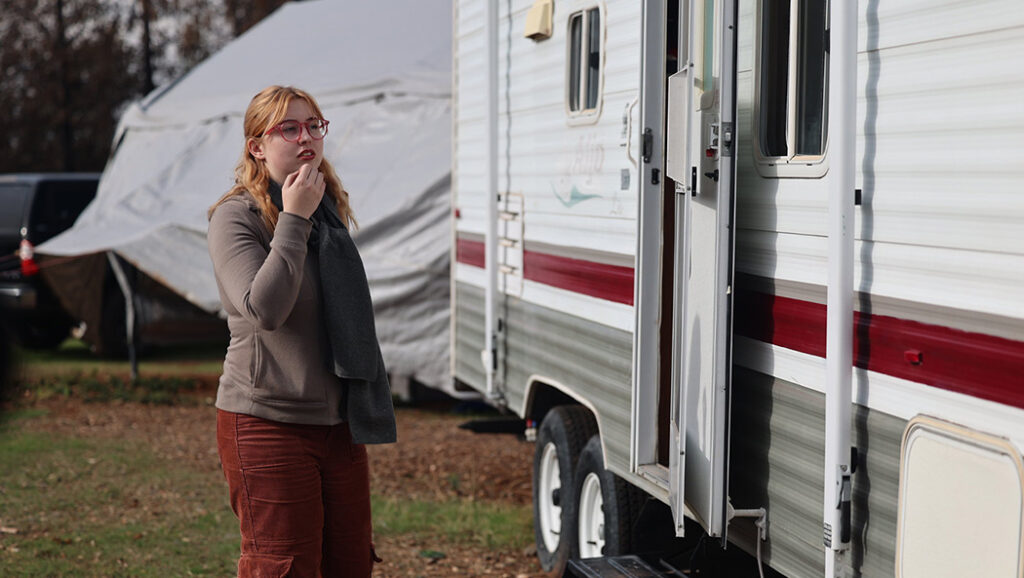
On October 24, 2025, Havyn Morris walked across a bare, fire-scarred clearing, the dirt beneath her feet raw and open to the sky, the ground only beginning to green again in patches. A horizon of blackened trees surrounded the white trailer she was approaching, one that her grandfather, James Morris, had used his work truck to place on the family homestead in Cohasset, California.
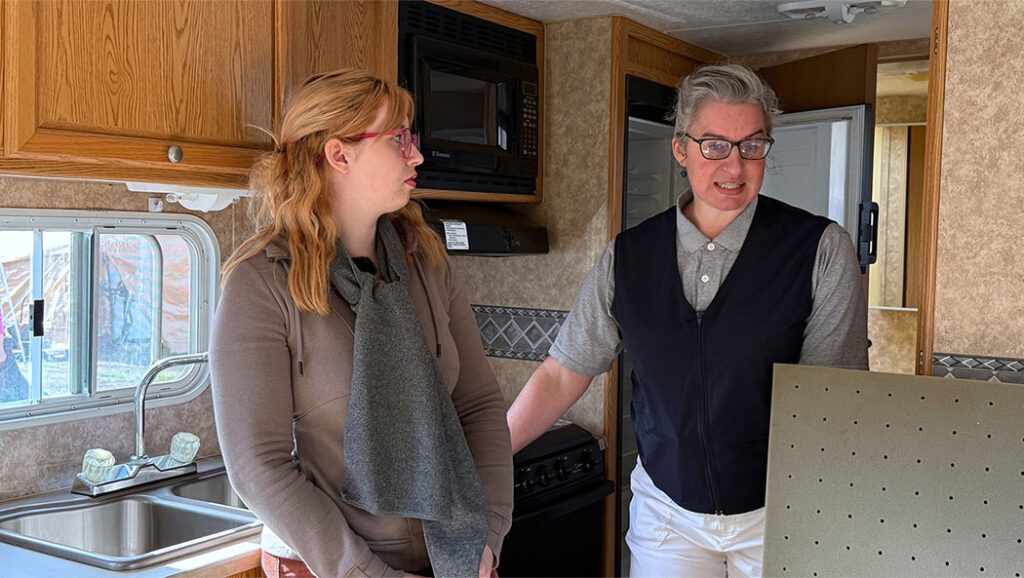
Bobbie Rae Jones, a disaster case manager from Tzu Chi USA’s Chico Recovery Center, was just behind her as they stepped inside, and the 20-year-old exclaimed upon looking around, “Yay! It’s a stove. I get to cook and bake. I’m so excited! I love it.”
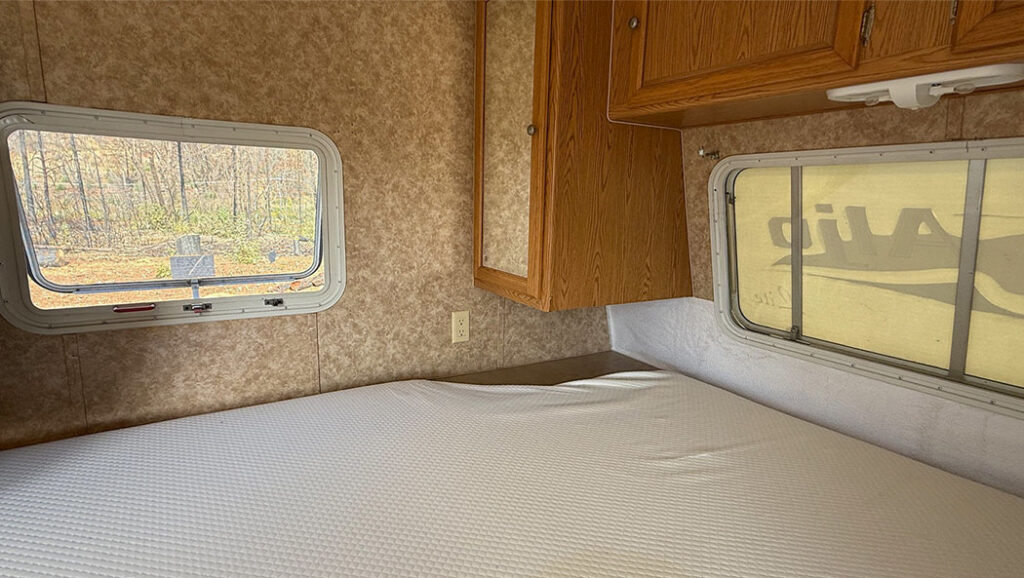
The trailer’s interior furnishings were simple but complete, including a compact bathroom, sleeping area, dinette, kitchen with cabinets and sink, and right there, the stove that made her grin. Aftermore than a year of displacement and uncertainty since the Park Fire burned through the region in 2024 and upended the Morris family’s stability, the arrival of the trailer felt like a fresh start for Havyn, a home, finally, that would soon put an end to months of couch-surfing.
As Havyn Morris looks at the trailer that will soon be her home, the tension of the chaotic months after the Park Fire begins to ease. Photo/Kitty Lu
The window beside the bed in the trailer looks out on Cohasset’s quiet landscape, which Havyn Morris truly appreciates. “I really prefer to be up here. It’s quiet, it’s a small community, it’s really mellow.” Photo/Kitty Lu
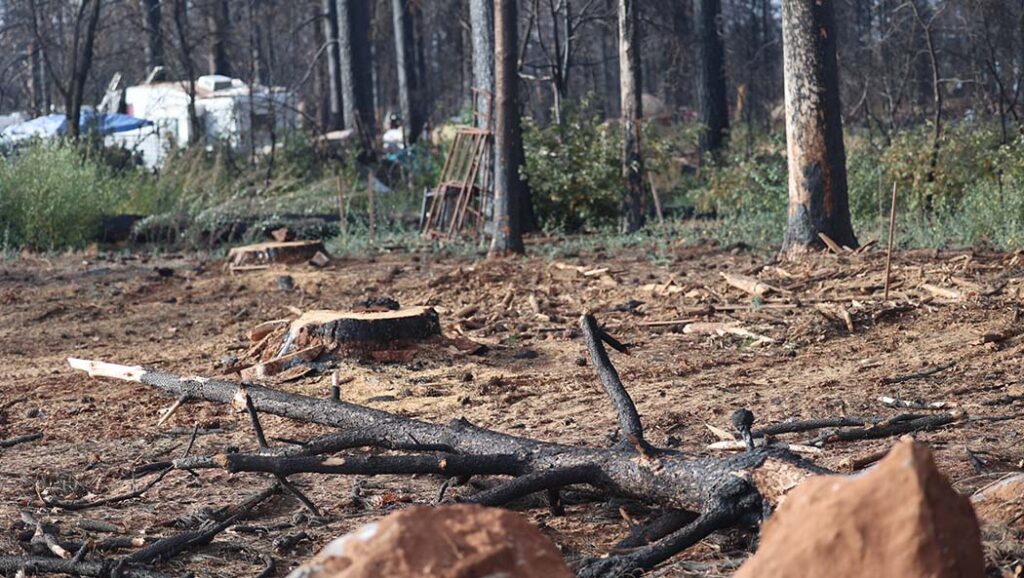
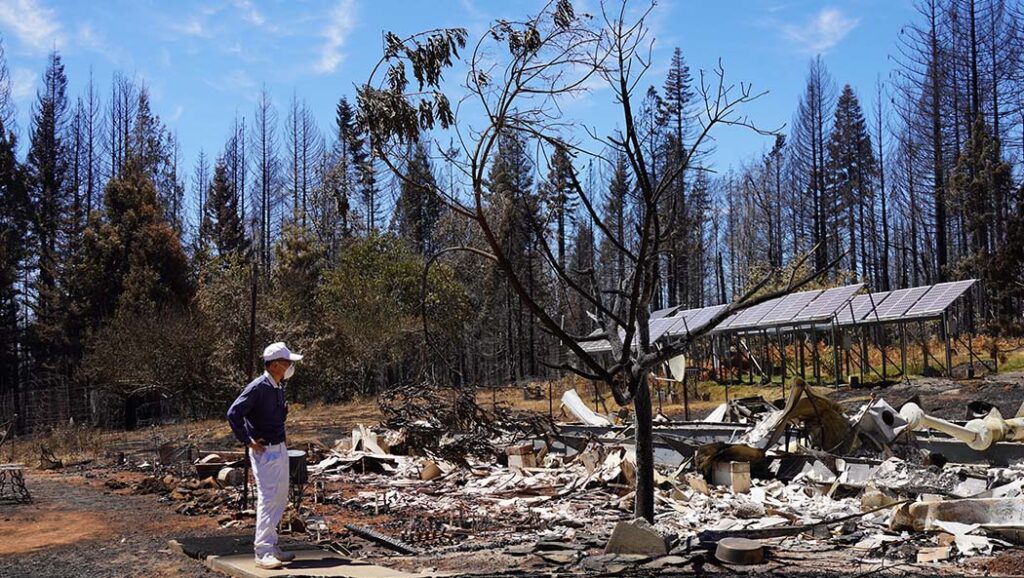
For her grandparents, too, James and Renee, married 36 years, daily life was no longer as it was before the wildfire. “This would have been the porch right here. And then the front door was here. The living room was here. There was a hallway here and a bathroom and two bedrooms…” James described wistfully as he traced the interior of the house that once stood there, now just bare ground, tree stumps nearby marking where majestic evergreens grew and cradled the home.
We lived up here for about 25 years before the fire. We had a manufactured home, three-bedroom, two-bathroom. Yeah, all my family lived in this house up until the fire.
“James was the second case I opened and I met him and his wife out on the property,” Jones recounted. “It was a really sad day because they were removing the hazardous trees and there was this really large tree. It was actually, I found out later, the biggest tree in Cohasset, and it was being taken down that day and his wife was crying…”
Only stumps and fire-damaged trees surround the spot where the Morris family’s home once stood in Cohasset, California. Photo/Kitty Lu
To make matters worse, the insurance the couple had been paying for since 1997 was inactive. “They cancelled it three months before, they dropped our insurance. We didn’t know we weren’t insured,” James said. A mason with his own business, he had lost more than the family’s residence as well. “All my equipment was here. That all got burned down.”
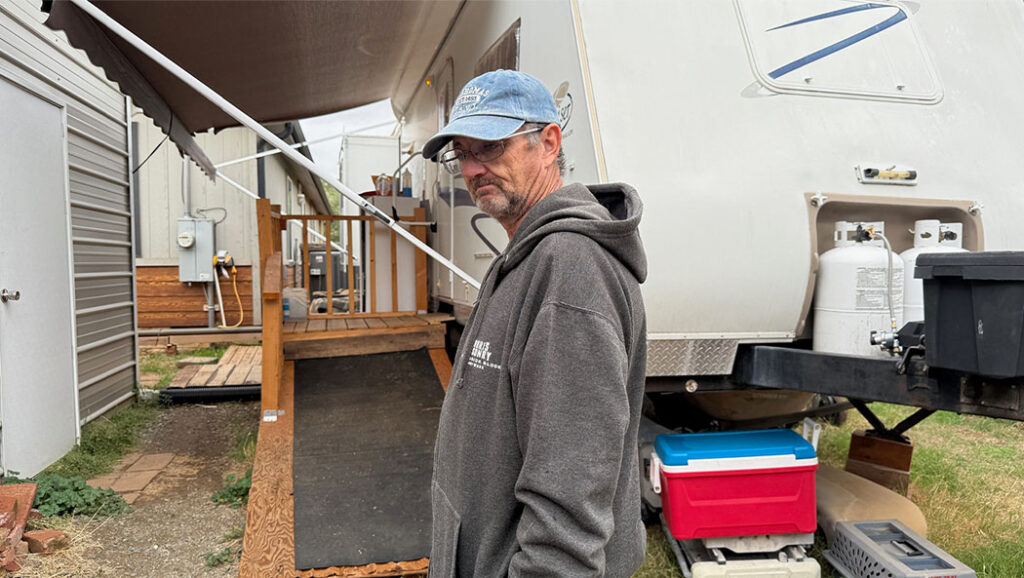
The family relocated to an RV trailer that they parked behind James’s mother’s house in Thermalito, a census-designated place generally considered part of Oroville, about 40 miles from Cohasset. “The trailer, my mom purchased for us, because we didn’t have any money at that time because of the loss of business, and things were slow right before the fire. After the fire, unfortunately, we had to live off our credit cards, and our credit went down. We’re trying to rebuild that, but it’s a slow process,” James noted.
James Morris stands outside the RV trailer behind his mother’s house in Thermalito, reflecting on the long road to recovery after the Park Fire. Photo/Kitty Lu
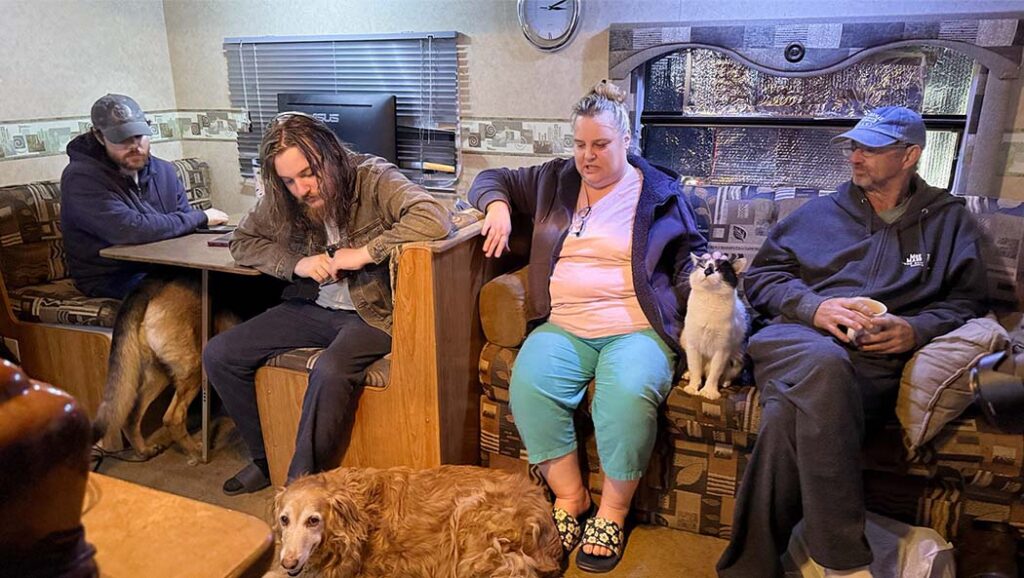
While the material losses were severe and the financial situation was dire, what added to the family’s misery was the fact that although they had secured shelter, the space could not comfortably accommodate the whole household under the same roof. Before the fire, at their home in Cohasset, James and Renee had two adult sons living with them, along with two granddaughters, Havyn and her younger sister. Now, in the trailer, with two dogs and a cat in there too, the space was cramped. “It’s just pretty crowded. So I figured I would go somewhere else for the time being,” Havyn said. By July 2025, her sister also found somewhere else to stay. “So we were all kind of separated. There’s four of us in there now,” James added.
For Havyn, the decision to move out came at an emotional cost, as she had become accustomed to the daily presence of her grandparents, which was suddenly absent. “I also didn’t have a way to go see them or anything since I didn’t have a vehicle until probably two to three months after the fire. I only talked to them on the phone.”
The most difficult thing was not being around any of my family. I didn't have the support system that I normally have, which are my grandparents.
Since the Park Fire destroyed their Cohasset home, Havyn Morris’s grandparents, James and Renee Morris, and two of their sons have been living in a crowded RV trailer parked in Thermalito, which can’t easily accommodate the full household that once lived under one roof in Cohasset. Photo/Kitty Lu
Havyn and her sister had already endured more than their fair share of trauma even before the Park Fire. One reason was that they are known among disaster case managers as “dual-impact” survivors, having also been affected by a previous disaster, the Camp Fire. Havyn was in middle school at the time, living with her mother and siblings.
“Both the Camp Fire and the Park Fire were the scariest moments,” Havyn admits. “With the Camp Fire, I was on my way to school and I got separated from everyone besides my little sister.” The girls made it to safety but at a certain point during their escape, Havyn’s sister was pulled from a burning car and now suffers from Post Traumatic Stress Disorder (PTSD). For this reason, knowing there was no room for everyone in their grandparents’ trailer after the Park Fire, Havyn left so her younger sister could stay.
The impact of the Camp Fire reached even farther for the siblings. Their mother, who was a renter without insurance, didn’t apply for available wildfire disaster relief assistance after the family lost their home, and the household received no financial support from other resources. This led to continual displacement from one housing solution to another. They were eventually taken in by James, and while the sisters stayed, their mother was eventually asked to leave due to substance abuse issues.
Sadly, to add to their woes, Havyn and her siblings’ childhood has been perpetually marked by instability due to their parents’ lifestyle choices. “My dad has been in and out of my life through my whole entire life. He is currently in San Francisco in rehab, and my mom is an alcoholic, so I don’t want to be around her. I prefer to be around my grandparents,” Havyn, who suffers from complex PTSD, anxiety, and bouts of depression, confided.
James Morris leans in to hug his granddaughter Havyn Morris, who has relied on her grandparents for stability amid family upheaval. Photo/Kitty Lu
This is why Havyn’s current situation, displaced since the Park Fire and essentially never having the opportunity to truly settle since the Camp Fire, was disheartening. When Jones learned about it from James, for whom she had been putting together several aid applications over the course of several weeks, she decided to meet her and was genuinely impressed.
“She’s very strong. She’s very resilient,” Jones observed. Through all the turmoil, Havyn had managed to finish high school and attend college. With help from part-time jobs and college grants to cover living expenses, she was able to stay afloat and graduate, with plans to start working in the salon industry building her clientele. “I’m a licensed cosmetologist and I’ll be taking my state board soon to become a licensed barber,” Havyn is happy to say.
Jones ascertained that Havyn’s principal need was a family support system, which she had found with her grandparents and uncles.
I could see that she needed help getting back home. She said, ‘I want to just be back home with my papa.’ And I said, ‘I'm going to help you get back home.
Purchasing a trailer to place on James’s land in Cohasset was the optimum solution at this juncture, as the whole household was planning to return there as soon as possible. Jones was determined to make it happen, although there were obstacles ahead as the Park Fire was not a typical disaster in terms of possible government assistance.
When Recovery Resources Fall Short
Several historic catastrophes had impacted Butte County even before the Park Fire. The Camp Fire razed the town of Paradise and killed 85 people in 2018, becoming California’s deadliest wildfire to date. In 2020, the North Complex fires destroyed over 2,300 structures and killed more than a dozen people, followed by the Dixie Fire that grew so large that it became the first known wildfire to burn across the Sierra Nevada, crossing the mountain range and spreading onto the other side.
And then, on July 24, 2024, the Park Fire ignited in Chico’s Bidwell Park, about 15 miles west of Paradise, and quickly grew into the fourth-largest wildfire in California history, burning 429,603 acres across Butte and Tehama counties. While the fire began in Chico, the worst structural losses were concentrated in foothill and mountain communities north and northeast of the city.
A Tzu Chi volunteer surveys Park Fire damage at a Cohasset property during disaster assessment efforts on August 7, 2024. Photo/Judy Liao
Tzu Chi USA’s Northwest Region volunteers responded quickly, thanks in part to the proximity of the Tzu Chi Chico Recovery Center, which had been established following the Camp Fire to facilitate mid-to-long-term recovery services to individuals and families impacted by that calamity. Overall, the Park Fire destroyed 713 structures and damaged 57. In Cohasset, a census-designated place about 18 miles from Chico, local reporting estimated that roughly 90% of homes were destroyed.
Tzu Chi’s disaster relief distributions in August 2024 provided $104,500 in cash card aid, yet it was evident that assistance beyond the immediate emergency phase was crucial. In early 2025, even more severe wildfires erupted in Southern California, and many organizations providing disaster case management shifted staff and resources and ended services for Park Fire survivors. For those still displaced, the pullback added hardship on top of hardship, triggering renewed anxiety and a fresh wave of uncertainty about recovery.
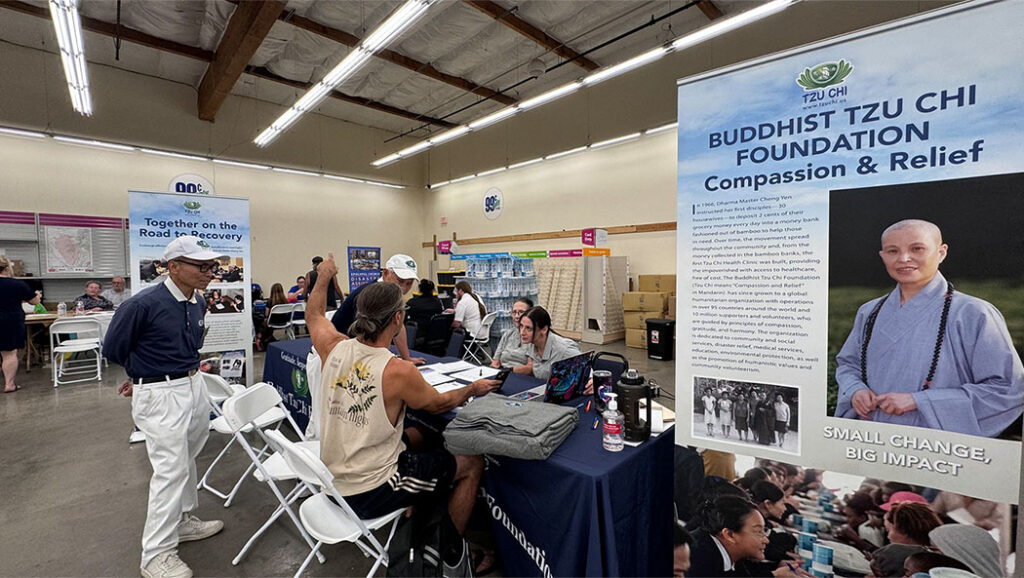
Volunteers staff Tzu Chi USA’s Park Fire disaster relief station at the Local Assistance Center in Chico on August 6, 2024. Photo/Judy Liao
Moreover, although the Park Fire was the fourth-largest wildfire in California history, survivors didn’t receive assistance from the Federal Emergency Management Agency (FEMA). “We have a unique situation here with the Park Fire because FEMA didn’t approve it as a disaster. I actually tried to send an appeal with a group of us here to have FEMA come and help survivors, but it was denied,” Bobbie Rae Jones explained. “When people are denied a declaration from FEMA, they don’t get the immediate individual assistance to help repair the things in their homes that burned down.”
Jones said the funding gap has reshaped recovery on the ground.
One of the things that I'm dealing with right now working with Park Fire survivors is that there aren’t enough funds to help them even to live in a trailer on their property. Before, I could request funds to rebuild a house. Now, I can’t even request enough funds to repair the well.
Another issue was the loss of partner support. “When I started working, we had three or four other organizations where we were all working together as a team to go out into the Park Fire burn scar and help survivors. Now, it was very challenging for other organizations to help because they didn’t have any funding specifically to hire people for the Park Fire. So, they had to lay off their employees, or they went to different departments,” Jones said.
And there was more to contend with. “When the Camp Fire happened, about $70 million came in, in donations. When Park Fire happened, about $100,000 came in. So it’s a drastically different disaster,” Jones added.
Nonetheless, Tzu Chi USA’s aid for Park Fire survivors continues through disaster case management and steady community presence. Since the emergency-phase disaster relief distributions in August 2024, volunteers have provided recovery support through long-term efforts, helping survivors navigate the barriers that remain.
This commitment has also opened a path for local residents to step forward, transforming aid recipients into caregivers. That momentum came into focus in September 2025, through a volunteer orientation event.
From Survivors to Volunteers
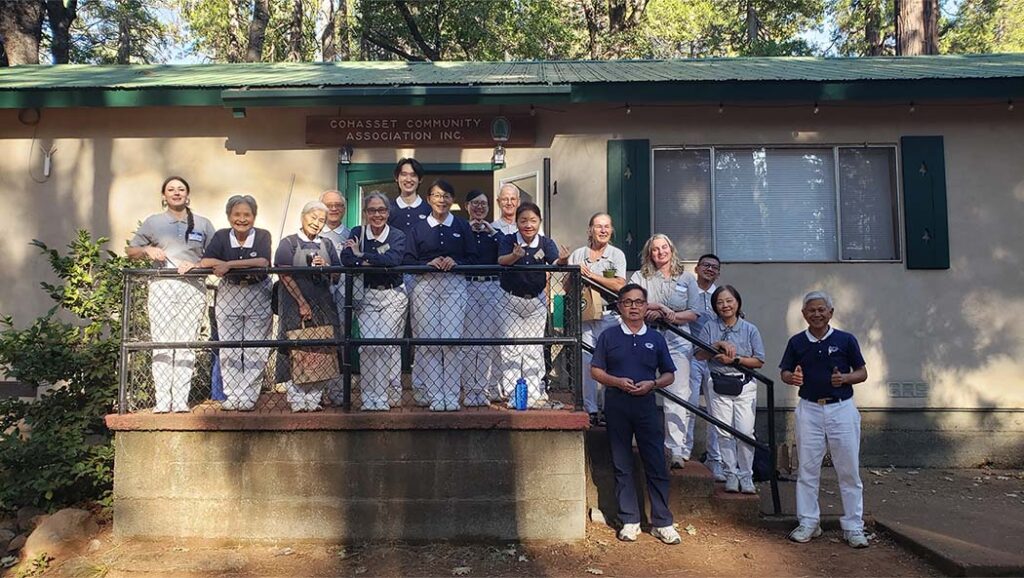
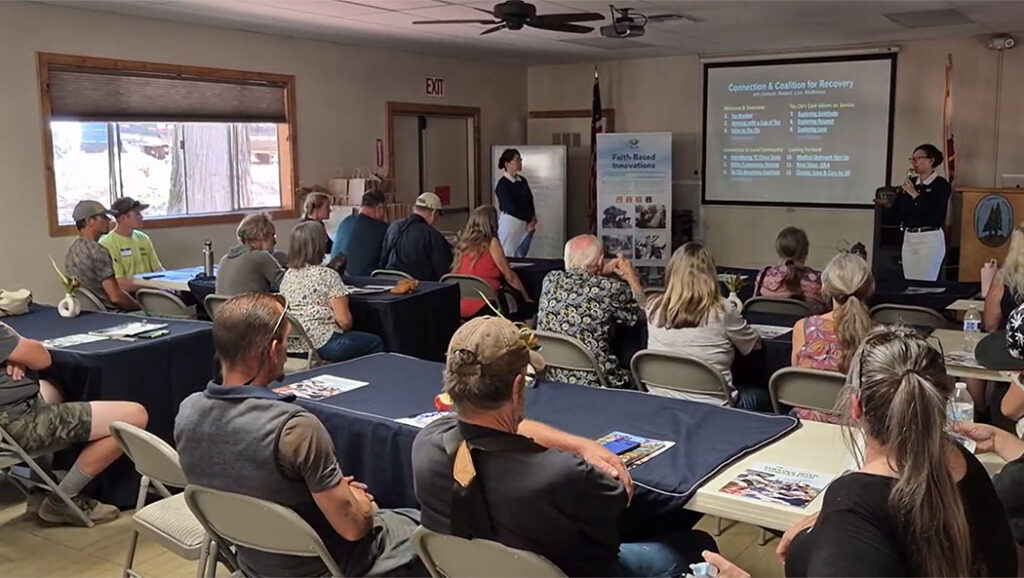
The Connection and Coalition for Recovery gathering on September 14, 2025, was held at the Cohasset Community Association’s building, nestled among the towering pines that dominate the region. Led by Minjhing Hsieh, Tzu Chi USA Northwest Region’s Deputy Executive Director, alongside 20 volunteers from San Jose, Santa Rosa, and Sacramento, the event brought together 30 disaster survivors interested in becoming community volunteers. The participants were all local residents, and even they were surprised by the turnout.
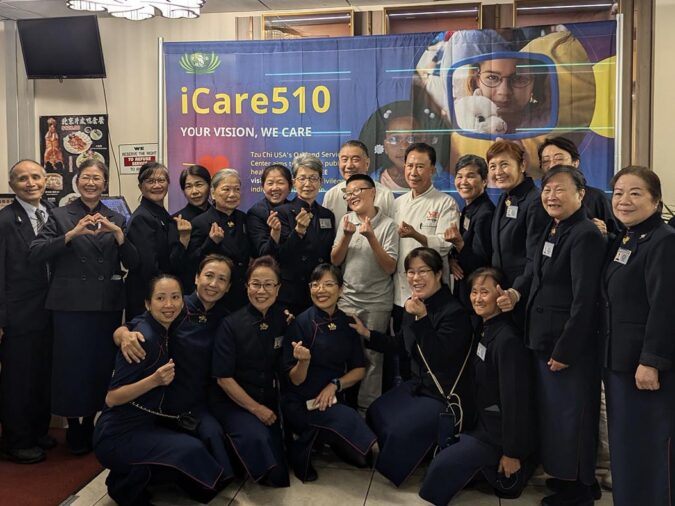
The Tzu Chi USA Northwest Region team poses for a group photo during the volunteer orientation held at the Cohasset Community Association's building on September 14, 2025. Photo/Event Participant
A Tzu Chi volunteer introduces the objectives of the Connection and Coalition for Recovery volunteer orientation event. Photo/Sai Leong Wong
“We really hope for this event to be more of a dialogue rather than a presentation. So we’ve designed a lot of activities and interactive parts where we really hope to focus on getting to know you…” a Tzu Chi volunteer said, addressing the attendees filling the community space. And that’s what ensued: a program that included presentations introducing Master Cheng Yen, Tzu Chi’s origins, its missions, and the bamboo bank spirit, combined with volunteer sharing and opportunities for the participants to mingle, discuss, and get to know each other and the Tzu Chi volunteers present.
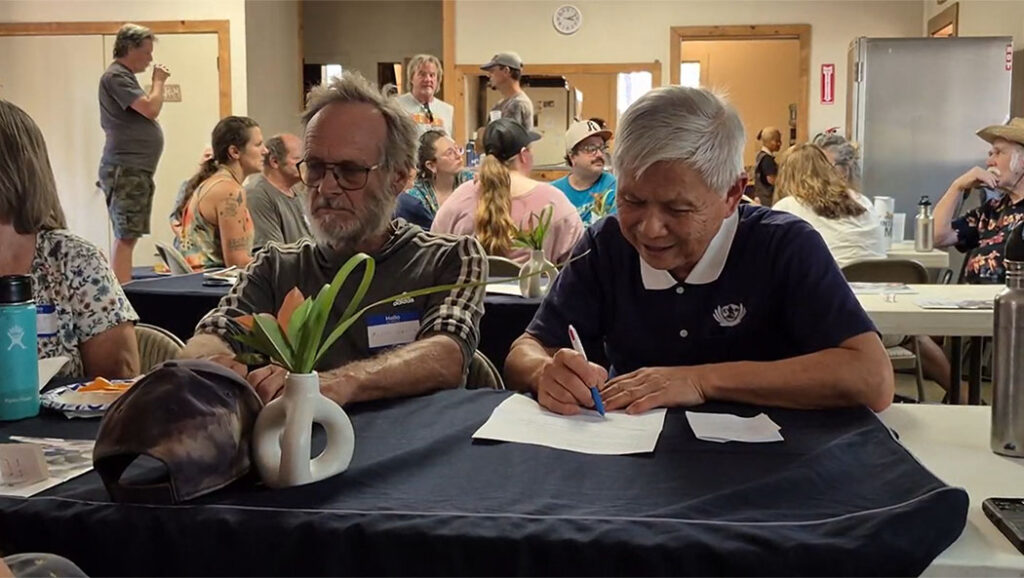
Tzu Chi USA Northwest Region Deputy Executive Director Minjhing Hsieh (right) joins a table discussion during the volunteer orientation event. Photo/Sai Leong Wong
Julie Bos, one of the volunteers, is herself a Park Fire survivor and was recently hired to join the Tzu Chi Chico Recovery Center as one of its disaster case managers. She first volunteered with Tzu Chi in 2019, helping Camp Fire survivors after the November 2018 blaze. “I felt compelled to go do that work because I was burned in an explosion in 1985, and what I know from trauma is that sometimes it’s hard to just listen to the person who has been traumatized, and help them while supporting their choices. I learned how to say, ‘I will do what is best for you, not what is best for me,’” she shared.
Bos fondly recalls how she was received during the Camp Fire mission by one of the Tzu Chi volunteers. “He walked up to me and put a scarf around my neck and made me feel comfortable to be who I am. I didn’t feel nervous or anxious or having to perform. I just had to be a good soul. And that was it.” After she lost her home in the Park Fire and Tzu Chi volunteers came to Cohasset, Bos was glad to hand him the bamboo bank she had received a year before. “I kept it with me even though I didn’t have a home. I was so happy to give it back to him completely full, knowing that we’re going to keep continuing to help the world,” she recounted. “All of us want to help make the world a better place and make communities stronger everywhere we go.”
Bos truly exhibits the heart of what it means to be a volunteer. “What’s important is showing people kindness, compassion, patience and tolerance, and love,” she said. “Because those are the things that people are needing the most.” She also emphasized the importance of community. “Cohasset is a very small community. We had about 1,000 people here before the fire. We only have about 300 here now; 425 houses were lost. But we’re a strong community. We love each other… There’s a lot of love in this small community.”
Julie Bos (right), a disaster case manager at the Tzu Chi Chico Recovery Center, shares her insights on volunteering during the Connection and Coalition for Recovery volunteer orientation event. Photo/Sai Leong Wong
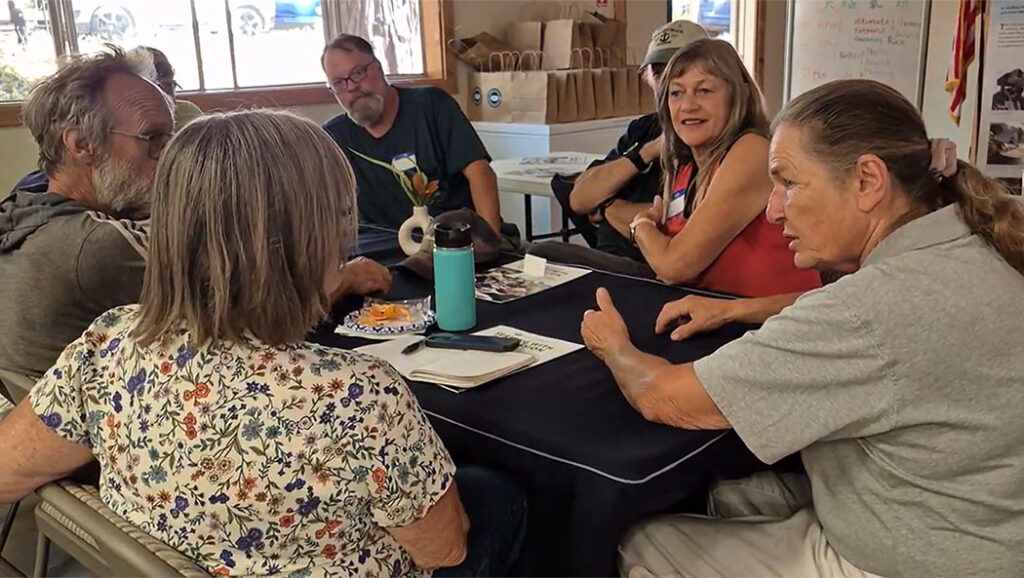
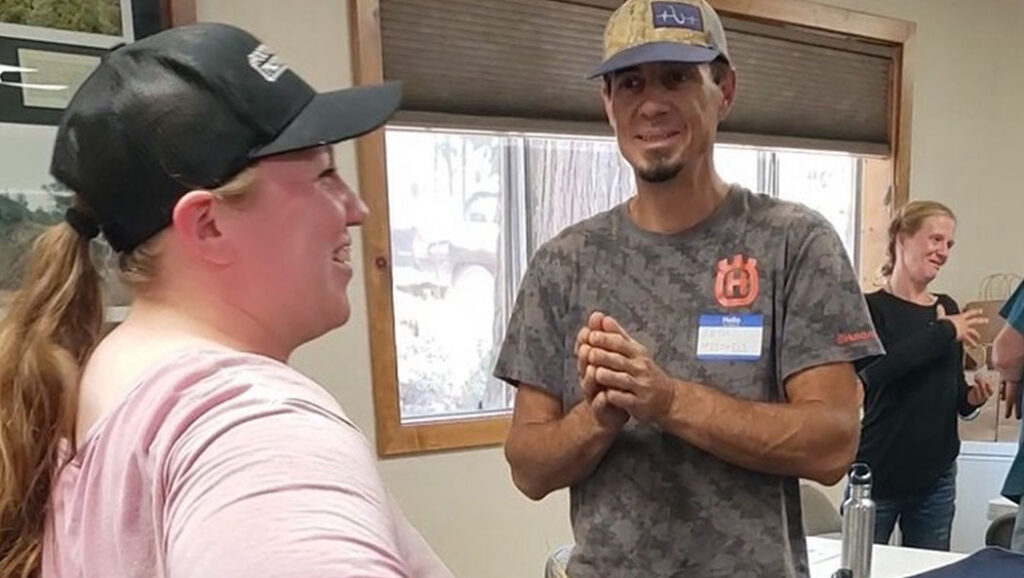
Seth Mitchell, also a Park Fire survivor, is a perfect example of that community spirit. He is a Cohasset Community Association board member and community leader. “I’m one of the Park Fire Heroes here up in Cohasset. I stayed during the Park Fire to help save the community infrastructure and the homes that were where we are today, in the green zone,” he explained. By “green zone,” he was referring to a central pocket of the Cohasset community that didn’t burn.
Even so, Mitchell was more interested in celebrating Tzu Chi volunteers’ enduring presence in the community. “We didn’t have enough people’s homes burned and fatalities in the fire, which would spark FEMA and state funding. We relied on the foundations that came up during and after the fire to help,” he noted. “I have felt great compassion with the Tzu Chi Foundation because they continue to provide support. And the attitudes within the community have changed because people have gotten the support. We’ve gained more smiling faces, which brings others into a better state of mind in recovery. Because what we’ve found is that a lot of people are having trouble moving back in…”
Seth Mitchell, a Cohasset Community Association board member, engages in conversation with fellow community members during the Connection and Coalition for Recovery volunteer orientation event. Photo/C.M. Yung
Bobbie Rae Jones confirmed the challenges that persist in Cohasset. “There’s a lot in need,” she said. “There’s a lot of people that are living in tents on their properties. They don’t have water. They don’t have power. And as a disaster case manager, I can access funding through the partner agencies, different tables, to help request those funds for the survivors so they can get their power reinstated, so they can purchase a trailer, and do many, many other things.”
The volunteer orientation event was also an opportunity to let residents know that help was still available. “There are resources for people that have been affected by the fire. And if you have tried to get resources, you had a disaster case manager, and it didn’t work, or you know somebody that still needs some assistance, there will still be time to come through the Tzu Chi Chico Center to get assistance through that. So if you or you know somebody that still needs assistance, please, you can contact our office,” Jones told the participants.
The conversation also turned to practical steps the community could take to reduce risk and strengthen essential services. Locally, Seth Mitchell will work with Minjhing Hsieh to promote a water tower installation project, since some Park Fire survivors are still living on land without water. He explained that the project would also strengthen the community’s preparedness ahead of future wildfires. “We have it for that reason too. The Tzu Chi Foundation has offered to help us get that for the community.”
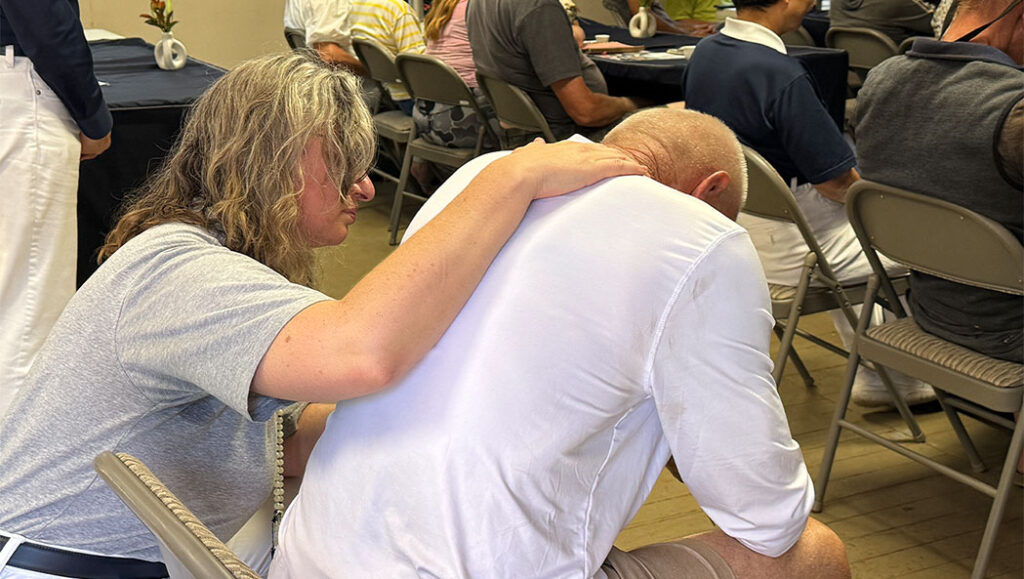
Since the orientation session lasted four hours, the Tzu Chi team additionally made time for Tai Chi exercises to help participants loosen up after sitting for much of the program, along with a guided meditation set to music, during which volunteers served tea. As everyone settled, surrounded by others who had also endured the Park Fire’s ferocity and aftermath, some felt their emotions rise to the surface and broke down in tears.
Bobbie Rae Jones comforts a distraught participant during the guided meditation session at the volunteer orientation event. Photo/Nancy Ku
The Connection and Coalition for Recovery event concluded with the classic Tzu Chi song “Love and Care for All,” aptly capturing why so many Cohasset residents came. They were there to explore how they could step forward to support their community as it heals from a wildfire that left so much destruction in its wake, and to strengthen readiness for what may lie ahead.
I’m very glad we could hold such a different kind of new volunteer training here in Cohasset today. After it ended, several people signed up and expressed willingness to become Tzu Chi volunteers, and they also hope to take part in the next activity.
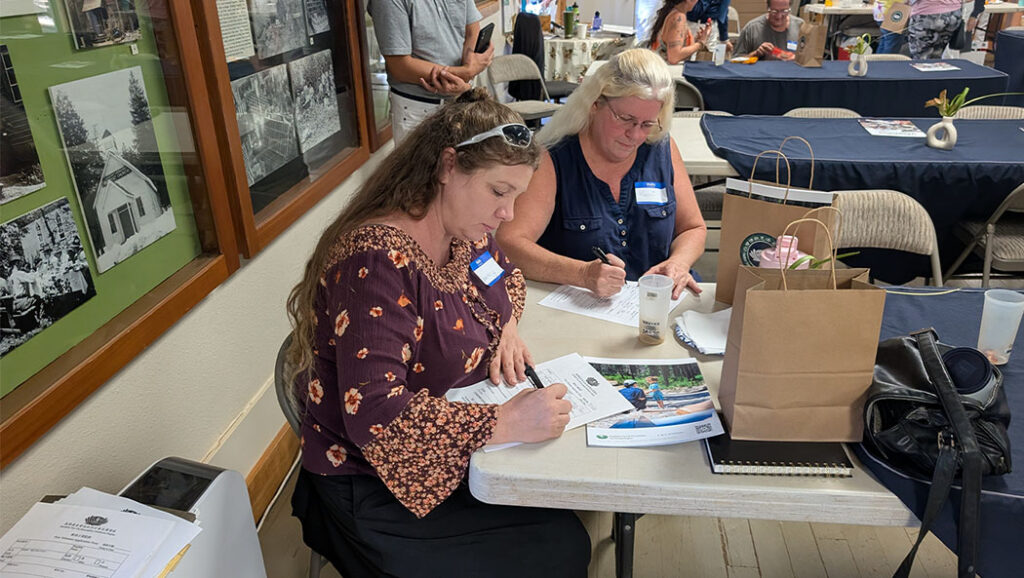
At the end of the volunteer orientation event, some participants complete registration forms, formalizing their interest in becoming community volunteers with Tzu Chi. Photo/Minjhing Hsieh
Step by Step Toward Home
It was a few weeks after the volunteer orientation event in September 2025 that members of the Morris family could mark a milestone on their path to recovery after the Park Fire, with the arrival of the trailer that would soon be Havyn’s home. One practical advancement at a time, even while navigating limited funding and finding creative ways to secure support, Bobbie Rae Jones had been keeping the Morrises’ recovery plan moving forward.
“Working on these disasters with very few funds, you have to be very strategic,” Jones said. To help make it happen, she tapped into available Camp Fire resources. “It’s not normal for a Park Fire disaster case manager to go to the Camp Fire and ask for funds, but because she is a Camp Fire survivor, they allowed me to go to those funding tables, and I requested funds to get her a trailer so she could move back onto the property with her family when they return.”
Bobby, she's been great. She's always checking in to make sure we're… if we need anything, she's just really been very helpful.
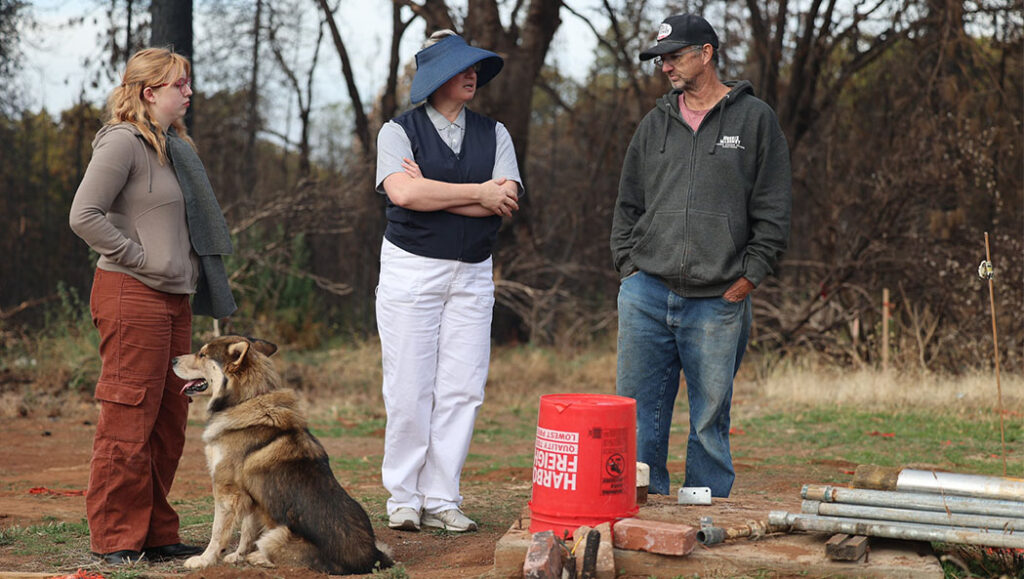
Standing on his property in Cohasset, James Morris, his granddaughter Havyn Morris, and Bobbie Rae Jones review progress and priorities in the family’s Park Fire recovery plan. Photo/Kitty Lu
Jones assessed Havyn’s next needs as a generator, a fridge, and other essentials, since she has no household belongings. For Havyn, the steady support is helping her navigate the emotional roller coaster associated with complex PTSD. “I definitely do have some of my ups and downs. But how I look at it is, I just have to keep a smile on my face. That’s the best thing I can do. I can’t hold on to the past. I have got to move forward,” she said resolutely.
To see her trailer, and to see this is going to be her home, and give her the opportunity to live back with her family in the same area, it brings me so much joy.
Inside the trailer that will soon be her home, Havyn Morris listens as Bobbie Rae Jones outlines a plan for securing the essential equipment and household basics Havyn still needs. Photo/Kitty Lu
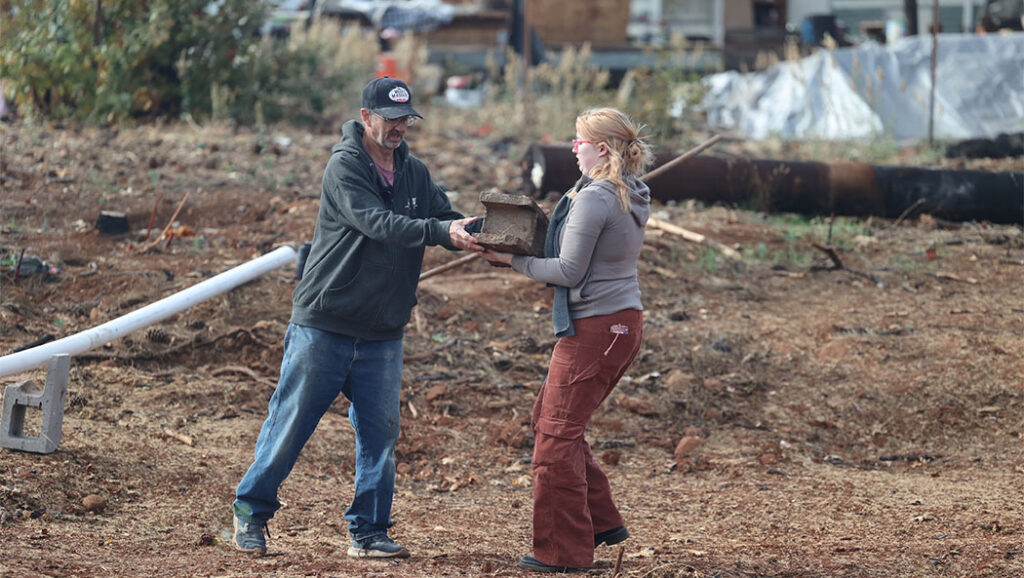
Jones is continuing to assist Havyn’s grandfather, James Morris, as well. The ultimate goal is to secure funding to rebuild a home that can accommodate the whole family, and in the meantime, they are proceeding step by step. Once infrastructure is recovered, the plan is to bring the trailer that is now parked in Thermalito, and one that they hope to acquire for Havyn’s younger sister, onto the property as soon as possible. “I’m trying to get that ready. I got the power, waiting on the power, but today I’m going to be doing the sewage system so we can hook into the trailers when we get up here. We got a temporary permit to live on the premises while we’re rebuilding,” James reported.
Havyn Morris helps her grandfather James Morris move bricks as he prepares to install septic piping on his property in Cohasset, California. Photo/Kitty Lu
Looking back on how far they have come, and how Tzu Chi has played a part in their progress restoring stability after the Park Fire, both Havyn and James are grateful. “The one thing I’ve learned is you just never know when you need to reach out for help. And luckily, there are plenty of people who help,” James said. “I absolutely love the help. We all appreciate it very, very much,” his granddaughter Havyn added, her cheerful, optimistic tone suggesting that some of the anxieties of the past were finally beginning to ease.