John Fell’s New Badge: A Legacy of Resilience
Written by Pheel Wang
Translated by H.B. Qin
Edited by Adriana DiBenedetto
Published #80 | Spring 2026 Issue
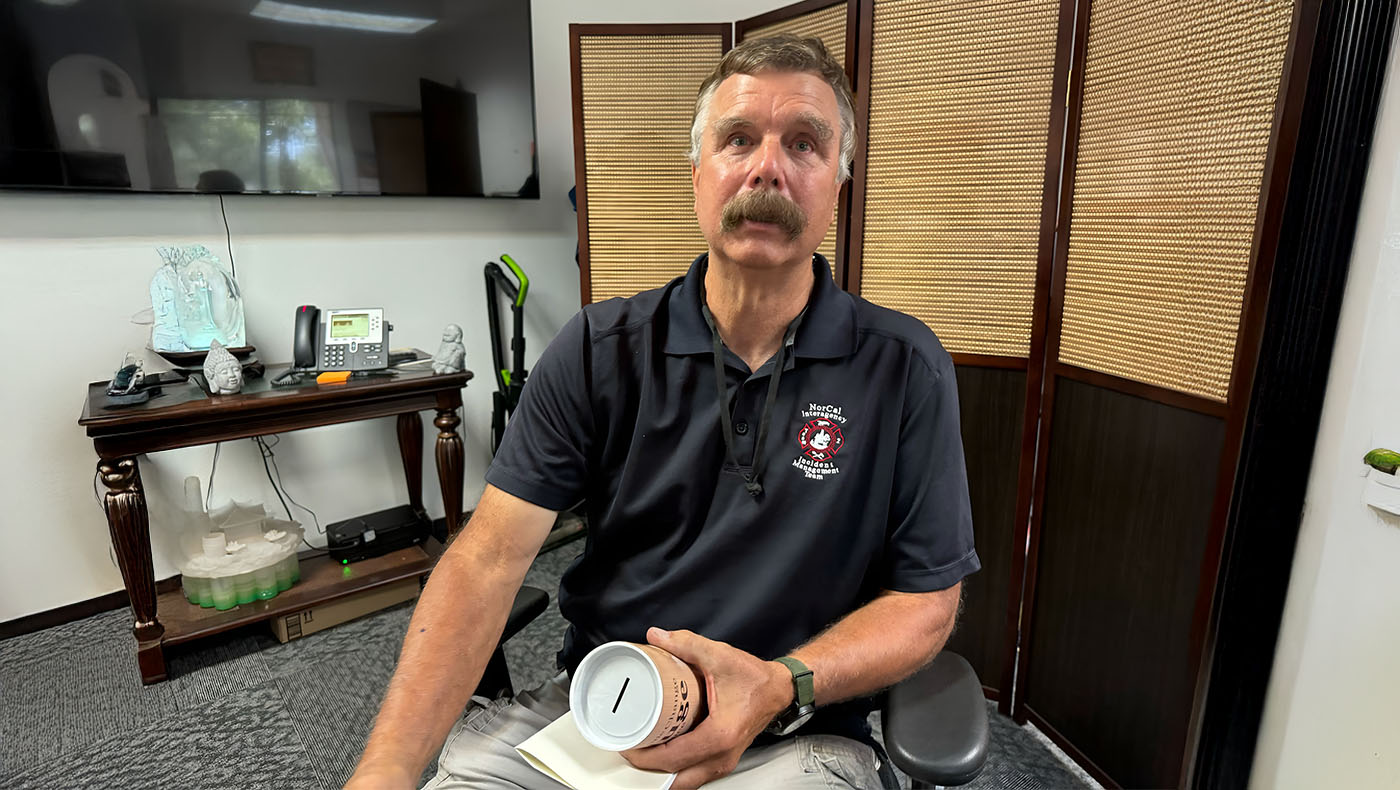
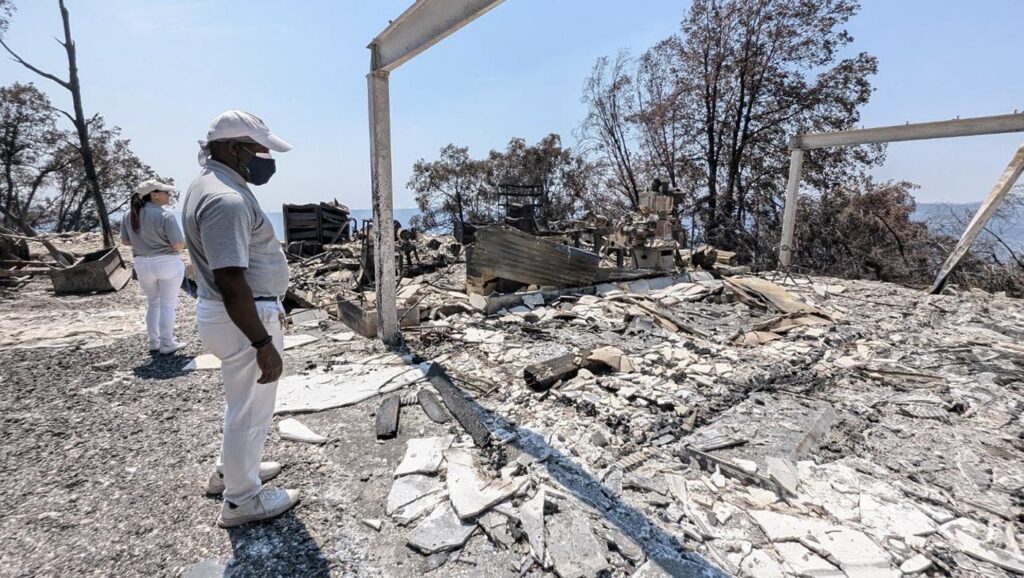
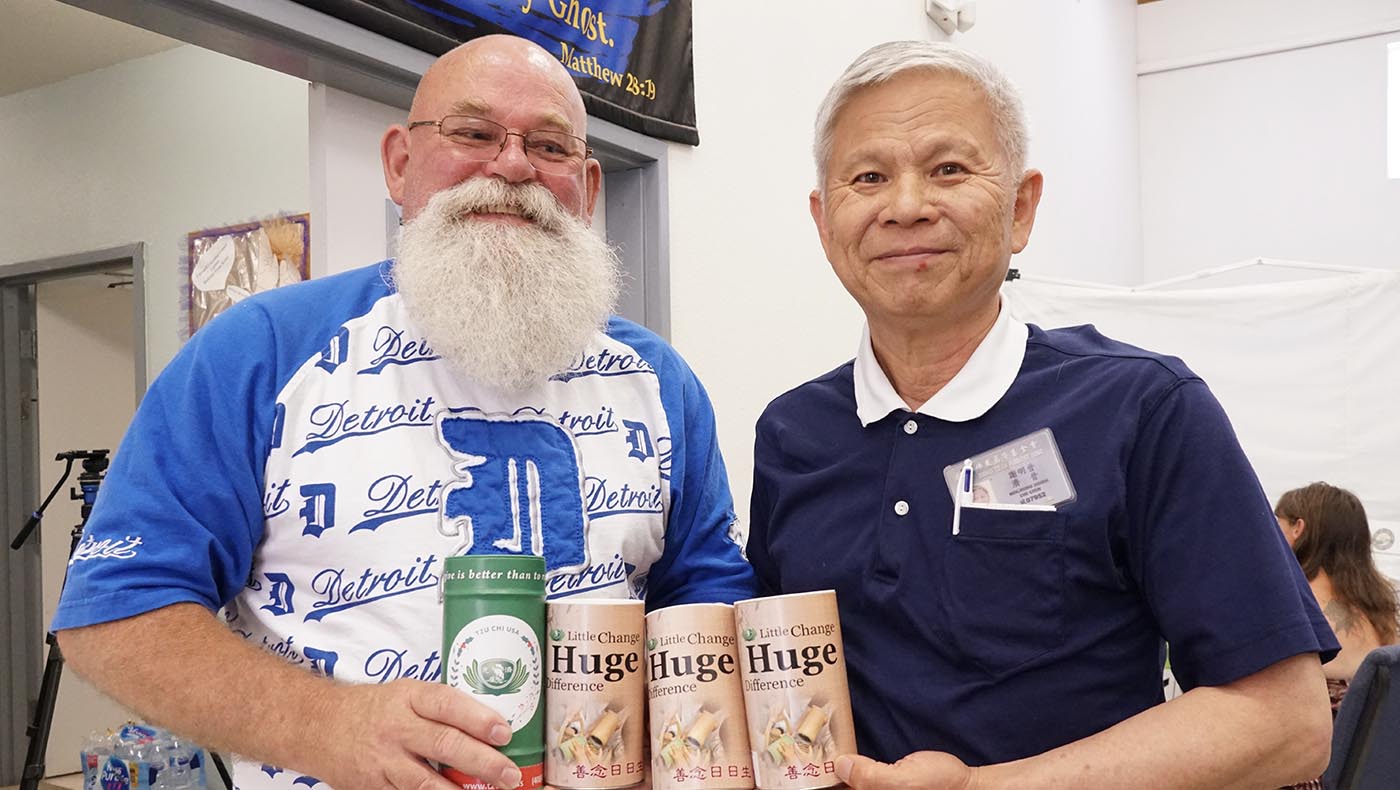
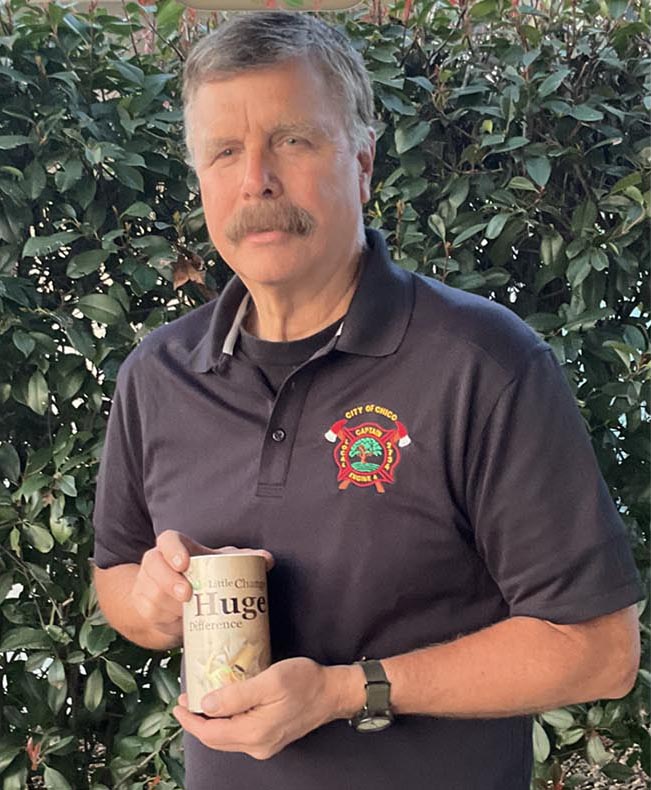
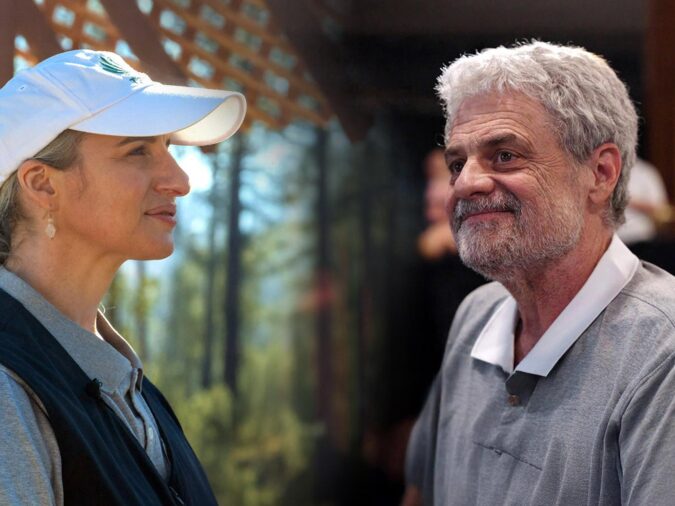
Retired Chico Fire Captain John Fell has dedicated his life to protecting his community. When the 2024 Park Fire erupted, he became a disaster survivor himself. On August 11, 2024, he visited the Tzu Chi Chico Recovery Center to receive emergency financial assistance and requested a bamboo bank. Placed in his home, it serves as a daily reminder to pass on the love. Photo/Courtesy of John Fell
SHARE
“I met… and I may not pronounce it right… Tzu Chi? Is that correct?”
John Fell, a retired captain with the City of Chico Fire Department, spoke with the levelheaded, approachable demeanor of someone who had spent decades serving others on the front lines. “I kept [a filled bamboo bank] in my truck,” he said. “I tried a couple of times to drop it off, because your office isn’t open all the time.”
The local office John visited was the Tzu Chi Chico Recovery Center, a mid- to long-term reconstruction service hub established after the 2018 Camp Fire. As Tzu Chi case workers often conduct visits in disaster areas or at survivors’ homes, John wasn’t able to return his bamboo bank on more than one occasion. Still, he remained determined.
“It was a rainy day,” said John. After arranging a time with the staff, he ultimately succeeded in returning the bamboo bank. “I was able to get it to somebody, and I said, ‘I want another one.’ So, she gave me another one.”
John has become very familiar with the local neighborhood over the years, from residences, to businesses, and organizations alike. However, “I really didn’t know anything about your organization until I went to the disaster center,” he said, “and when I needed help after my disaster.” John’s home had been severely impacted by the 2024 Park Fire that devastated Northern California’s Butte and Tehama counties, burning a shocking total of 429,603 acres. “They told me that they get donations all over the world and that people donate to help people like myself. And that’s when I thought, well, maybe I can give back… And that’s what I’m trying to do, in my little way, is just give back a little bit,” he shared. “[It] just seemed so unique that someone from Taiwan came all the way over here to help me, and I was very impressed by that, and like you said, not only from Taiwan but all over the world, people take these bamboo banks and use them to donate, and I thought that was kind of very unique and very special, and I want to be part of that.”
It was a ‘now the shoe’s on the other foot’ kind of thing. I mean, I always felt empathy for people, always tried to give them some understanding, a shoulder to lean on… You know, do the same thing Tzu Chi did for me.
John Fell
Retired Captain
Chico Fire Department
A Lifetime on the Front Lines
John Fell had lived in Chico for more than 50 years, and spent most of that time protecting the region as a firefighter. After the 2018 Camp Fire, he also spent four months commanding charred tree removal efforts in the devastated town of Paradise, California.
At 70, John speaks about the profession with equal parts warmth and wisdom. “I started firefighting when I was 18,” he shared, while describing the quick problem-solving that makes all the difference when it comes to saving lives. “People call us when they’re having the worst day in their life,” he said, pausing. “And I know that, because I’ve had the worst day in my life… But it’s like, you‘ve got to take chaos and make sense out of it and stop it. That’s what firefighters do.”
Yet, his eyes held no boastfulness, only a deep understanding and respect for the science behind the flames and the people who help put them out. Fighting flames brings one into a sobering proximity with impermanence, and so, John’s perspective is defined not by congratulations, but by care for all those he leads. “I’d always make sure that everybody that went out with me in the morning came back with me in the evening. Depending on the complexity of the fire, the geographics, and the fuels, it could be… it keeps you sharp. It keeps your senses sharp, because you’re always watching out for the way the wind’s going to change, and fuels change, and topography changes,” he explained.
For decades, John and his team have successfully extinguished blazes with such care and patience, saving homes, lives, and panicked animals. “Another time, we saved a cat in a big sycamore tree,” he recounted, a bit of mirth finding its way into his expression. “I told my firefighter, I said, ‘Put your full turnout gear on. Put your gloves, your helmet, your big heavy jacket, because when you pick him up, he may not be happy, and he may scratch and bite the heck out of you.’ Which he did.” Thankfully, both the feline and his human friend were deeply pleased to be reunited.
John is also very familiar with how giving can strengthen communities. “We have a fund in the fire service in our fire department. It’s called the Ray Head Fund. And Ray Head was a captain back in 1970. He is the only line-of-duty firefighter death we’ve had in the city of Chico. He died on a fire called the Silver Room Fire.” Now, the fire department uses this memorial fund to help those impacted, including burn survivors who need nutritious meals to aid in their healing. “So, we worked with the hospital, and we set up — this is before Uber Eats and DoorDash — we basically worked with some local restaurants and got him some high-calorie meals delivered instead of the hospital food. Just stuff like that. And then, people who lose their homes or their vehicles that need to get to work, we would donate money to help them. Kind of like what you guys did for me.”
The Night Everything Changed
Over the years, Northern California has experienced a series of increasingly destructive wildfires.
“We had the Camp Fire, we had the Dixie Fire, we had the Bear Fire, we had the North Complex, we’ve had the Park Fire. There isn’t one community in Butte County that hasn’t been affected by wildfire,” John Fell shared with solemnity. “Every town has a scar to prove it.”
Seasonal firefighters, too, once worked three or four months each year. Today, many serve far longer as wildfire seasons grow more intense.
“People argue about climate change, but I’ve seen how fire season has changed, and how when I first started fighting fire back in 1974, a big fire was like 500 acres, and a campaign fire was like maybe three to 5,000 acres. That was a big fire — three to 5,000 acres was big; 10,000, really big. Now, we’re having these mega fires, half a million acres, you know, and losing thousands of homes,” John explained. “A seasonal firefighter for CAL FIRE [California Department of Forestry and Fire Protection] would work maybe three, four months. Now, they’re all working nine months.” Then, the seasons would become wetter and colder, and fires would be far rarer.
With this groundwork laid, he also shared his observations on changes in fire formation, and how, once trees burn, another fuel model emerges. “We get more brush. When the trees are standing, they shade the ground so it doesn’t warm up, and a lot of the other shrubs can’t grow because they don’t get the sun. As soon as the timber goes away and gets burnt, it gets replaced by brush, because now the brush gets all that energy from the sun,” John said, continuing, “And brush fires burn faster than timber fires.” Sparked by a lightning storm and stoked by dry, hot, and windy weather, intense fire incidents known as “complex fires” have also impacted communities in Northern California, merging due to wind conditions and terrain. It would be one such fire that marked the beginning of a spiral of tragic events.
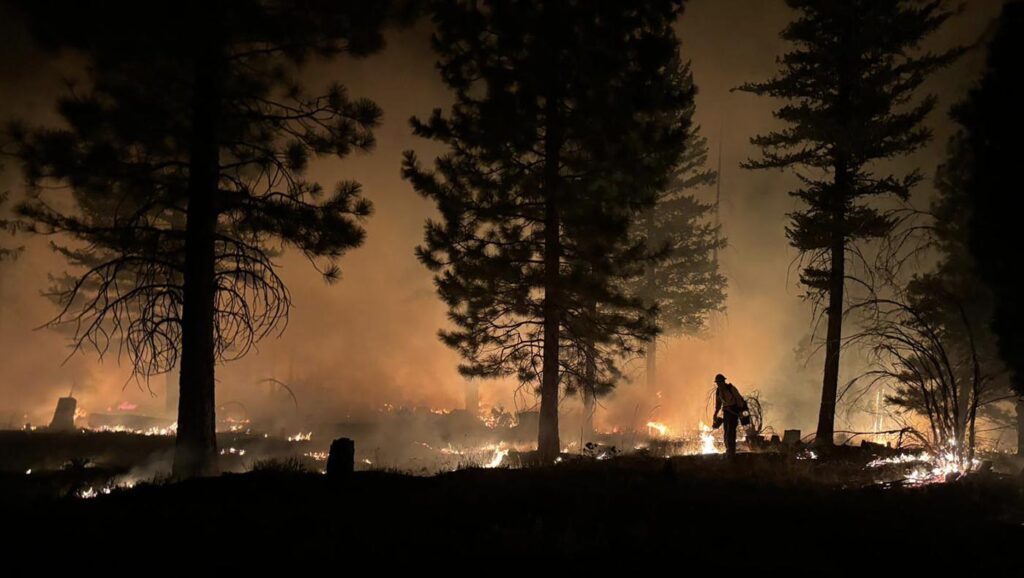
“Even though I’m retired, I still am active in the fire service as a retired annuitant, and I’m on a U.S. Forest Service incident command team, and my team was assigned to a fire in a county just a couple of counties south of us called Plumas County,” he said. “I was on a fire called the Gold Complex. It was a Complex. And we were by an area called Graeagle.” In July 2024, while John was working on the Gold Complex Fire in Plumas County, news arrived that another blaze had ignited closer to home: the Park Fire.
“I was on the [Gold Complex Fire] for a couple days when I was notified that the Park Fire in Chico had started. And I felt fairly secure about staying with my team,” said John. “Over the 30 years I worked with Chico, we had numerous fires in the park, and never seemed to have a problem containing them… But this fire had a mind of its own.” At first, John felt relatively safe based on prior experiences with similar fire situations over decades of service. He never imagined how uncontrollable this one would prove.
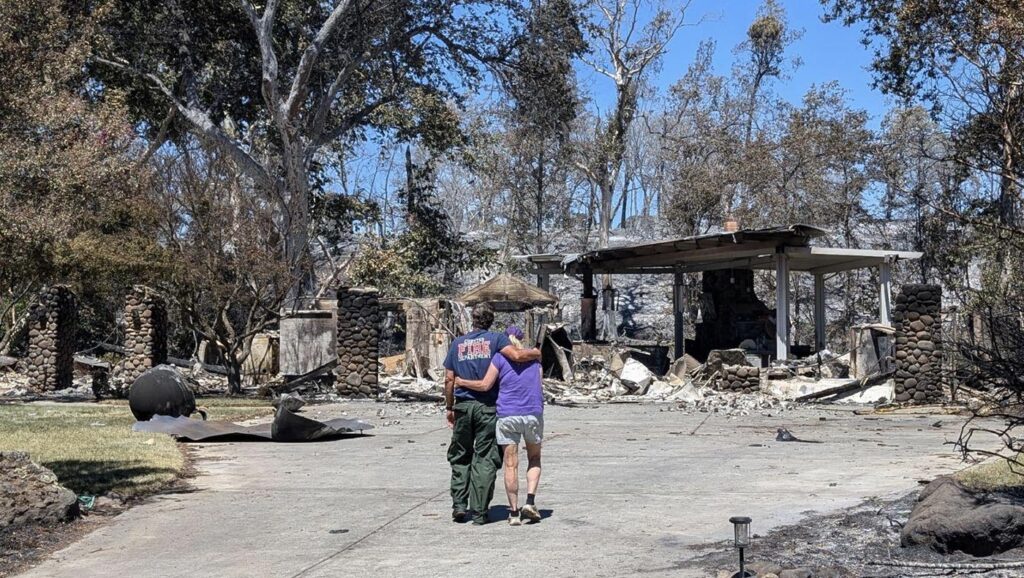
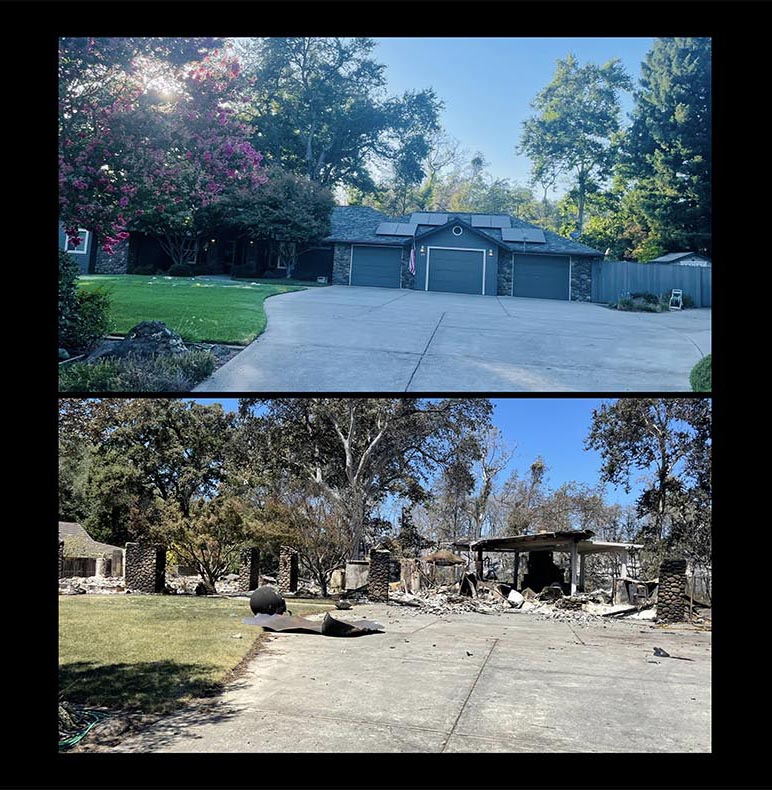
“It kind of ran under the power lines, and it was difficult to get air assets onto the fire because of the high voltage power lines. So, later that day, I heard the fire had made significant run and increased the acreage, so I told my incident commander that I was going to demob and go home, and by the time I got home, the fire had already penetrated my house.” His son, a captain with CAL FIRE, had rushed to the scene with four fire engines and a water tender. “And their efforts… they could not put the fire out. It established itself pretty well into the attic. So, I got there just in time to watch the fire destroy my house,” John recounted.
By the time he stood before his home, it was midnight. The flames had already engulfed the roof, advancing relentlessly into every inch of the house, inside and out. Wearing wildland fire gear, John rushed inside to salvage whatever he could, but the flames were too intense. However, he was able to escape with a cherished familial treasure his great-grandmother had painted.
“I kind of feel like I let my family down by losing all my generational belongings. It’s still kind of like, you still feel that way sometimes, you know? My great grandparents had it, my grandparents, my dad, and then I had gotten it… and then it’s gone. It was family stuff, like a lot of my grandfather’s badges when he was a fireman, my dad’s flag from his funeral as a veteran, stuff like that.”
Even amidst the retelling, John continued to offer his expertise, explaining how the fire behaved with an educator’s patience. “There’s a thing called a diurnal wind change,” he began, illustrating how convective movement drives warm air up canyon, while colder, denser air sinks. “So it comes down, and it’s called ‘outflow.’ And that’s what got our house. It came back down canyon about midnight, and it came down our drainage, and it was kind of like a tsunami of fire, and it has high-velocity wind behind it.” John described how the fire had taken some homes, then skipped over others before resuming its devastating path, affecting his neighbor’s home before consuming John’s. “I always figured that fire would come during the day, with a diurnal wind coming from either the north or the south, depending on the weather pattern. So, it kind of caught me off guard. But now that I saw the fire behavior, and saw the fire analysis, I saw where it happened. There’s seven homes lost in my neighborhood, and after I called my son and told him that there was a fire in the neighborhood, and he brought his fire engines down, no other houses burned. They were able to make a stand at my house, and then they had resources available, so none of my other neighbors burned after my house. So, that was a good thing.”
John’s wife had also not been at home when the fire began, but was staying nearby, taking care of their son’s little girl while he was at work.

Learning the Bamboo Bank’s Legacy
Having burned for two months before being fully contained, the Park Fire destroyed more than 700 structures, and the fire ranks as the fourth-largest wildfire in California history by area burned. Tzu Chi USA’s Northwest Region volunteer team immediately mobilized and headed to disaster recovery centers to gather information on affected residents.
John Fell first met Tzu Chi at a disaster recovery center, where volunteers recorded his information and learned about his situation. He met with them once again at Tzu Chi’s Chico Recovery Center on Willow Street, where John was provided with a cash card to help his family get started again. “It was $1,000, which I thought was a pretty substantial sum. I was very grateful for that amount. During the first months after the fire, everything we owned was destroyed. We had nothing. I had the clothes that I had taken with me on the fire.”
This disaster marked John’s first encounter with Tzu Chi and introduced him to their bamboo banks. Tzu Chi’s cash cards contain the love of people all over the globe who care deeply, and wish to make a tangible difference wherever relief is needed most.
And, many times, that love is delivered through daily acts of kindness, placed into a bamboo bank. John knew that the cash cards were made possible through the generosity of others, but was surprised to learn the bamboo banks played such a powerful part, too.
“I mean, I assumed that it was like it’s a contribution that you make for other people,” he said. “Kind of like we do at the Red Cross, the United Way, but I really didn’t know anything about your organization until I went to the disaster center, and when I needed help.”
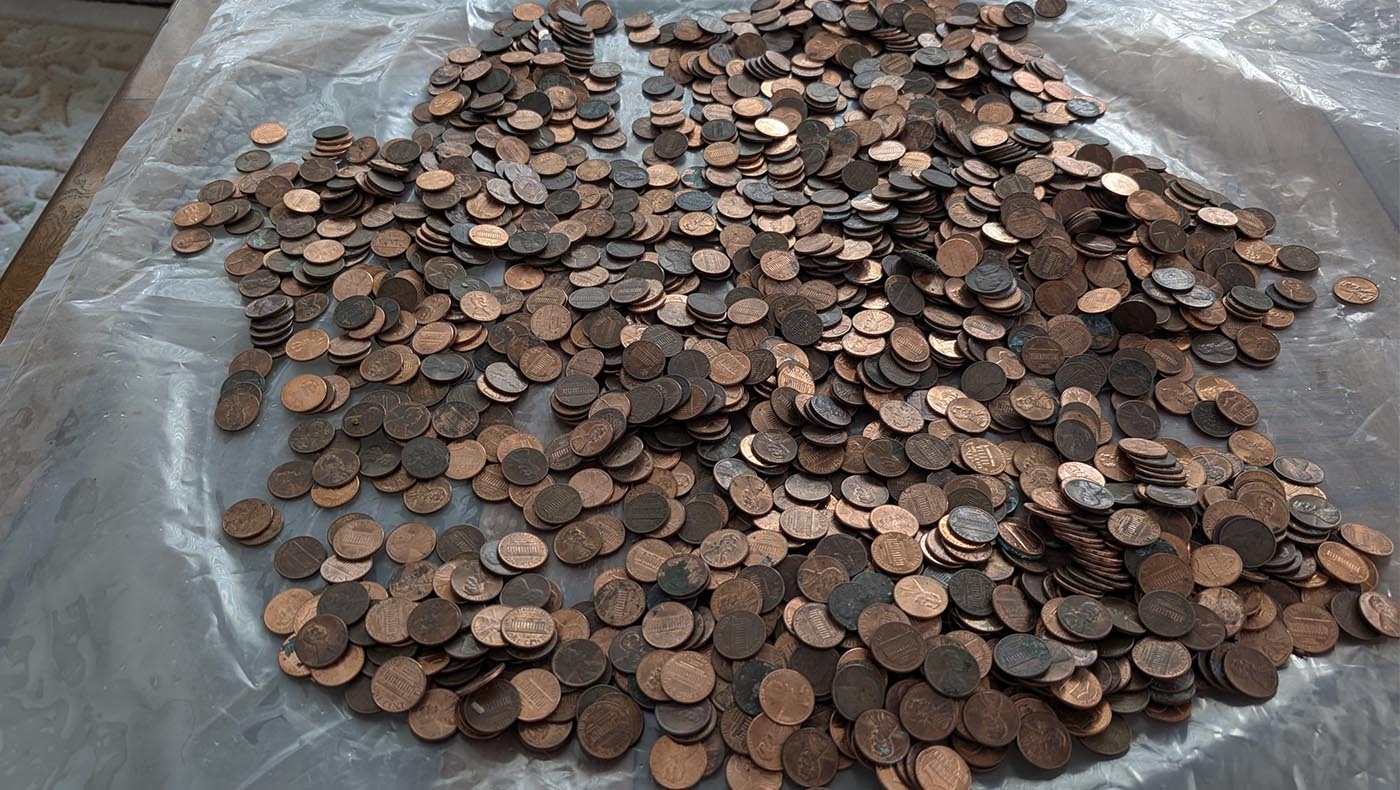
I want to basically try, you know, one quarter at a time, one 25-cent piece at a time, to kind of give back to your organization so someone else can benefit like I did.
John Fell
Retired Captain
Chico Fire Department
And indeed, this very same spirit has echoed across decades, beginning in the heart of one woman. In February of 1966, Tzu Chi’s founder, Dharma Master Cheng Yen, then a nun in her twenties, visited a disciple’s father who had recently undergone an operation at a private medical clinic in Fenglin, Taiwan. Upon saying farewell for the time, she was struck by the sight of blood and quickly inquired about what occurred. The medical clinic’s staff relayed a horrible tragedy. They explained how a woman experiencing labor complications had presented to the clinic in urgent need of care to save her baby following an exhausting eight-hour journey. However, she was turned away, unable to provide the security deposit.
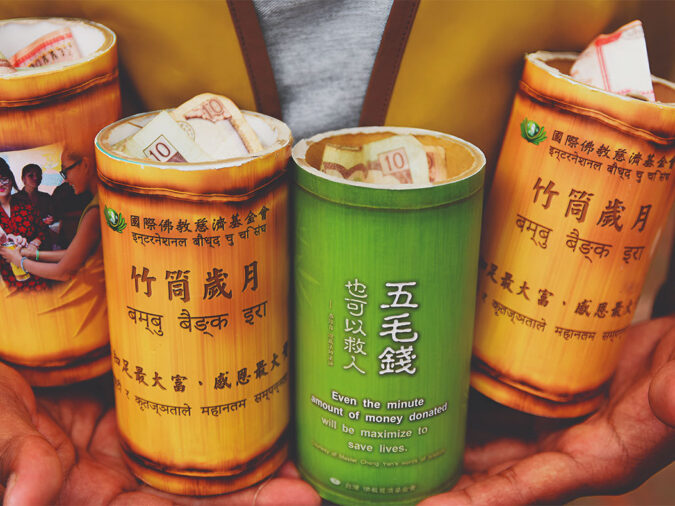
Stunned and heartbroken, Master Cheng Yen knew she had to do something. Joined by her disciples, she set aside funds over the course of a year to raise the amount needed for someone like that woman to receive the treatment they need and so deserved. Together, her followers, 30 women, put small change into a bamboo tube each day before purchasing any food for themselves, whilst crafting baby shoes to sell.
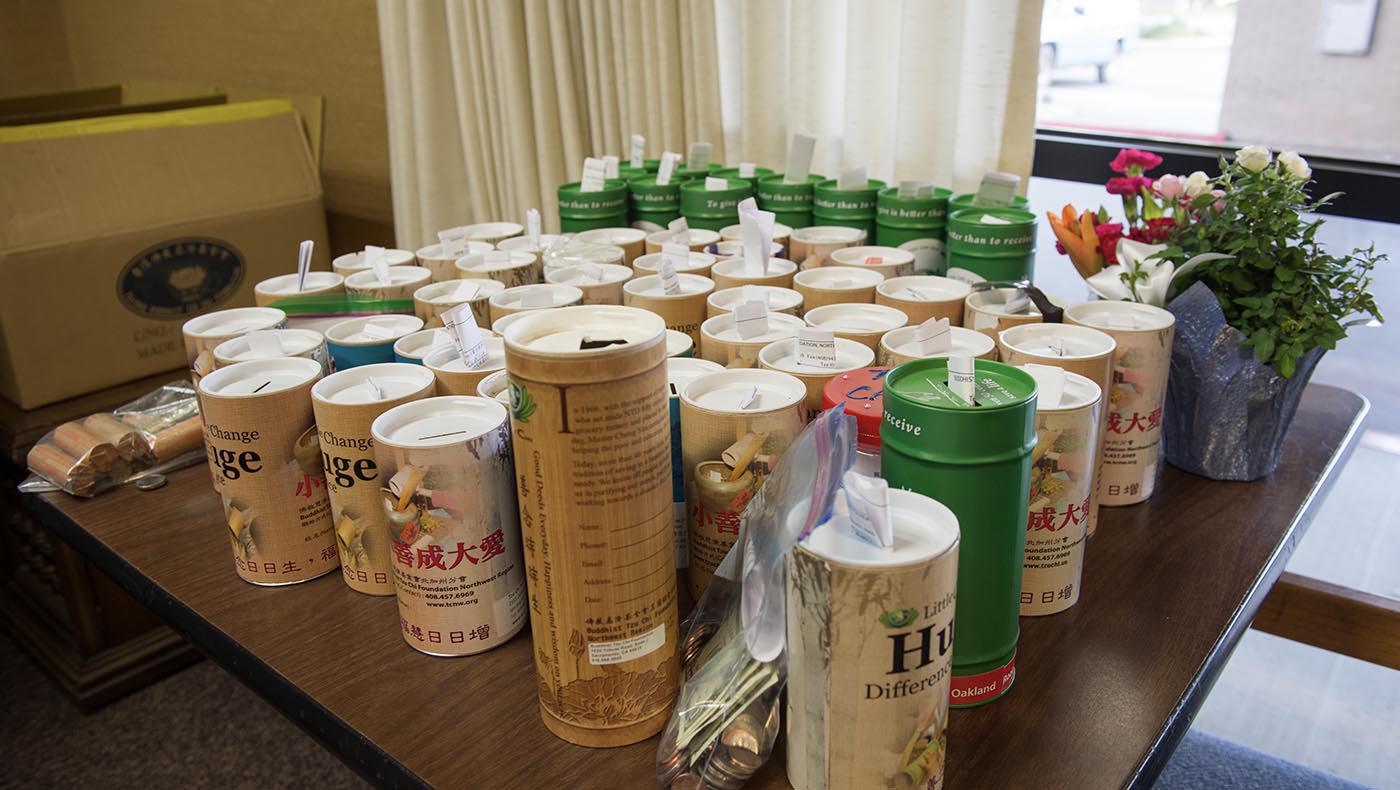
And so, on a chilly January morning in 1983, a group of nuns and female lay followers carrying tools gathered in a field in Hualien. Their goal: Clear a space where a new hospital would one day stand. Once dismissed as a daydream, the Tzu Chi General Hospital was inaugurated in 1986. The Buddhist Tzu Chi Foundation’s footprint of charity and humanitarianism now spans the globe. To this day, Tzu Chi continues to use a symbolic iteration of these bamboo tubes — the Foundation’s signature bamboo banks — as an everlasting reminder of this noble act.
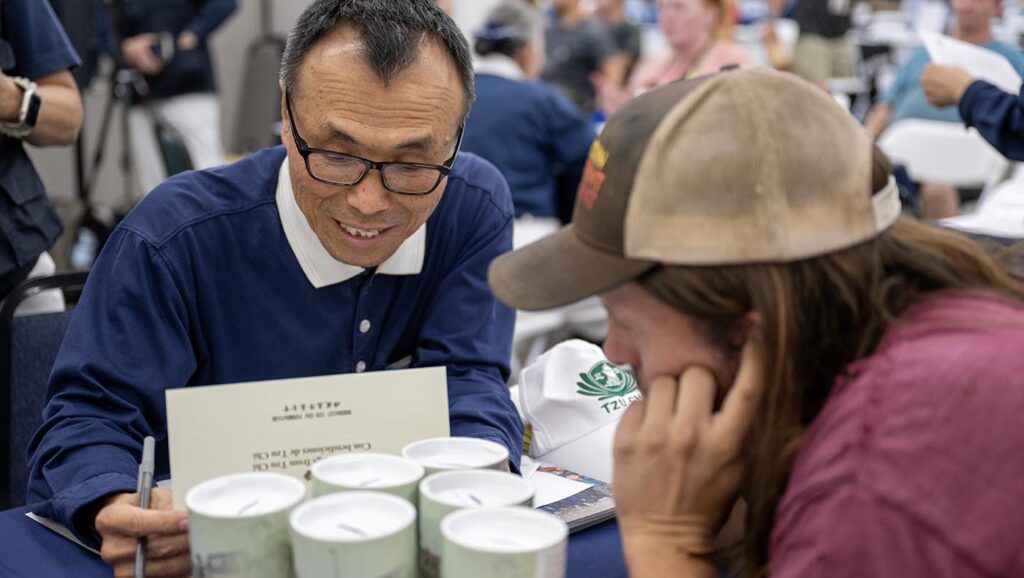
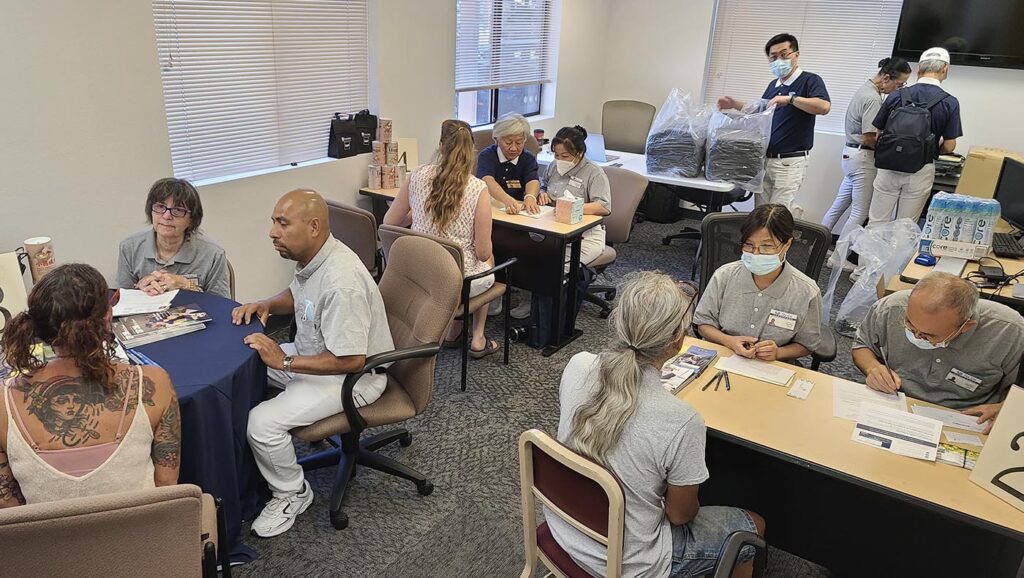
“One thing we do exceptionally well in the U.S. is that every time we conduct emergency relief, the bamboo bank becomes something every volunteer actively introduces.” Minjhing Hsieh, Tzu Chi USA Northwest Region’s Deputy Executive Director, has participated in disaster relief distributions across the U.S. for decades. During the massive wildfire relief efforts in Northern California in recent years, he served both as the core of the command team and as a volunteer sitting at small tables listening to the stories of survivors.
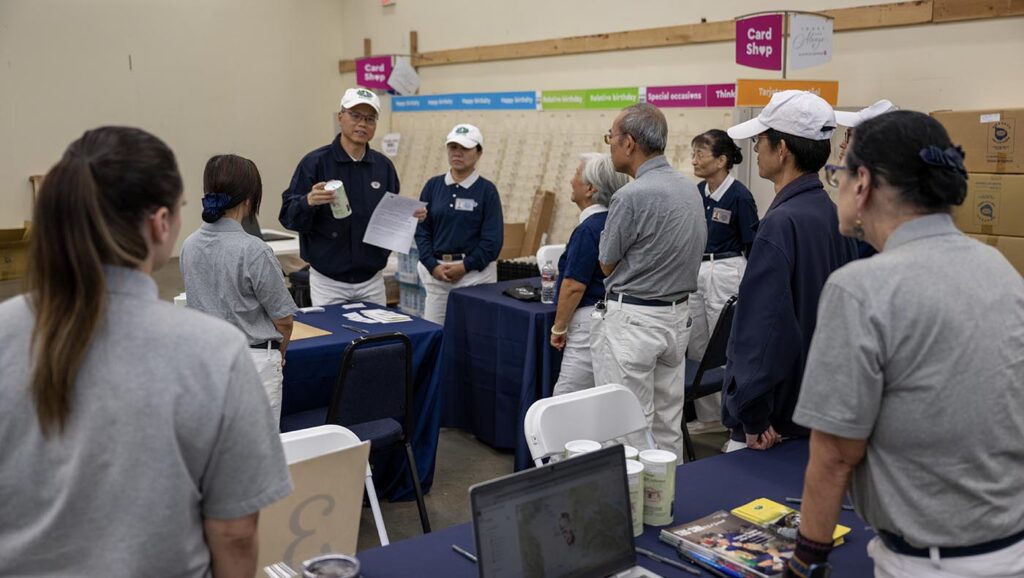
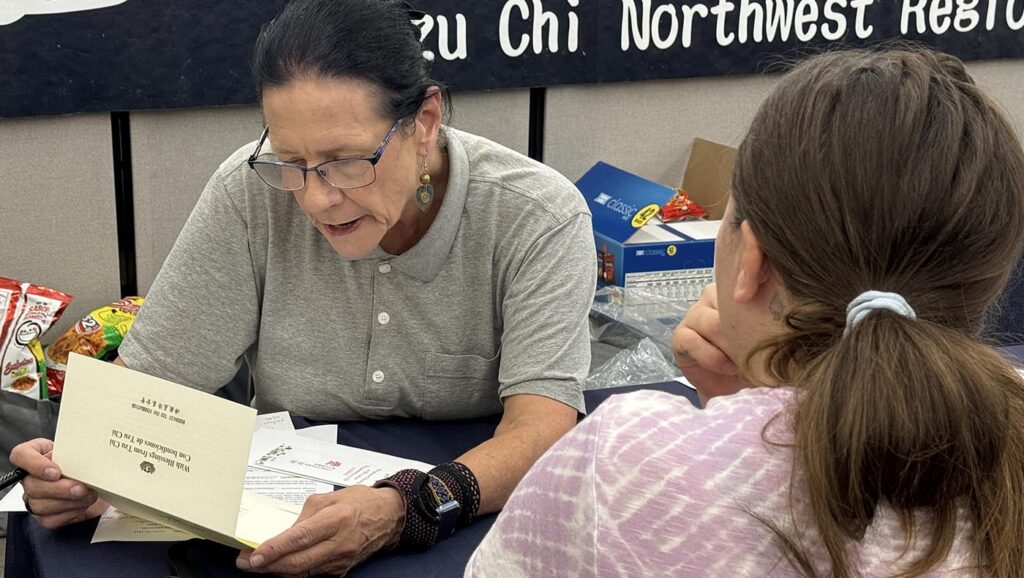
“There are three things we always do at distribution sites,” began Hsieh. “Introducing Tzu Chi, reading Master’s letter of comfort, and explaining the bamboo bank. These must be included when we interact with disaster survivors. We always remind every volunteer of this during the pre-distribution briefing.”
For large-scale distributions, volunteers must maintain smooth operations at every stage, ensure on-site safety, and coordinate personnel and supplies. When asked why they still make a special introduction for the bamboo bank, Hsieh answered without hesitation: “We actually consider this the most important part,” he said, drawing on decades of experience.
“We want survivors to understand that this aid accumulates from small contributions, which deeply resonates with them, realizing that strength comes from all directions. Their eyes light up when they hear this, genuinely surprised. Additionally, telling the bamboo bank story helps bridge the gap with the survivors; it can be used to initiate meaningful conversations.” With this knowledge, volunteers hope survivors can feel that they are not alone, and that they are going forward with the love of so many who care about them.
Yet, many volunteers didn’t feel this way initially, including Hsieh, who has been through many disaster relief efforts. “Years ago, introducing the bamboo bank to disaster survivors felt awkward. They came seeking help, yet we asked them to donate spare change; it seemed strange. Once, an official from another organization who didn’t understand the practice told me it wasn’t appropriate. They argued that since we were there to help disaster survivors, how could we possibly be fundraising in that context? But in recent years, this other organization has come to understand our motivation, that we’re not raising funds, but offering a small way to empower; paying it forward, and passing on love. That’s our true purpose. We hope survivors can help others once they’ve recovered.”
It’s crucial that we don't ask for donations in large amounts. We encourage them to save small amounts regularly. As for how they use these funds, we don't mandate they give back to Tzu Chi. If they go to church, they can donate there, or support other organizations they believe in; it doesn't have to be Tzu Chi.
Minjhing Hsieh
Deputy Executive Director
Tzu Chi USA Northwest Region
During a 2018 Camp Fire distribution, Tzu Chi invited survivors they had assisted to participate in Buddha Day ceremonies in early 2019.One ceremony was held at the Tzu Chi Chico Recovery Center, and another at a century-old elementary school near the disaster area.
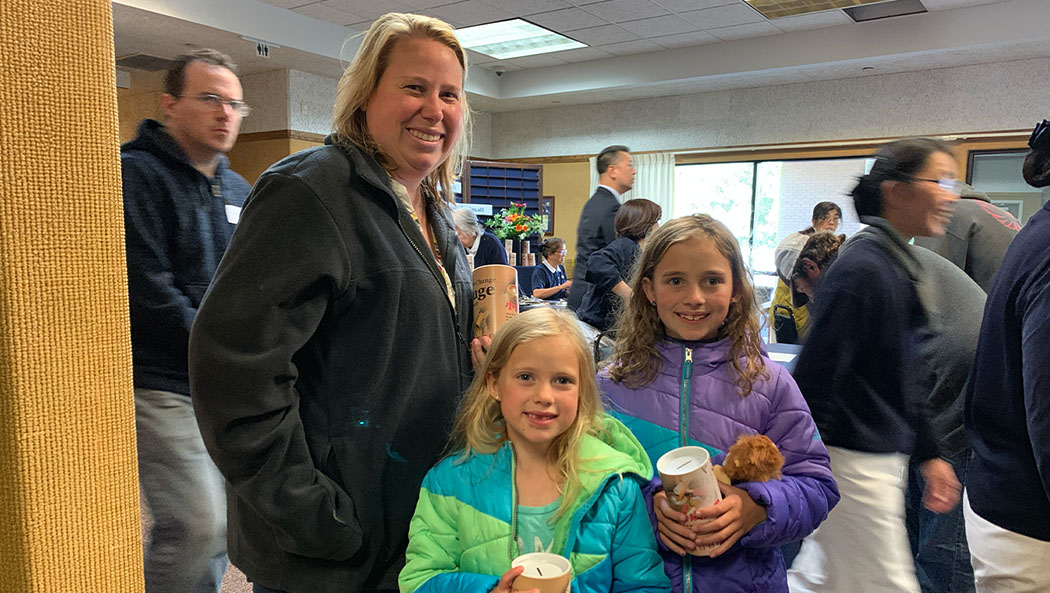
“When we invited them, we told them that if they had received a bamboo bank during last year’s relief distribution and found it meaningful, they could bring it back.” Having lived in the U.S. for years, Hsieh has come to recognize and admire Americans’ strong sense of individual autonomy. Hsieh and all frontline disaster relief volunteers soon grasped the profound significance and impact of Master Cheng Yen’s bamboo bank through each distribution experience. “They share in that spirit,” continued Hsieh. “Even though they know the amount is small, they recognize how action has its own significance. Later, two Buddha Day ceremonies saw over a hundred people in attendance, and over four hundred people attending another. Roughly one in two guests brought back their bamboo banks! It was completely unexpected. This gave me confidence, showing our fellow volunteers did a good job passing on this spirit. My view on introducing the bamboo bank has changed, too. I now approach it with ease, and if I skip it, it feels like I’m missing something crucial. The monetary value itself isn’t large, but the feeling is truly different.”


A New Family Legend
After losing their home, John Fell and his wife moved into a temporary rental.
“We don’t have a lot of furniture right now because we’re going to move to the new house,” John said, seated at a desk in the rental home, a bare wall behind him. “So, we’re kind of at a very minimalistic point in our lives. We don’t have much.” Before the fire, the walls of John’s home had displayed decades of memories: awards, certificates, and badges from the fire departments where he served. “I mean, I worked for, let’s see, one, two, three, four different fire departments, so I had a lot of, you know, memorabilia from those departments.”
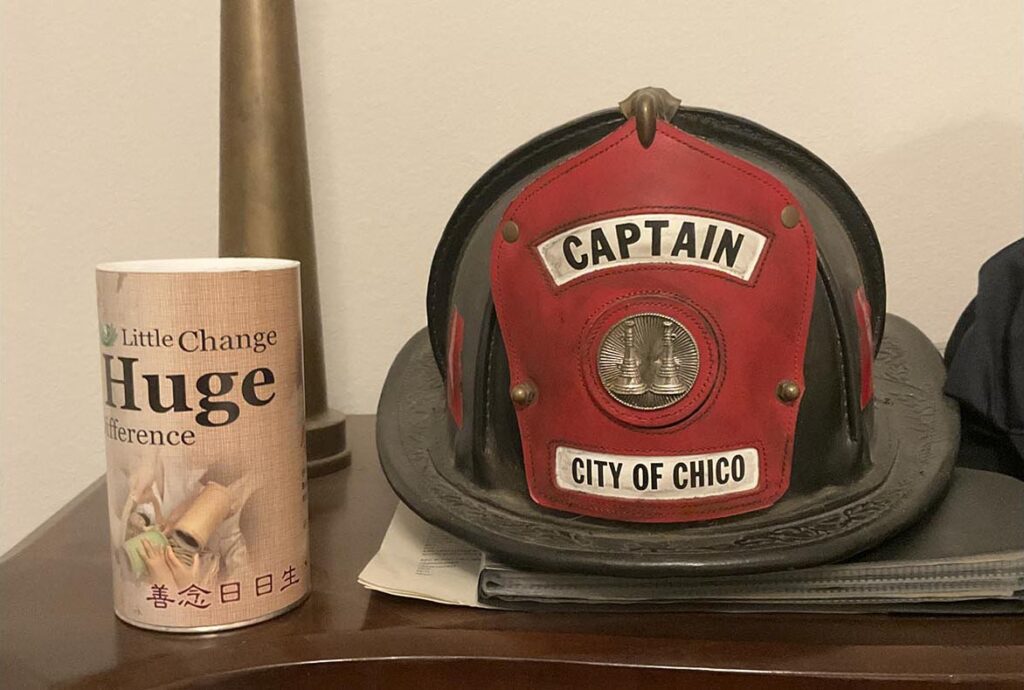
Most of those items were lost. However, John turned then to retrieve something from nearby in the room. “This is a replica of my helmet shield. It’s a replacement,” he said, examining the new, bright red shield, bearing the words CHICO FIRE CAPTAIN across the top. “It’s got my name on it, and I got a replacement helmet. I got a lot of replacement stuff.”
John had always stood on the other side of disasters, helping and reassuring survivors across decades of committed service. Now a survivor in more ways than one, he has stepped into the shoes of the many people he’s protected in the past.
“If you ever want to make the gods laugh, make a plan,” he said. “So, I had a plan, and then I got this thing called cancer. I’ve been fighting cancer for the last six months. So, it’s kind of like another thing to deal with. Right now, I am in remission, and I’m cancer-free, but it was just another thing to deal with.” It was an occupational hazard for many firefighters, John explained, even despite all of the protective equipment they wore.
He shifted gears with a wry smile. “So, right now, I’m good; everything’s good. Everything is really good. We’re rebuilding. I’m cancer-free, and I’ve got no complaints.”
John’s neighbor, a draftsman, is the very same individual who designed his home 34 years ago. After the fire, he contacted his neighbor once more with a request: “‘Build me the same house.’ So, we’re building the same house.” Construction is expected to be completed in June 2026.
Today, John Fell continues to restore the symbols of his service, with care for his community ever at the forefront, through the lasting spirit of the bamboo bank.
SHARE:
One ripple of kindness.
Thousands of lives touched.