Tzu Chi’s charity ventures in India are multifaceted, responding to both community-wide and individual needs that are discovered through medical outreach and other interactions between volunteers and local residents. Whether assisting vulnerable communities during the cold winter months, caring for disadvantaged elders, supporting personal aspirations, empowering women through vocational training, or constructing permanent homes like those in the Great Love Village in Silaunja, Tzu Chi volunteers remain ever ready to help and attentive to needs.
Assisting Communities During Winter
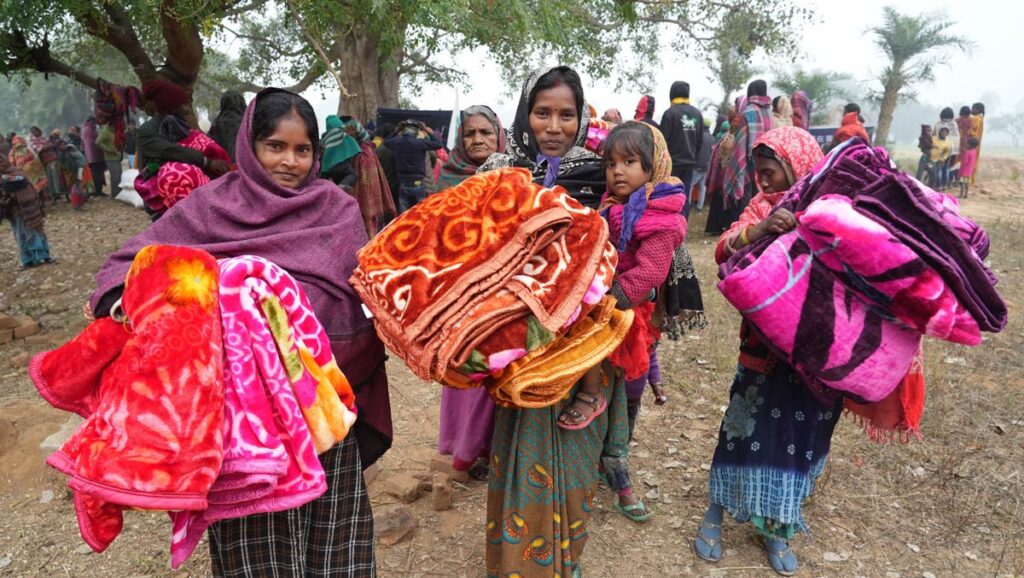
In January 2024, Tzu Chi volunteers distributed 822 thick winter blankets to 411 families across five villages near Bodh Gaya, helping them cope with the region’s coldest month. The initiative was prompted by observations from Tzu Chi Malaysia volunteer Raymond Kua, who had noticed villagers struggling to stay warm, often resorting to burning plastics for heat – a practice harmful to health. Therefore, during the distributions, the volunteers also used the opportunity to share fire safety tips
Villagers leave the distribution site smiling, holding the cozy blankets they received from Tzu Chi, which will keep their families warm. Photo/Wenhui Yang
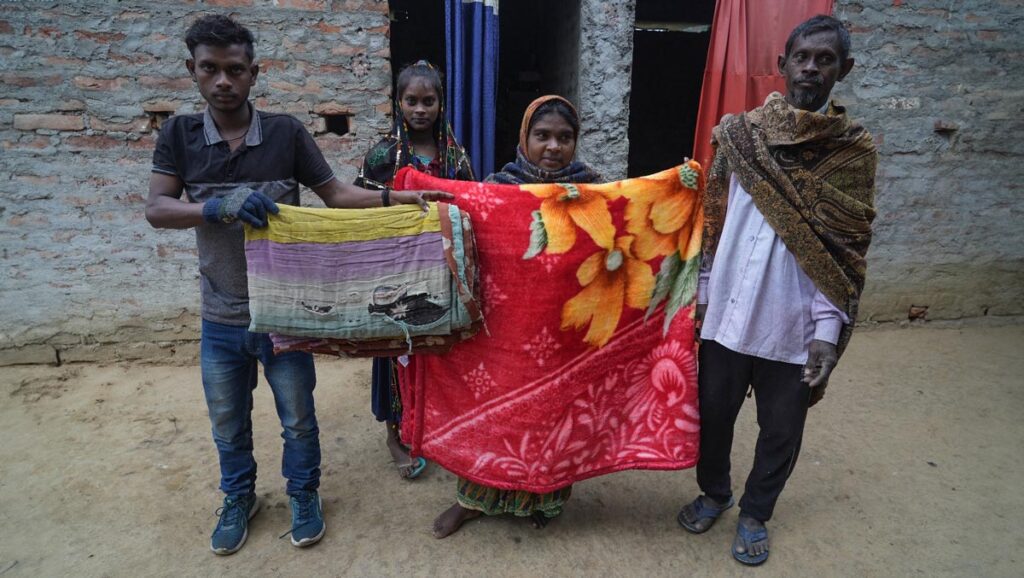
Each household received two blankets, replacing the thin and tattered coverings many had relied on. One recipient, Anita from Jagdishpur – whose family of six had been using old clothes and saris to cover themselves at night – was deeply grateful. “Now that we have blankets, we can get through the winter. Thank you!” she said. Yet her frugal family didn’t discard their old coverings. “We’re using the new blankets along with our homemade ones, which keeps us warmer,” she added with contentment.
Anita (second right) and a relative display the blanket received from Tzu Chi alongside one of their old coverings, illustrating the difference in warmth and quality. Photo/Wenhui Yang
Other villagers expressed similar appreciation. “Tzu Chi has helped me a lot, providing clothes, food, and now blankets and sweaters. I’m thankful,” said Cecilia from Ganga Bigha. “Now the children in our village won’t cry from the cold at night,” shared Ajit Manjhi from Bakraur.
Taking Care of Disadvantaged Elders
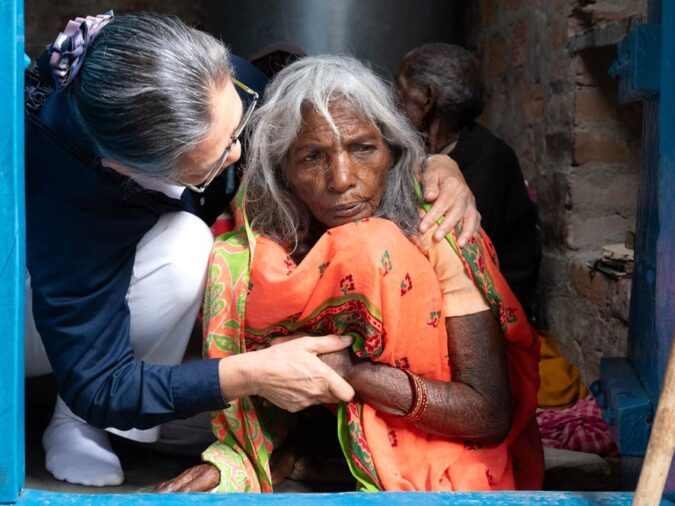
Tzu Chi volunteers pay special attention to those most vulnerable in the communities they serve, including older villagers facing a variety of hardships.
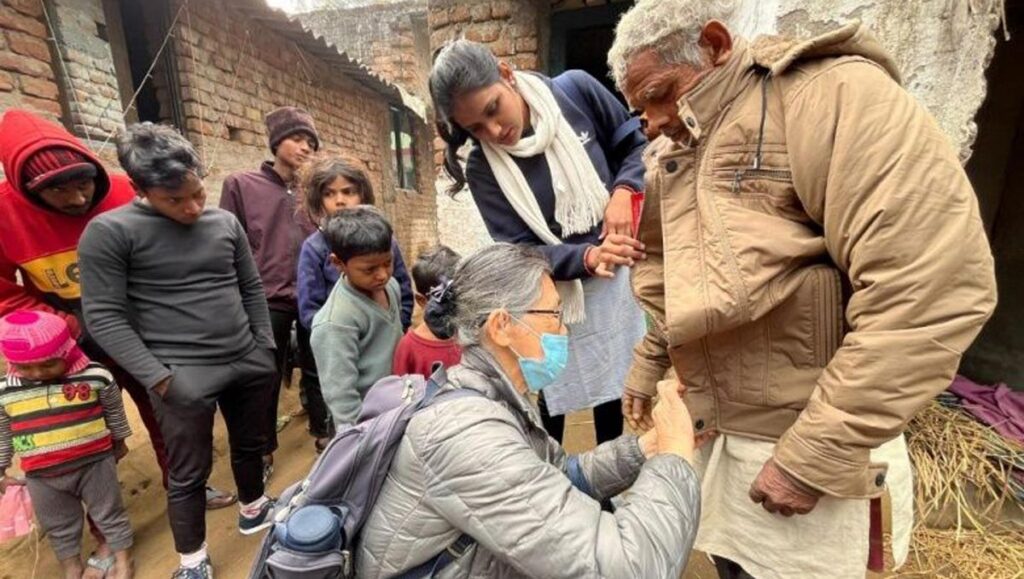
During the winter months in Ganga Bigha, the team met 70-year-old Rajendra Paswan, who couldn’t shield himself from the cold. Wearing five thin layers and still chilled to the bone, he asked for a winter jacket. Upon receiving it, Paswan bowed repeatedly, visibly moved.
Rajendra Paswan in Ganga Bigha can finally stay warm after receiving a winter jacket from Tzu Chi. Photo/Laychoo Koh
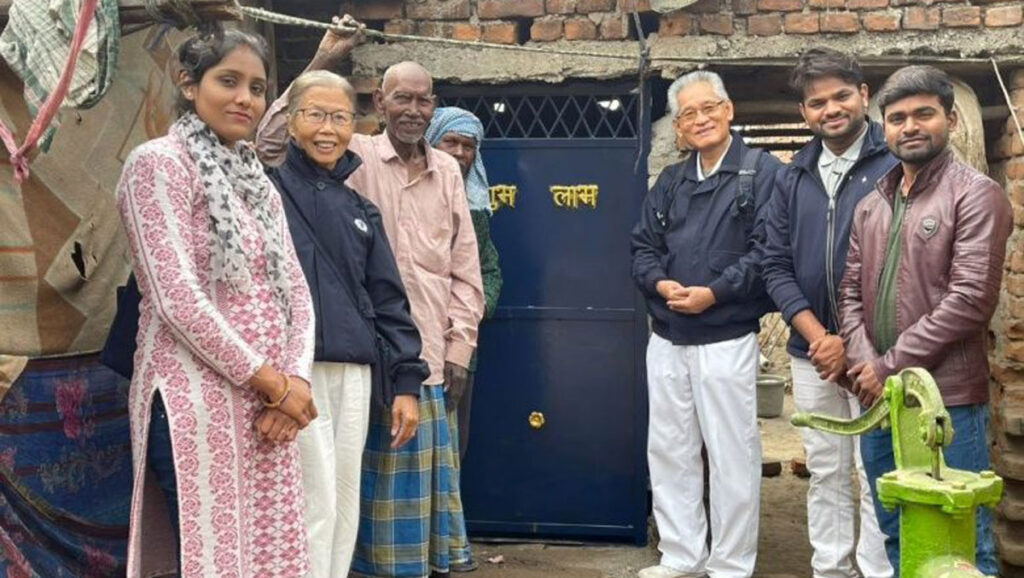
In Bodh Gaya, 78-year-old Jagdish Manjhi lived with his two grandchildren in a home without a proper door. An iron sheet and a piece of cloth covered the entrance, offering little protection. “This leaves them vulnerable to animals like chickens, dogs, or others coming in and eating their food,” explained volunteer Vivek Kumar, as plans were made to remedy the situation.
The volunteer team commissioned a local iron workshop to craft a customized door for the household. Once installed, Manjhi was overjoyed. “It’s all thanks to Tzu Chi that we have this. Otherwise, every day would be the same, with animals coming in and eating our things, which was a constant worry for us. But now we have a door, and we are very grateful.”
Jagdish Manjhi (third left) is all smiles once his new, proper door is installed. Photo/Laychoo Koh
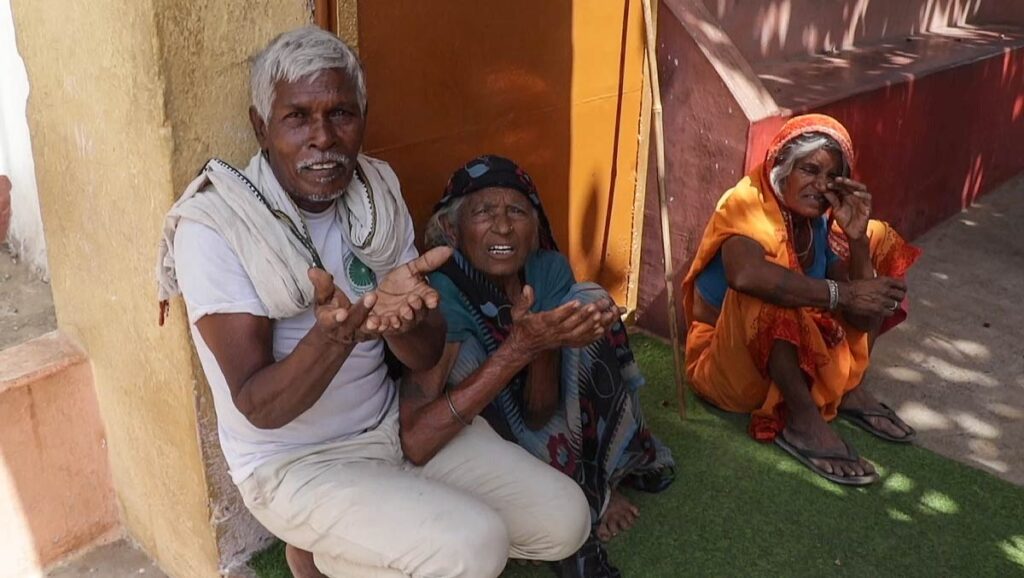
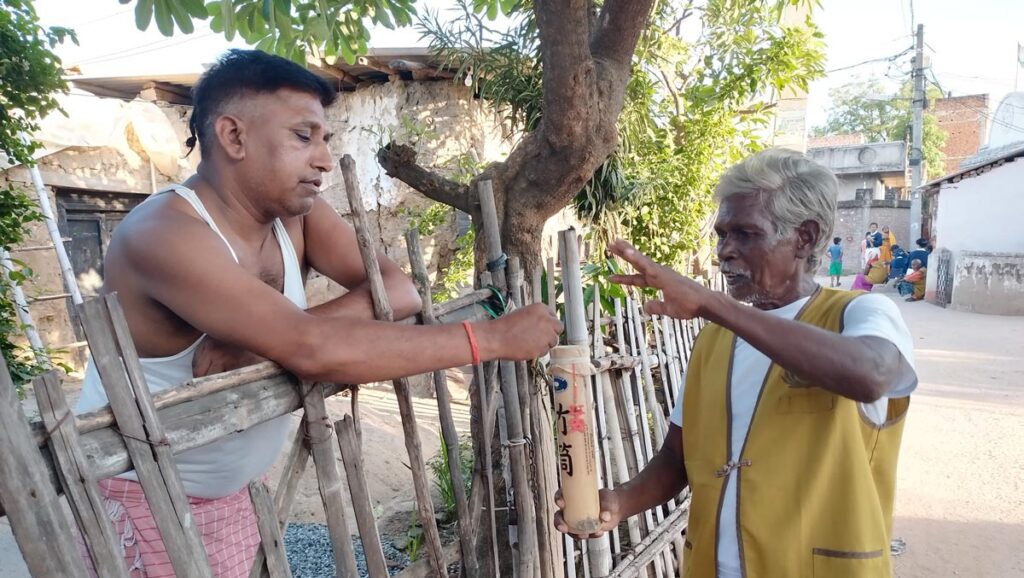
Another poignant story is that of 70-year-old Gaina Manjhi from Bakraur. As a member of a marginalized caste and long treated as an outcast, Manjhi once survived by begging. “In India, those belonging to the lower castes can only engage in certain occupations such as scavenging, cleaning, driving, laboring, carpentry, or begging,” Tzu Chi volunteer Yachen Lo explained, adding that these prejudices persist today.
“When I encountered him, I felt heartbroken. He was being mistreated by others, and he told me that he needed help,” recalled Rajesh, a resident of Bakraur who reached out to Tzu Chi volunteer Vivek Kumar, setting the wheel of aid in motion.
Gaina Manjhi (left) demonstrates how he used to beg to survive. Photo/Wenhui Yang
Before long, Manjhi’s life was transformed. Volunteers visited regularly, bringing essential supplies and, more importantly, treating him with compassion and dignity. With their encouragement, he resolved to give up his old ways. His sincerity touched the team. “We feel that this elderly man has a pure heart, so we invited him to participate in some Tzu Chi activities,” said Lo.
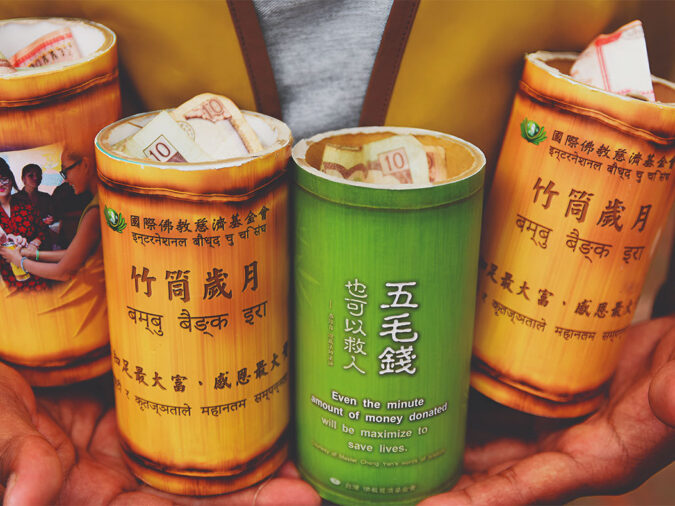
Manjhi agreed and soon became actively involved in community service, spreading the news about Tzu Chi events and encouraging his fellow villagers to donate to bamboo banks to help others in need. “I feel tranquility in my soul. I will never again beg from others. I want to help others,” he now says, having also embarked on the Tzu Chi volunteer training path, marking his commitment to a life of giving.
Gain Manjhi helps spread Tzu Chi’s bamboo bank spirit in his home village, encouraging fellow Bakraur residents to donate in support of others in need. Photo/Yuhua Huang
Then, in April 2024, disaster struck. A devastating fire swept through Bakraur, destroying more than 30 homes, including Manjhi’s newly built thatched hut. A Tzu Chi team rushed to the scene, where they found him at the site, shaken and in shock. The blaze had consumed his few possessions, including his cherished Tzu Chi volunteer uniform. “The most important thing is that everyone is safe. Take care of yourself first,” said Tzu Chi Malaysia volunteer Boon Tiong Tan, comforting him.
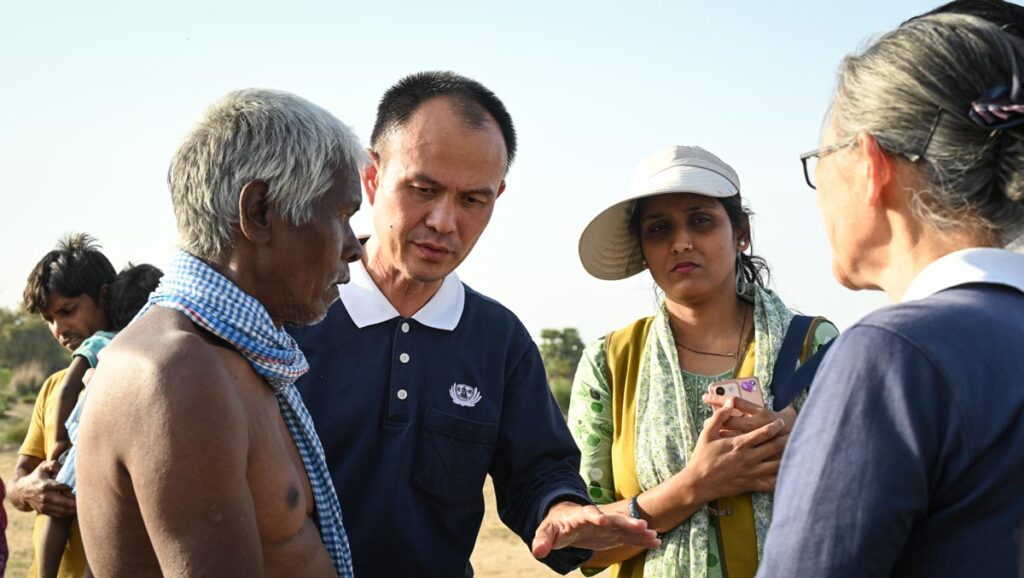
Tzu Chi Malaysia volunteer Boon Tiong Tan (second left) comforts Gaina Manjhi after his home was destroyed by fire. Photo/Wenying Chung
The next morning, the team returned with emergency relief funds, clothing, and shoes. Deeply moved, Manjhi shared, “I now have the strength to face the future.”
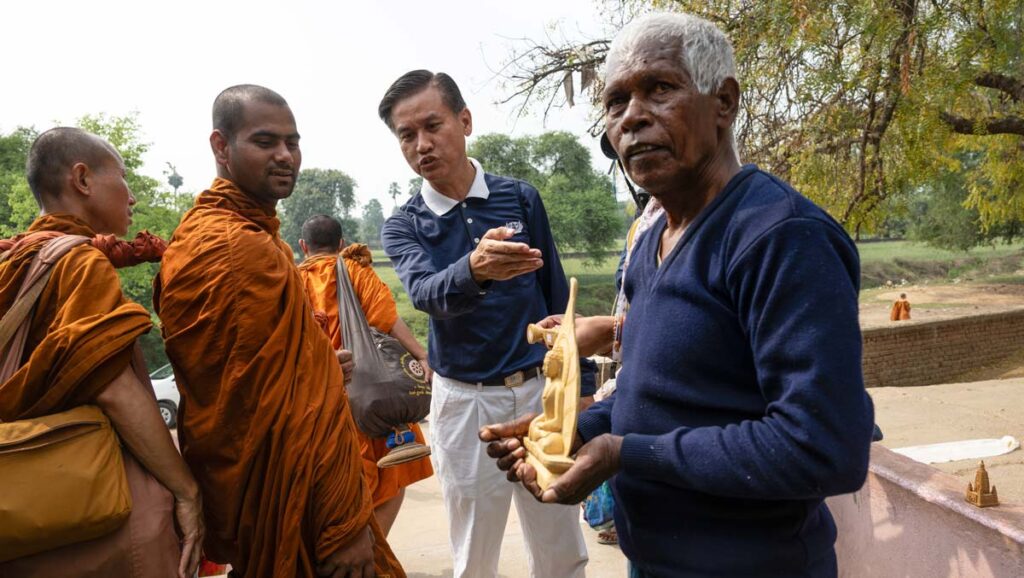
Today, Gaina Manjhi lives a life of dignity. No longer begging to survive, he now serves his community as a Tzu Chi volunteer in training and earns a sustainable livelihood by selling Buddha statues near a Buddhist pilgrimage site. Tzu Chi volunteer Siokee Hong supplies the statues to help support his entrepreneurial venture.
Gaina Manjhi (right) sells Buddha statues supplied by Tzu Chi volunteer Siokee Hong (second right) to earn a living. His personal story inspires all who meet him. Photo/Yiuhwa Hsiao
Making Dreams Come True
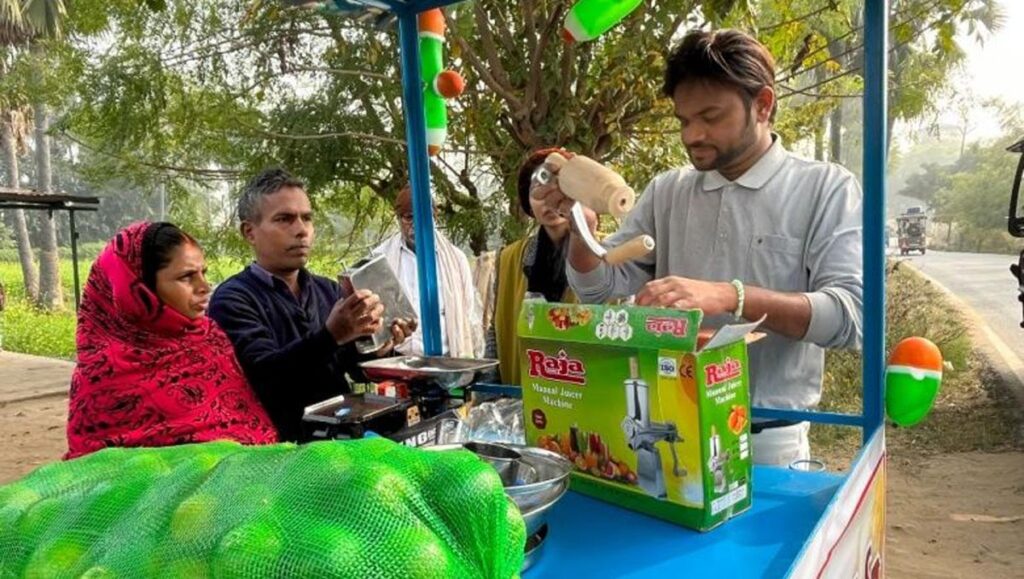
In January 2024, Tzu Chi volunteers supported Bhimsen Prajapati, a resident of Bakraur who had suffered memory and physical impairments after an electric shock six years earlier. His aspiration to start a juice business had come to Tzu Chi’s attention the previous November, when a neighbor shared his story. Recognizing his determination, volunteers provided a custom-built cart and helped purchase a manual juice extractor.
Tzu Chi volunteers deliver the juice extractor to Bhimsen Prajapati (second left) before the launch of his new business. Photo/Laychoo Koh
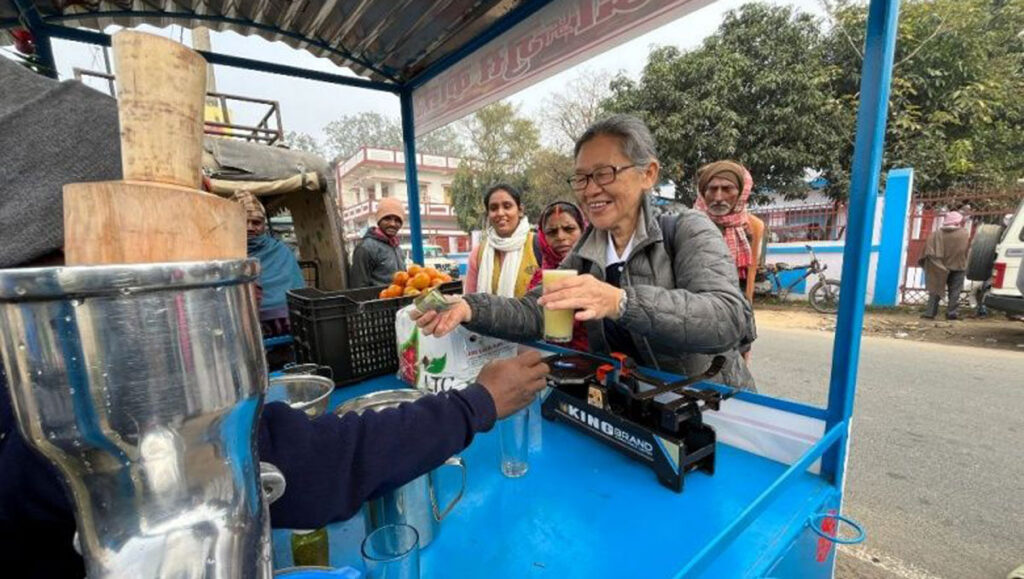
By mid-January, Prajapati and his wife had prepared the cart, which they named Buddha Juice, stocking it with fresh fruits and utensils. They performed a traditional ceremony to bless the venture, then officially opened the stand, serving the first cup of juice to volunteer Meechwong Chin. With support and encouragement from Tzu Chi volunteers, Prajapati’s entrepreneurial dream has become a reality.
Bhimsen Prajapati now earns an average of 587 rupees (about $7 USD) per day and hopes to increase his income during the summer months. “I feel very good, genuinely happy from the bottom of my heart,” he said.
Tzu Chi volunteer Meechwong Chin purchases the first cup of pomegranate juice from Bhimsen Prajapati’s stand. Photo/Laychoo Koh
Empowering Women
Despite notable strides in education and health, many women in India continue to face significant barriers to economic independence. According to a 2024 report by India’s Ministry of Statistics and Programme Implementation, the female labour force participation rate improved from 49.8% in 2017–18 to 60.1% in 2023–24 under the usual status, indicating increased female workforce inclusion. However, challenges persist, particularly in rural areas where women often lack access to vocational training and employment opportunities.
In regions like Bihar, where traditional gender roles are deeply entrenched, ventures aimed at women’s empowerment are crucial. Programs that provide skills training and promote economic self-reliance not only uplift individual women but also contribute to broader community development. By equipping women with tools and opportunities, such initiatives help bridge the gender gap and foster inclusive growth.
Responding to these needs, in November 2023, Tzu Chi launched a Sewing Training Program at its Bodh Gaya office, providing women from nearby villages with both practical skills and a pathway toward economic independence. Designed to empower participants with vocational skills and renewed self-confidence, the program began with foundational techniques, such as sewing collars and attaching sleeves, and then progressed to stitching full school uniforms for boys in government schools.
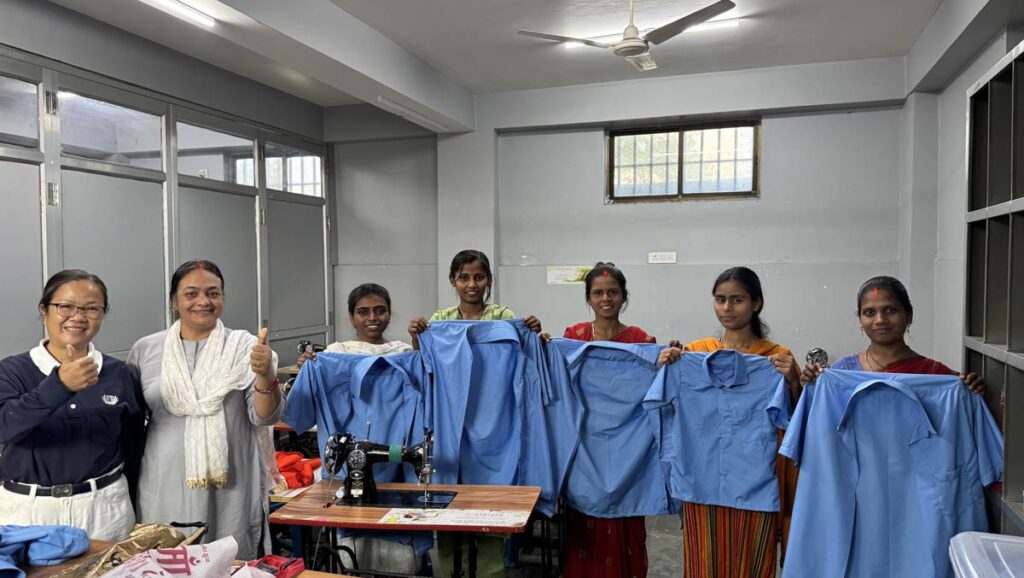
With Tzu Chi volunteer Sewyong Lim (left) and instructor Rekha Devi (second left) by their side, the five advanced students of the Sewing Training Program, including Rubi Devi (third right), proudly display the school uniform shirts they made themselves. Photo/Yuanchen Hu
Tzu Chi offered monetary rewards for the uniforms the trainees produced, encouraging steady progress. On March 15, 2025, five advanced students were recognized for their accomplishments with such an award. Among them was Rubi Devi, a mother from Bakraur, who had previously never operated a sewing machine before. “I’ll use this money to pay for my children’s school fees,” she announced proudly.
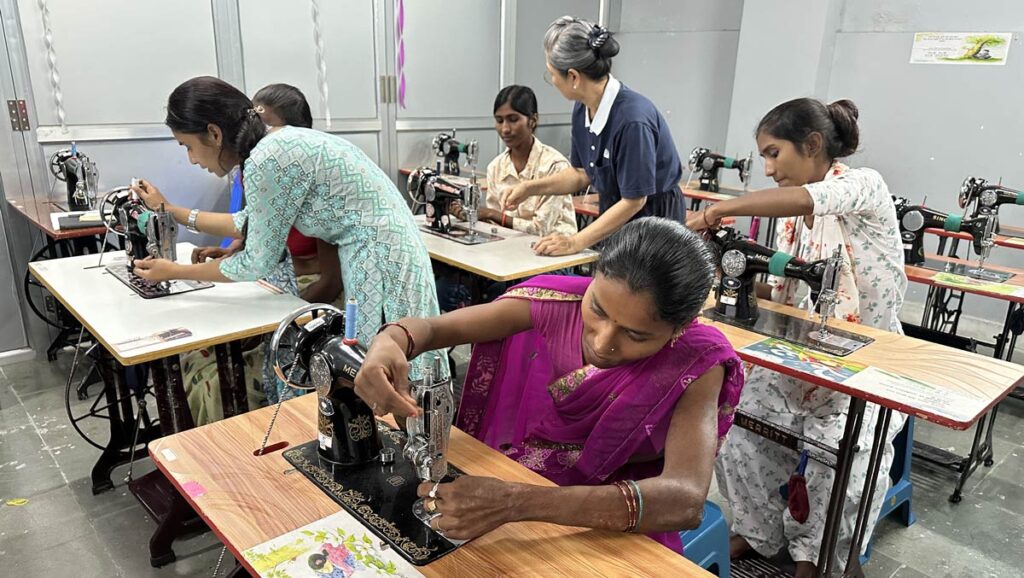
In the meantime, the program continued to grow. In October 2024, a new beginner class was inaugurated, welcoming eight women from the villages of Ganga Bigha and Turi Buzurg. Whether through mastering technical skills or gaining confidence, the women who are joining Tzu Chi’s training program are not just learning to sew: they are stitching new paths forward.
Students familiar with sewing machines prepare for class, while instructor Afshana Parween and Tzu Chi volunteer Geok Kim Lim assist the others. Photo/Chingchun Lin
Tzu Chi also offers other classes at its office in Bodh Gaya, such as English and computer skills instruction. These educational sessions, not exclusively for women, can enhance employability, empowering all who participate.
Building a Great Love Village
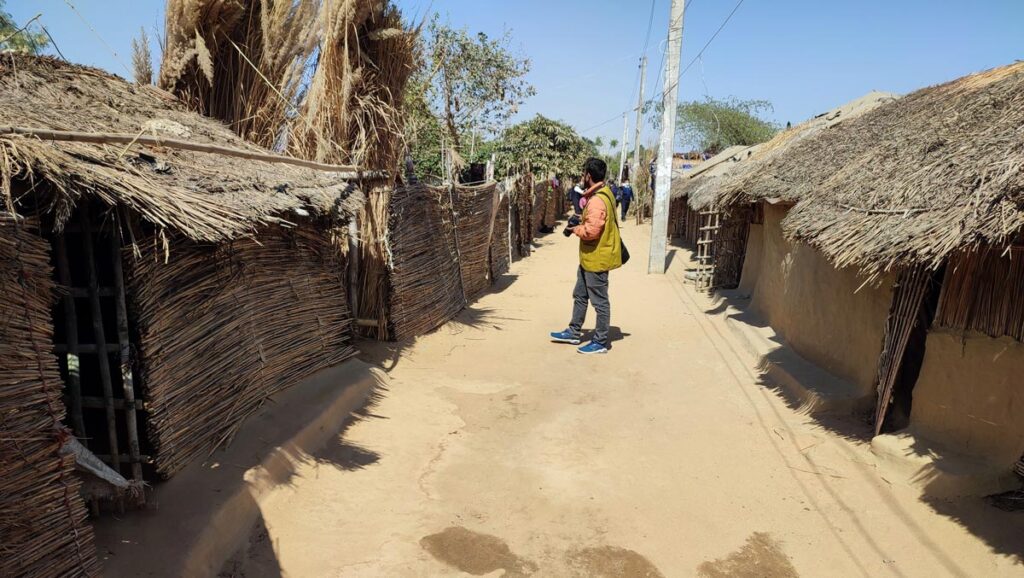
During medical outreach and health education efforts in Silaunja, Tzu Chi volunteers observed the village’s dire living conditions and urgent need for adequate housing. Many families resided in makeshift huts built from mud and straw, lacking basic utilities. Measuring less than 160 square feet, these cramped dwellings often housed six to eight individuals.
Residents relied on outdoor pumps for essential needs, and cooked in open-air kitchens using earthen stoves fueled by cow dung cakes and tree branches. Although two toilets had been constructed at the village entrance with foreign aid, many villagers preferred to go outdoors, often walking to the nearby Niranjana River.
When visiting the impoverished village of Silaunja, Tzu Chi volunteers take note of the rudimentary dwellings. Photo/Buddhist Tzu Chi Foundation
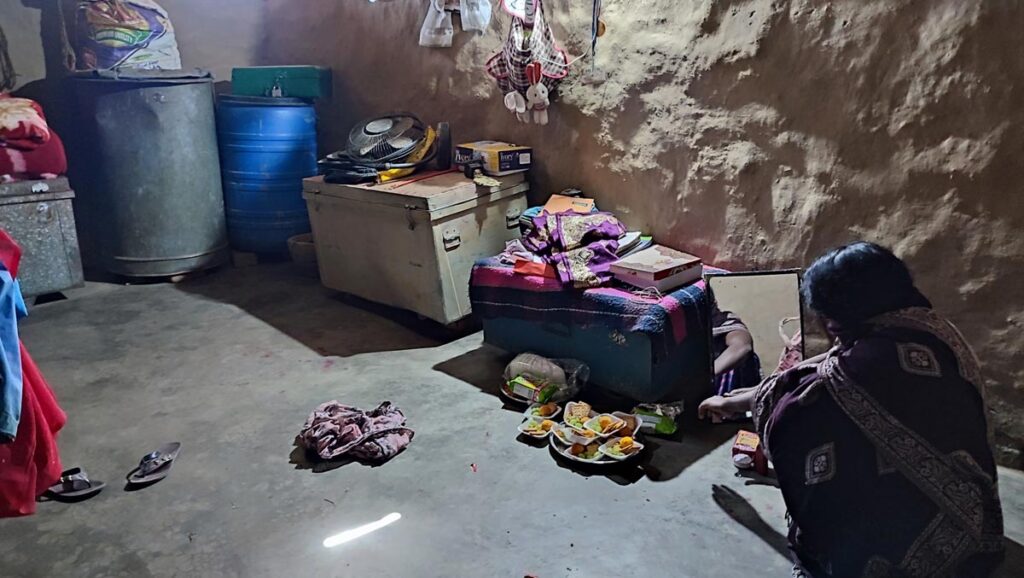
The typical interior of homes in Silaunja is sparse, with earthen floors and few comforts. Photo/Lihsin Li
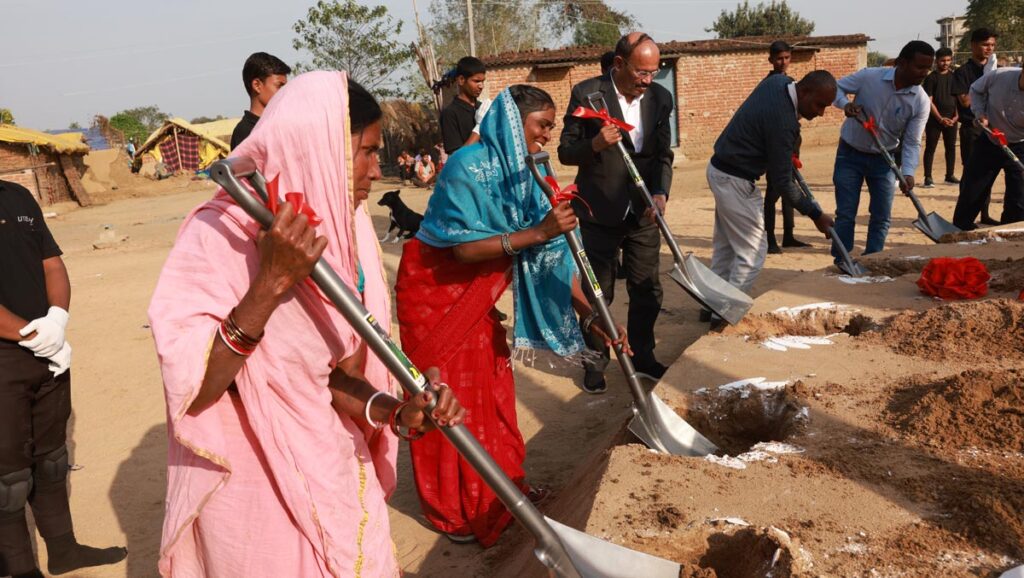
The situation in Silaunja prompted Tzu Chi to launch the construction of a Great Love Village comprising 36 permanent houses. The project commenced with a groundbreaking ceremony on February 25, 2024, and was scheduled for completion by the end of the year.
Each 414-square-foot house, built with durable materials and equipped with electrical wiring and plumbing, is designed to include a living room, two bedrooms, a kitchen, and a bathroom. To combat the summer heat and improve ventilation, the houses are 13 feet high, with elevated foundations to prevent flooding during the rainy season. Cultural norms are also respected by situating toilets outside the main living areas.
The joyful groundbreaking ceremony for the Silaunja Great Love Village takes place on February 25, 2024. Photo/Buddhist Tzu Chi Foundation
The future residents often visited the construction site, unable to contain their excitement. “We are so grateful!” exclaimed Jayanti Kumari, who lived with nine family members and supported the entire household on her monthly salary of 22,000 rupees (about US$265). She never imagined she could own a house like the ones Tzu Chi was building. Koshila Devi, the village chief and also one of the recipients, said, “Tzu Chi gave us more than just high-quality doors, windows, ceilings, and cement; they gave us a complete home.”
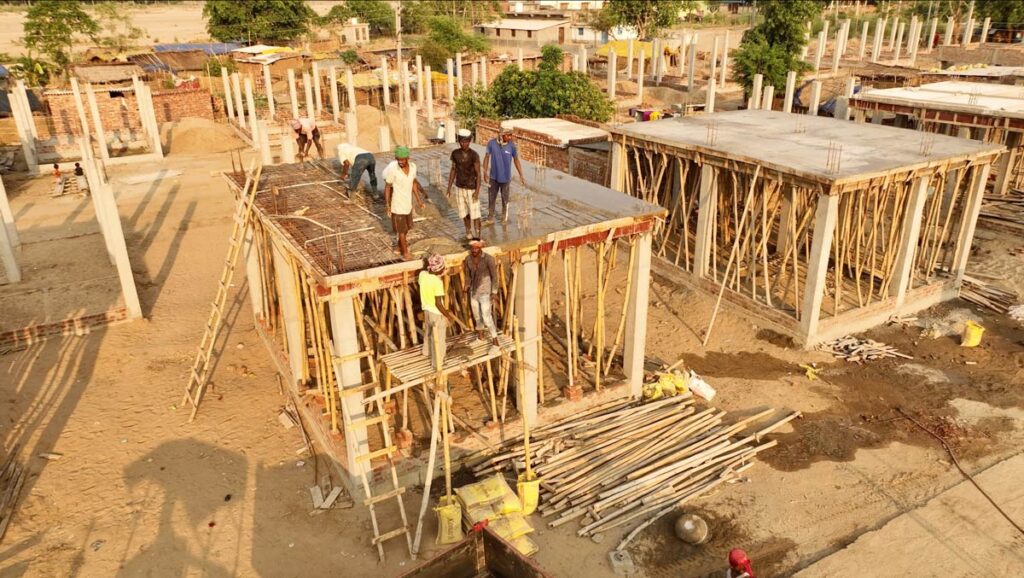
As a project bonus, since more than half of the adults in Silaunja, a village of 800 residents, were unemployed, Tzu Chi incorporated a Work-for-Relief program in the plan, allowing villagers to gain an income during construction. They were thrilled to participate, enduring the scorching summer sun without complaint. “Working in this weather is tough, but it’s much better than having no job. So, I’ll endure the heat for my family,” Basant Manjhi, one of the workers, said.
The construction of the Great Love Village in Silaunja is underway in the summer of 2024. Photo/Jengfeng Chen
Jamun Manjhi, another program participant and house recipient, focused on the final result as he worked, sharing, “In the past, when it rained or the wind was strong, my roof would blow off and the walls would collapse. I had to cover them with plastic and straw and keep repairing them. Now that Tzu Chi is providing such a comfortable house, my family will no longer suffer. Nothing makes me happier!”
In preparation for the handover of 36 new homes, Tzu Chi volunteers organized an environmental education session in July. This initiative aimed to instill good hygiene habits among residents transitioning from impoverished conditions.
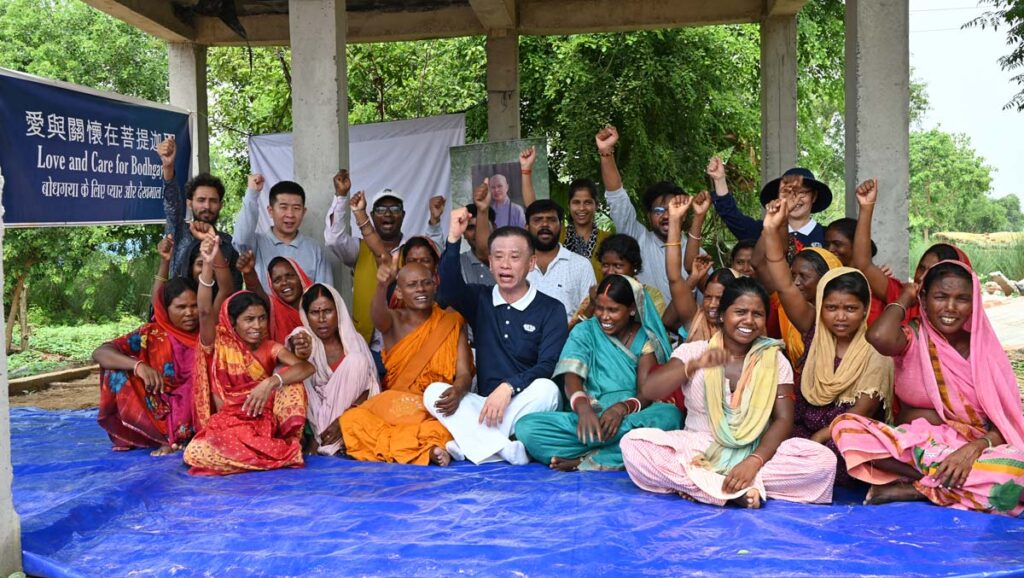
Residents and event volunteers gather for a group photo after the hygiene education session in July, arms raised to affirm their commitment to cleanliness. Photo/Cunci Zheng
Bhante Jamvudeep, a local monastic supporting the project, addressed the residents, emphasizing the significance of cleanliness and orderliness. He likened the move from makeshift huts to new homes as transitioning from “hell to heaven,” urging the villagers to uphold the dignity of their new environment. At the event’s conclusion, the homeowners pledged in Hindi, “Cleanliness! Commitment!”
In mid-October, Tzu Chi volunteers conducted additional sessions to prepare families for moving into their new homes, which were ready. The orientations inside the houses included practical demonstrations of home care, such as proper sweeping techniques to prevent back strain and making homemade glass cleaner from vinegar and water.
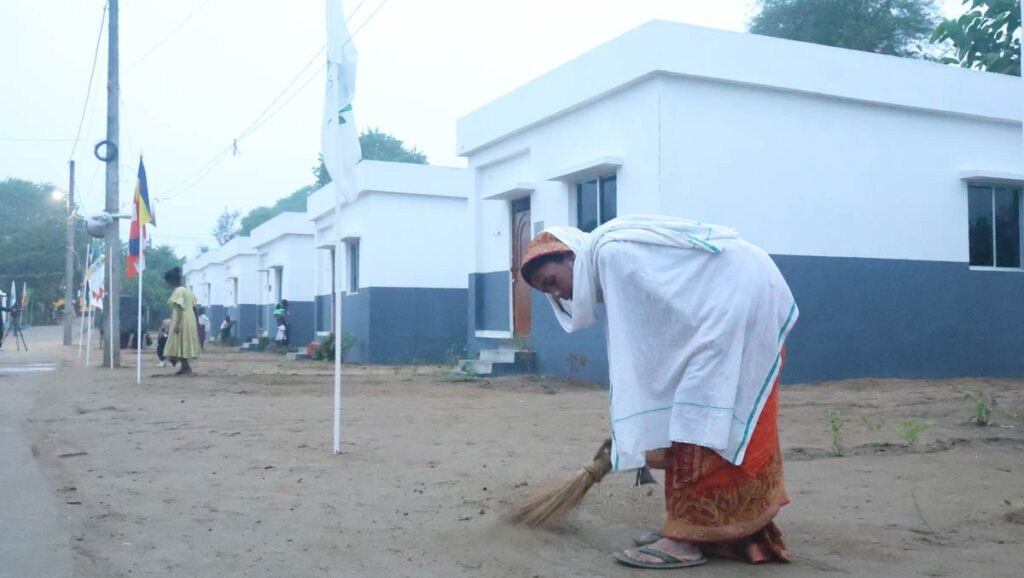
Silaunja’s Great Love Village residents strive to keep the whole community clean, not just their homes Photo/Juifen Huang
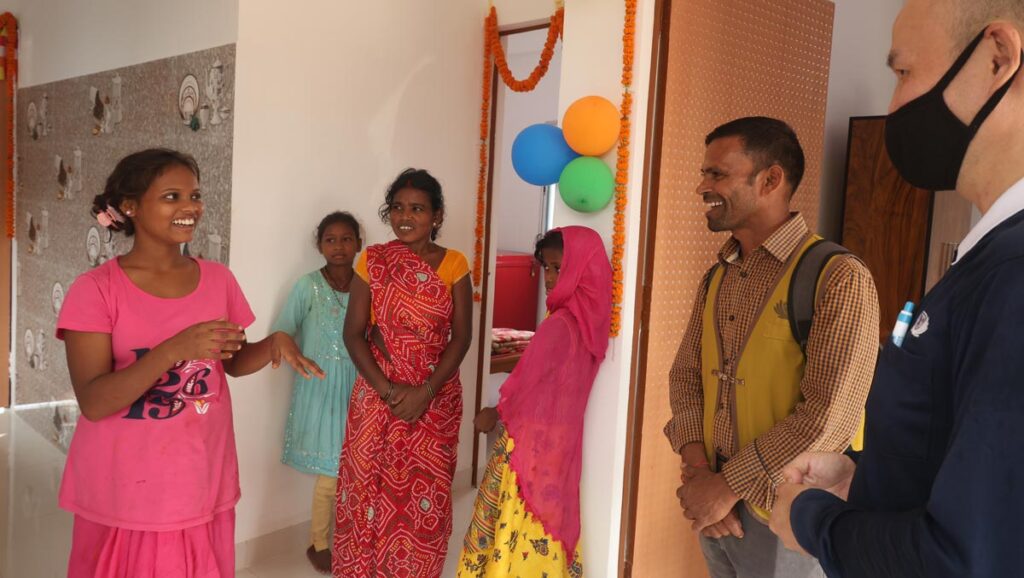
The villagers were overjoyed by the interiors. “We used to live in a house we built ourselves from bamboo and straw,” said Pyari Devi. “Now, we finally have a safe home where we can sleep under a solid roof.” Mintar Devi marveled at the spaciousness and brightness of the house, likening it to a temple and pledging to keep it spotless. “It feels like a dream, so unreal,” added Sunita Devi.
Finally, on October 27, 2024, the 36 homes of the Great Love Village in Silaunja were officially handed over to the residents. During the ceremony, Tzu Chi volunteers presented each family with blankets and keys, bowing respectfully as they offered these tokens of new beginnings.
Tzu Chi volunteers prepare to hand over blankets and house keys to each of the 36 families receiving a new home in the Silaunja Great Love Village on inauguration day, October 27, 2024. Photo/Jungfeng Chen
Since then, the village has begun to embody the model community envisioned by Master Cheng Yen, with families actively engaging in communal activities and maintaining clean homes. Children participate in household chores without complaint, and the improved living conditions have deepened the community’s commitment to education.
“The environment here makes learning much easier,” said Reha Kumari, a 10th-grade student who once studied on the floor of her family’s former home, often under dim light. Her mother, Sunita Devi, never had the chance to pursue formal education herself, but now watches Kumari study with hope. “Reha’s dedication inspires me. I believe she will achieve great things,” Devi said, her voice filled with optimism.
Residents of the new homes delight in the spacious, well-lit interiors, which offer their children a much-improved learning environment. Photo/Juifen Huang