Exploring Pathways to Healing With Harvard Divinity School
Written by: Adriana DiBenedetto
Published #77 | Summer 2025 Issue

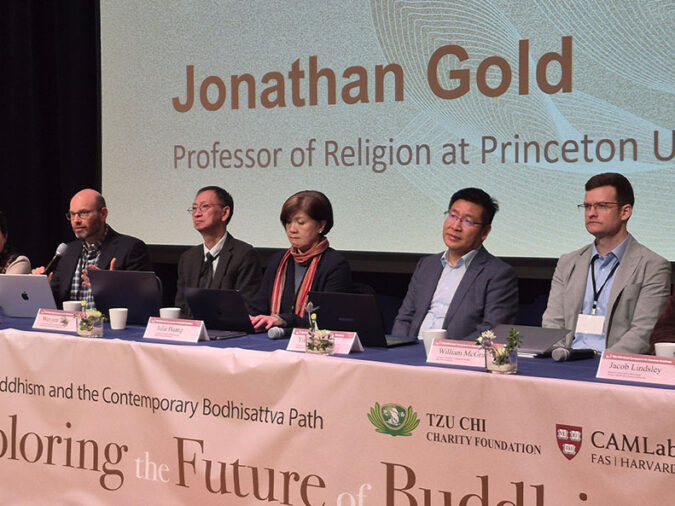
The Colloquium on Intercultural Spiritual Care for Culturally Chinese Populations, a collaborative event between the Buddhist Tzu Chi Foundation and Harvard Divinity School (HDS), is held from March 27 to March 29, 2025. Photo/Dan Ferrara
SHARE
“Spiritual healing involves storytelling,” said Tzu Chi Charity Foundation’s Deputy CEO, Rey-Sheng Her, as he stood before a podium within Harvard Divinity School’s historic halls. At its core, shared Her, Tzu Chi’s approach to spiritual healing embodies a method of learning passed from one individual to another, providing guidance that enables the discovery of personal value and meaning while supporting others. This practice, which can be traced back to Tzu Chi’s founder, Dharma Master Cheng Yen, who personally led a group of female followers in transforming the lives of others, continues at the core of Tzu Chi’s work today.
Everything in existence is our teacher. The more we give, the more our wisdom grows. The more we serve, the deeper our compassion becomes.
Rey-Sheng Her
Deputy CEO
Tzu Chi Charity Foundation
From March 27 to March 29, 2025, a remarkable gathering of hearts and minds unfolded. The Colloquium on Intercultural Spiritual Care for Culturally Chinese Populations, a collaborative event between the Buddhist Tzu Chi Foundation and Harvard Divinity School (HDS), brought together scholars, chaplains, monastics, medical professionals, and volunteers to explore diverse, multi-layered approaches to spiritual caregiving and meaning-making. From incorporating engaged Buddhism within the Silent Mentor Program, to providing comfort in times of illness or disaster, and helping youths expand their horizons, the colloquium highlighted the power of compassion, whether during times of crisis and distress, or in helping people of all ages find and strengthen their life’s purpose.
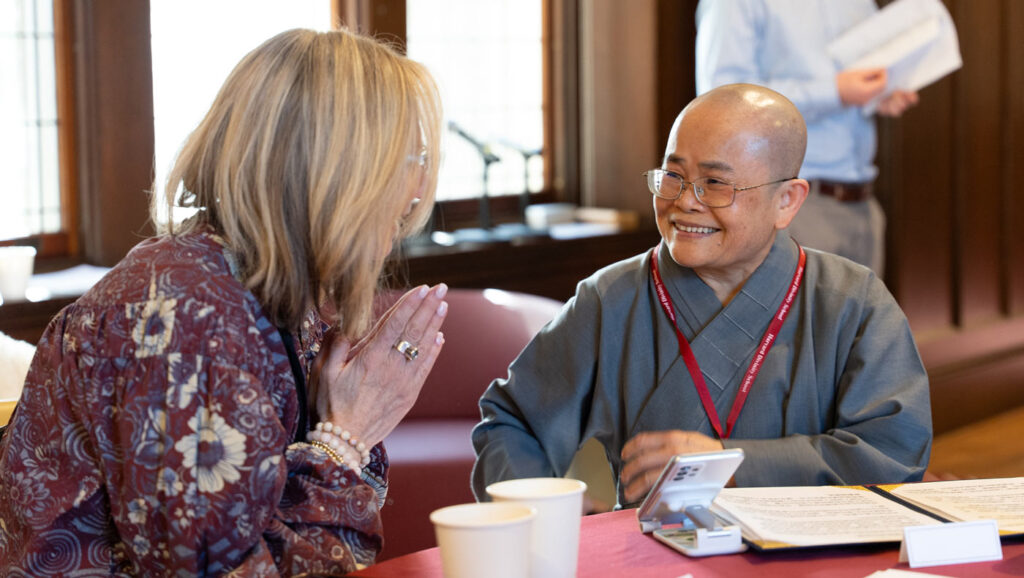
In bridging faith traditions, the colloquium provided a space for dialogue that highlighted the significance of spiritual caregiving within Chinese-speaking populations worldwide, with a particular focus on intercultural awareness in healthcare settings.
This colloquium marked the second time that Tzu Chi partnered with Harvard University — the first being a 2023 collaboration with the Harvard FAS CAMLab to host the Symposium on Ven. Cheng Yen’s Philosophy and Leadership focused on the life and teachings of Master Cheng Yen.
A Special Care Delegation Arrives
Amid this academic and spiritual exchange, Tzu Chi’s disaster relief was also in full motion, with the devastation wrought by deadly wildfires in Los Angeles, California, at the forefront.
Ever since the wildfires erupted in January 2025, Master Cheng Yen has closely followed the situation, as well as the dedicated relief efforts of Tzu Chi volunteers across the nation. And so, a care delegation of Dharma Masters from the Jing Si Abode in Hualien, accompanied by Tzu Chi volunteers, flew to the United States with a lengthy itinerary. In addition to visiting wildfire-affected areas to assess the circumstances in person, and understand the mid-to-long-term recovery plans, the delegation met with Tzu Chi volunteers, visited Tzu Chi family members, and held seminars.
On March 26, the care delegation led by Dharma Masters De Yue and De Wei arrived at Los Angeles International Airport alongside volunteers from the Jing Si Abode, with nearly 30 volunteers from Tzu Chi USA’s Headquarters joyfully receiving the delegation. This team of Dharma Masters and volunteers would then commence a nearly two-week care plan, with visits to Tzu Chi USA’s National Headquarters as well as Tzu Chi offices in Texas and Illinois, with their final stop at the opening ceremony for Tzu Chi USA’s Chicago Service Center on April 5, 2025.
That’s not all, however. The delegation had split into two groups upon departure from the Jing Si Abode, heading to Los Angeles and New York, respectively. And so, Dharma Masters De Chen and De Yuan also arrived in New York on March 25, alongside a team of volunteers. After a gathering with Tzu Chi New York volunteers, their journey would soon bring them to Harvard, where the Dharma Masters joined in the colloquium’s vital conversations.
Exploring Spiritual Care Across Cultures
The opening day of the colloquium, March 27, laid the foundation for the forthcoming discussions, with welcoming remarks from HDS Chief Academic Officer Dr. David Holland, Dharma Masters De Chen and De Yuen from the Jing Si Abode, HDS Associate Dean of Ministry Studies Rev. Dr. Teddy Hickman-Maynard, HDS Assistant Dean for Multireligious Ministry, Rev. Dr. Monica Sanford, Tzu Chi Charity Foundation CEO Po-Wen Yen, and Deputy CEO Dr. Rey-Sheng Her.
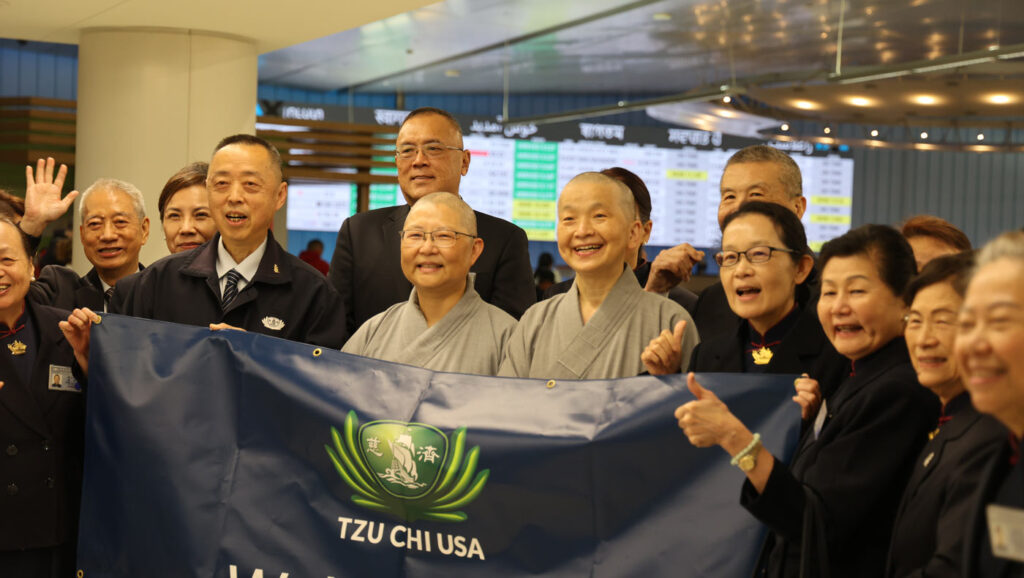
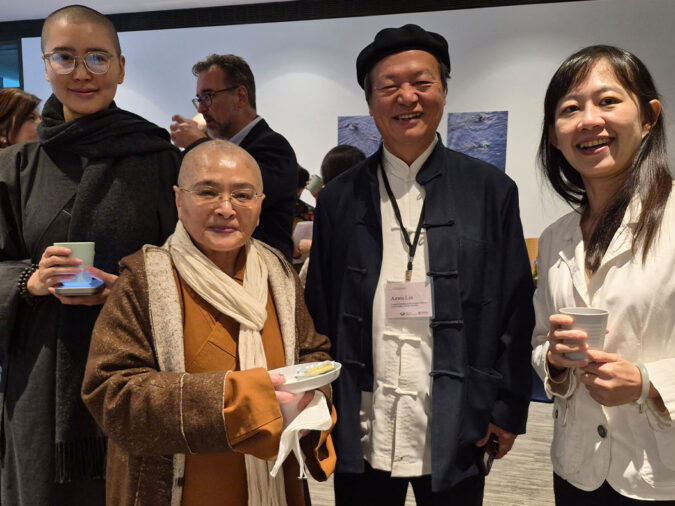
Members of Tzu Chi also present at the colloquium included Debra Boudreaux, then-CEO of Tzu Chi USA and current Chief International Affairs Officer of the Buddhist Tzu Chi Foundation, Guo-Fang Tseng, Medical Simulation Center Director at Tzu Chi University, Faisal Hu, CEO of Tzu Chi Türkiye, and Alfredo Li, Deputy CEO of Tzu Chi Philippines. Together, their presence underscored the global scale of the topics to be discussed.
During this colloquium, a common thread soon emerged across belief systems and cultures, shining a light on the complexities of the human experience: “It is about presence, connection, and the ways we bear witness to the unfolding of life,” expressed Stephanie Sears, a Lecturer on Spiritual Care at HDS. “At its core, spiritual care is relational — it is not something we do to people but rather with them, creating space for authenticity, meaning-making, and healing,” shared Sears in a piece presented to the colloquium, continuing, “Often, suffering arises when people experience unmet psychological and spiritual needs — needs for safety, belonging, purpose, and agency. Effective spiritual care requires attuning to these implicit dimensions of experience, helping individuals integrate their emotions and beliefs in ways that foster resilience and self-acceptance.”
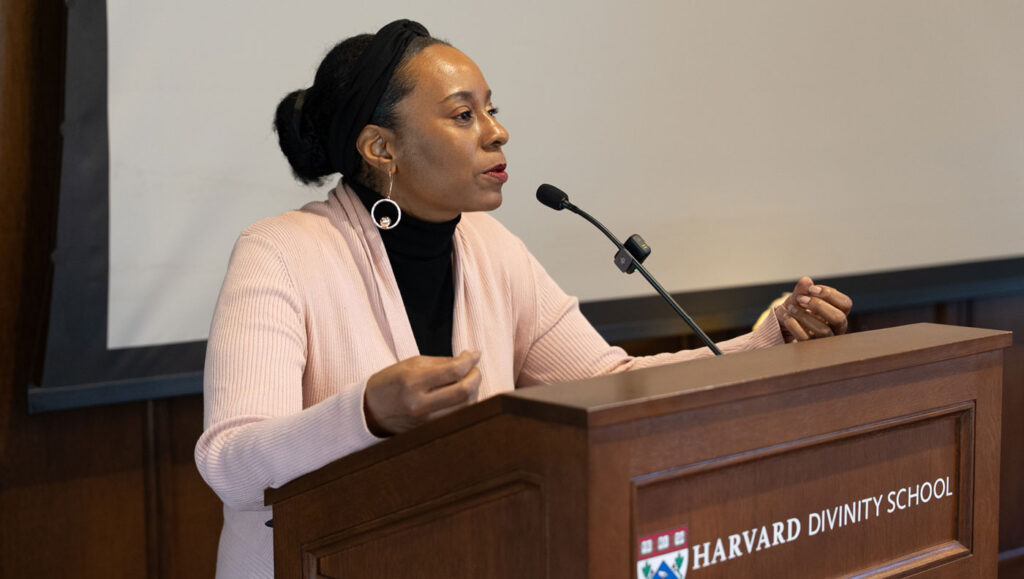
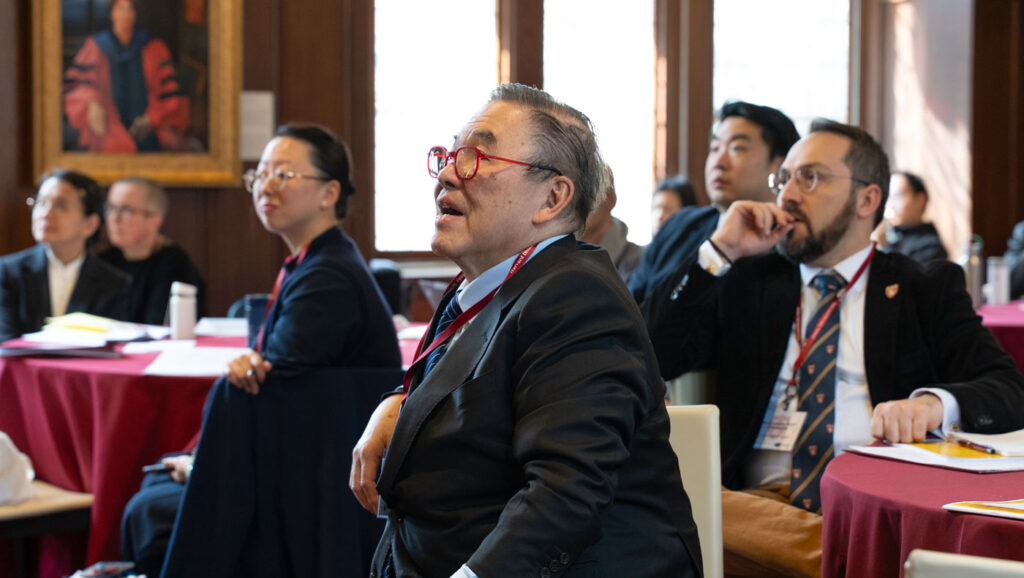
This approach to care was furthered by David H. Rosmarin, Director of the Spirituality and Mental Health Program at McLean Hospital. Rosmarin presented the significance of spirituality for individuals experiencing psychiatric distress through the implementation of Spiritual Psychotherapy for Inpatient, Residential, and Intensive Treatment (SPIRIT), which integrates spirituality and evidence-based psychiatric care in a way that honors one’s diverse spiritual and existential needs.
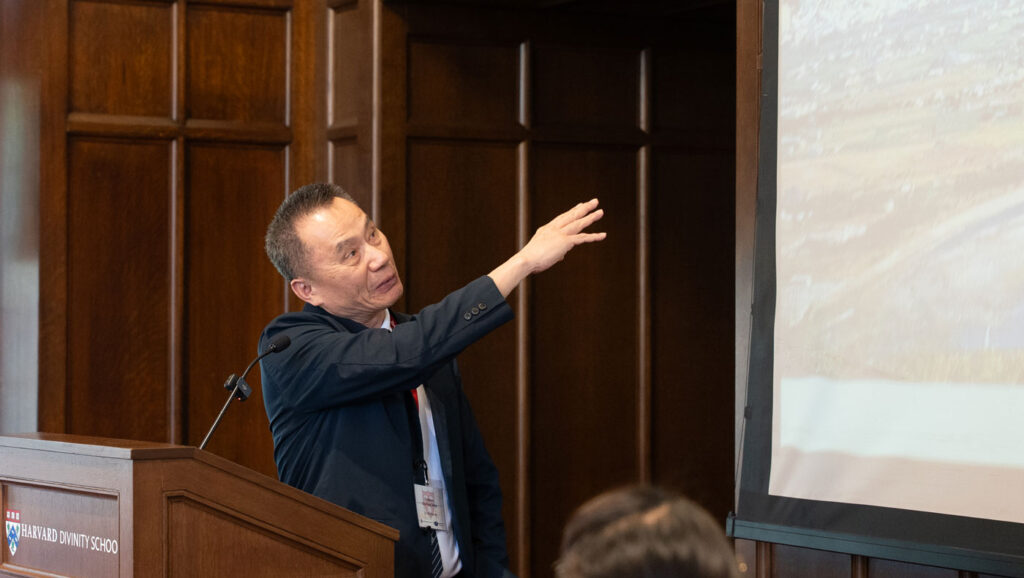
Dr. Guo-Fang Tseng, Director of the Medical Simulation Center at Tzu Chi University, also shared personal reflections on the Silent Mentor program, emphasizing the importance of serving the person as a whole. The Silent Mentor program initiated by Tzu Chi University offers individuals the choice of donating their body to science upon their passing. By visiting with the families of the Silent Mentors and learning about the donors’ lives, medical students cultivate a deep sense of empathy and respect, aligning with Tzu Chi’s mission to foster compassion and ethical integrity as well as skill in future healthcare professionals.
Nowadays, in medicine, we are dividing into finer and finer disciplines. So for each discipline, the doctor will just deal with a small part of the body and correct that problem… So, at the end, we left humanity aside, and that’s the problem, dichotomy. So, in Tzu Chi, [Master Cheng Yen] expects us to treat the body as a person, properly, and make sure that the surviving family finds inner peace.
Dr. Guo-Fang Tseng
Director
Medical Simulation Center
Tzu Chi University
Deputy CEO of the Tzu Chi Charity Foundation, Rey-Sheng Her, likewise expanded the discussion on the self through the lens of Buddhism. He spoke of the Buddhist doctrine of dependent origination, or pratītyasamutpāda, which posits a fundamentally different understanding of the self as compared to contemporary Western perspectives. Instead, it offers an understanding of the self as not an autonomous entity, but a web of relationships.
Edwina Chan, an ordained Christian minister serving as a hospital chaplain at New York-Presbyterian Hospital, offered another critical perspective on the scope of caregiving: Exploring the domain of care for atheist and non-religious individuals, opening conversations on harmony and mortality without relying on religious frameworks.
“As a hospital chaplain in New York, born and raised in Hong Kong, I bring a unique perspective on the cultural and spiritual diversity within Chinese patient populations, especially those shaped by the secular and Communist context of mainland China,” shared Chan in a piece on spiritual care prepared for the colloquium. By listening actively while offering support that acknowledges their unique worldview, Chan demonstrates “how spiritual care can be secular, culturally sensitive, and effective in addressing the diverse needs of Chinese populations in an intercultural U.S. context.”
Further discussions on March 28 included those from Monica Sanford, HDS Assistant Dean for Multireligious Ministry, Chris Berlin, HDS Instructor in Ministry Studies & Pastoral Counseling, Min-Che Lee, Superintendent of Taipei Medical University – Shuangho Hospital, Dimitrios Linos, Professor Emeritus of Surgery at Athens Medical School and Lecturer at Harvard Medical School, Faisal Hu, CEO of Tzu Chi Türkiye, and Elaine Yuen, Buddhist Educator and Chaplain, and Professor Emerita from Naropa University.
From Concept to Practice
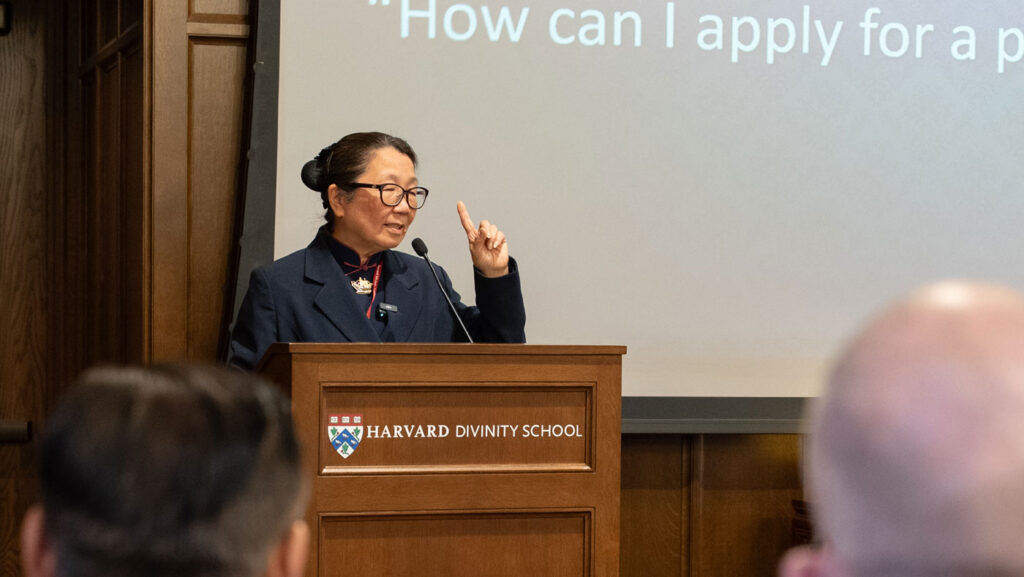
“The first day, we tried to identify, ‘What is spiritual care?’ and from spiritual care, the context, the competency, and the formation. And then, starting from there we, today, enter into case study,” said Debra Boudreaux, Chief International Affairs Officer of the Buddhist Tzu Chi Foundation.
The groundwork laid by the discussions held on March 28 took on a new ethical angle for the following day’s session, progressing from conceptual frameworks to real-world applications. Attendees were invited to engage with poignant case studies, the tables silent as they listened and took notes before sharing their thoughts, observations, emotions, and how they, themselves, might have responded.
Case studies were prepared by Alfredo Li, Deputy CEO of Tzu Chi Philippines, Debra Boudreaux, Chief International Affairs Officer of the Buddhist Tzu Chi Foundation, Sandy Stokes, Founder of the Chinese American Coalition for Compassionate Care, and Ven. Tianwen, a Buddhist monk with the Buddhist Ministry Initiative at Harvard Divinity School.
One account presented during the workshop, delivered by Sandy Stokes, painted a portrait of a 66-year-old Chinese woman known as Mrs. Wu, who has end-stage pancreatic cancer. Because she is not a candidate for chemotherapy, Mrs. Wu’s family expressed feelings of conflict over her care plan. The family agreed that everything should be done to “save mom,” but they did not want the medical team to tell her about her diagnosis and prognosis, and did not wish to discuss hospice care. With the family’s consent, a social worker arranged for a medical interpreter, and the palliative care team spoke with Mrs. Wu, accompanied by family members, to discuss goals for the care team.
In another case study presented by Ven. Tianwen, a 68-year-old Malaysian woman grapples with her faith amid terminal illness. The diagnosis and prognosis led to the patient expressing feelings of anger and resentment, in addition to questioning her beliefs as a devout Buddhist. Initially apprehensive about the chaplain’s spiritual care visit, the patient ultimately shared that she was able to rekindle her faith in Buddhism, and grew less fearful of her illness.
One more study, shared by Tzu Chi Philippines Deputy CEO Alfredo Li, illustrated the story of a young woman named Marithel, highlighting the life-changing spirit of compassion that extends beyond the medical sphere.
Born into a family of six children in a single-parent household, Marithel helped support her family’s income by working weekends and during school breaks, earning $5 per day as a laundry worker. Marithel also earned an income as a housemaid and a laborer in the sugar cane fields, earning $1.50 per day. In 2013, however, her life changed forever when Typhoon Haiyan, known in the Philippines as Super Typhoon Yolanda, struck her home.
In the days following the disaster, Tzu Chi volunteers arrived on the scene to provide relief. Upon witnessing Tzu Chi’s aid, Marithel approached one of the volunteers, giving thanks — and hesitantly asking for support. The volunteers facilitated her admission to Tzu Chi University in Hualien, understanding her hope of improving her and her family’s lives.
However, complications arose. Studying in an unfamiliar country, where students and professors alike spoke a different language, was deeply upsetting. “She called us, crying and wanting to quit and return to the Philippines, to her comfort zone,” shared Li. Marithel knew basic Chinese, but the speed at which lectures were conducted was far too fast for non-native speakers, and she despaired.
In time, however, Marithel devised a plan and shared it with Li: She could record her lessons and translate them upon returning to her dorm. With this, Li and other volunteers provided funds so she could purchase a laptop and camera. Knowing her will to succeed, Li had no doubt Tzu Chi’s investment in Marithel’s education would bear fruit.
“After school, I reviewed my lessons. I watched online tutorials that could help me — not just in journalism but also in learning the Chinese language,” Marithel shared with Li. “Whenever we had a report, I started studying the topic early. If our teacher gave the assignment in advance, I would prepare for a whole month. For every homework assignment, I gave my best. I always put my heart into my studies.”
This story is just one of many, said Li, sharing a Jing Si aphorism from Master Cheng Yen that states, “The hope of the parents is with the children. The hope of the children is with education.” At its core, the case study sheds light upon the many more Marithels across the globe, young people in need of support who, when given the care and resources they require, can attain a brighter future for themselves, their families, and society.
Marithel is graduating this year, and will begin working at the Tzu Chi Eye Center. In essence, Marithel’s story embodies the seed of truth at the very core of the colloquium: That love saves and uplifts, and understanding has the power to heal and transform, not just for individuals, but the world. As the final session came to a close, grounded in compassion and informed by lived experience, participants held the light of great love close within their hearts, ready to illuminate the path ahead.
The lights of fireflies are faint, but together, they can illuminate the darkness.
Jing Si Aphorism by Dharma Master Cheng Yen