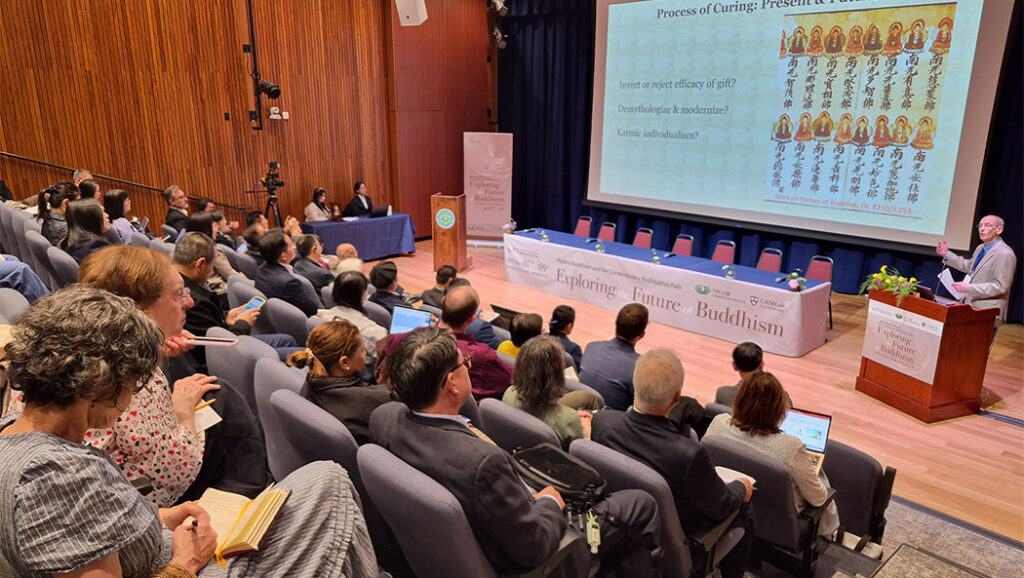
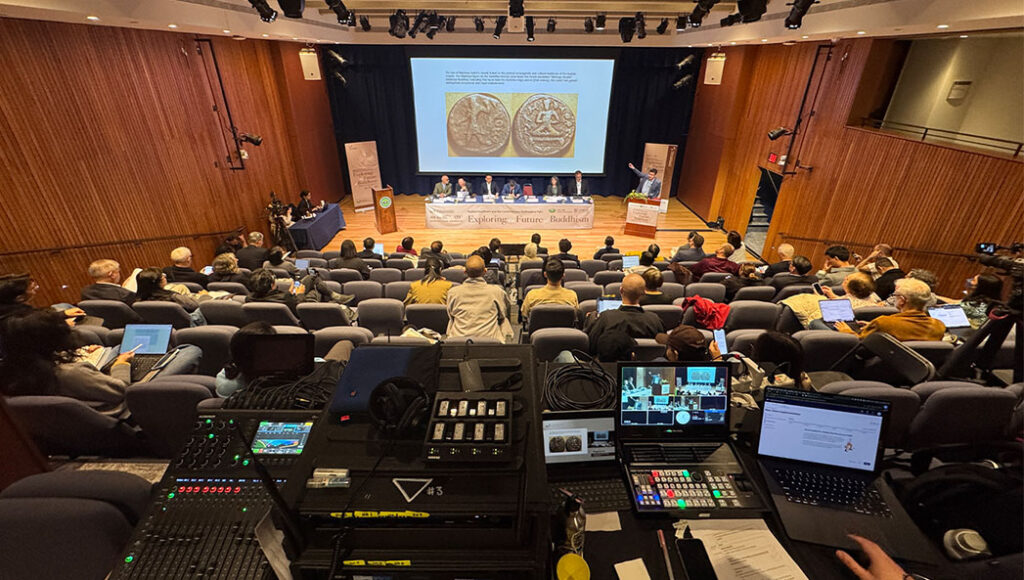
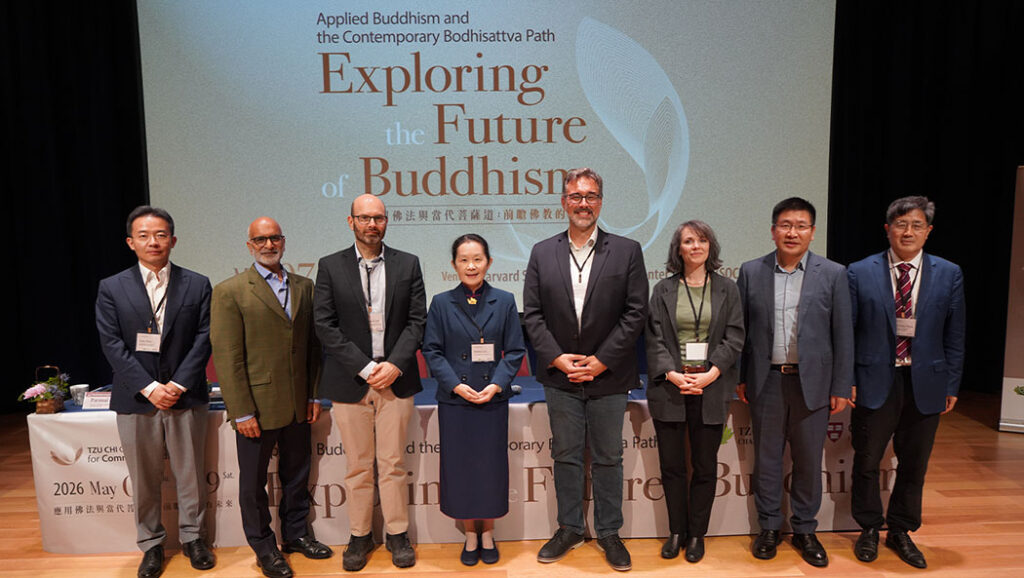
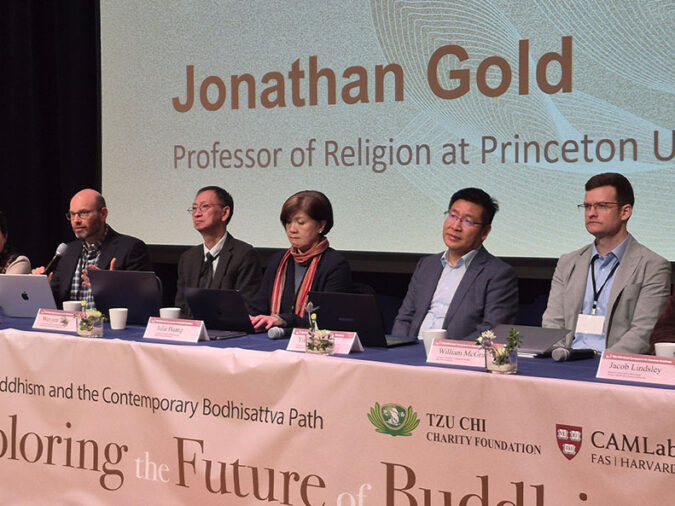
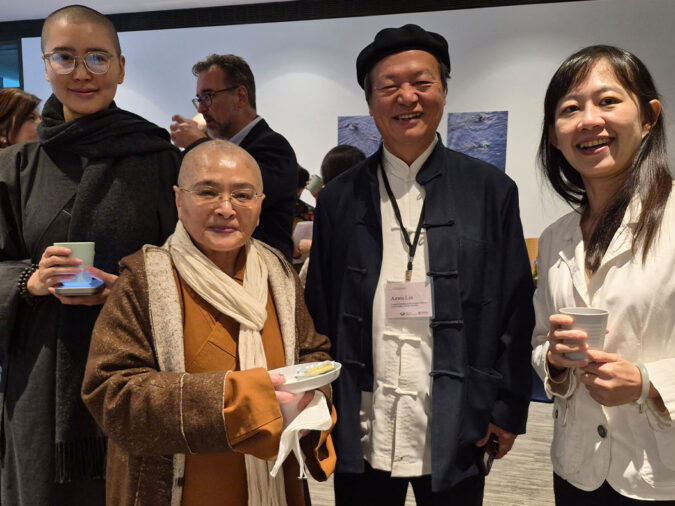
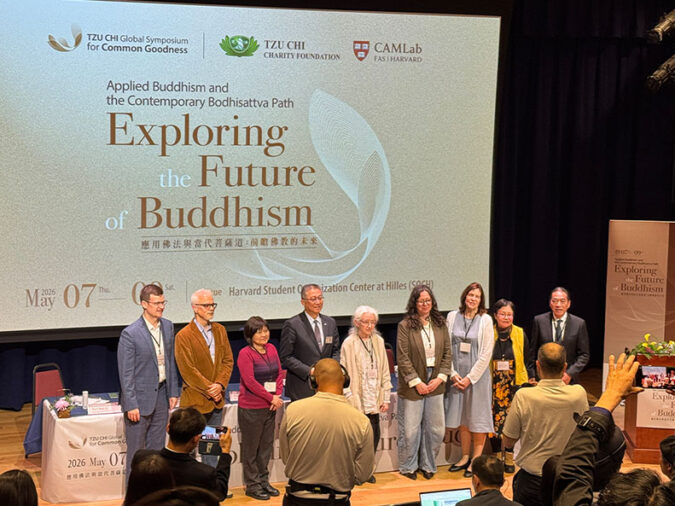
With the panelists seated beside him, moderator Parimal Patil, Professor of Religion and Indian Philosophy at Harvard University, introduces the session “Philosophical and Ethical Foundations of the Bodhisattva Path” on the opening day of the 2026 Tzu Chi Global Symposium for Common Goodness. Photo/Wendy Tsai
Written by Ida Eva Zielinska
Published #81 | Summer 2026 Issue
SHARE
In today’s world, Tzu Chi volunteers care for those unrelated to them as if they were family and feel for their suffering as their very own. This is what the Buddha taught.
Venerable Dharma Master Cheng Yen
Founder
Buddhist Tzu Chi Foundation
Presented in a video message that opened the 2026 Tzu Chi Global Symposium for Common Goodness at Harvard University in Cambridge, Massachusetts, Venerable Dharma Master Cheng Yen’s words offered more than a greeting. As Tzu Chi marks its 60th year in 2026, they framed the deeper purpose of the gathering, inviting participants to explore how the Buddha’s teachings can move from scripture into action, from personal faith into collective responsibility, and from compassion into concrete service.
Tzu Chi began convening the Global Symposium for Common Goodness in 2021 in Taiwan, as a platform to examine how Buddhist wisdom and values can respond to the needs of their time. From May 7 to 9, 2026, that ongoing dialogue came to Harvard University, where the Buddhist Tzu Chi Charity Foundation (BTCCF) and the Cognitive Aesthetic Media Lab (CAMLab) at Harvard’s Faculty of Arts and Sciences co-hosted the symposium under the theme “Applied Buddhism and the Contemporary Bodhisattva Path: Exploring the Future of Buddhism.”
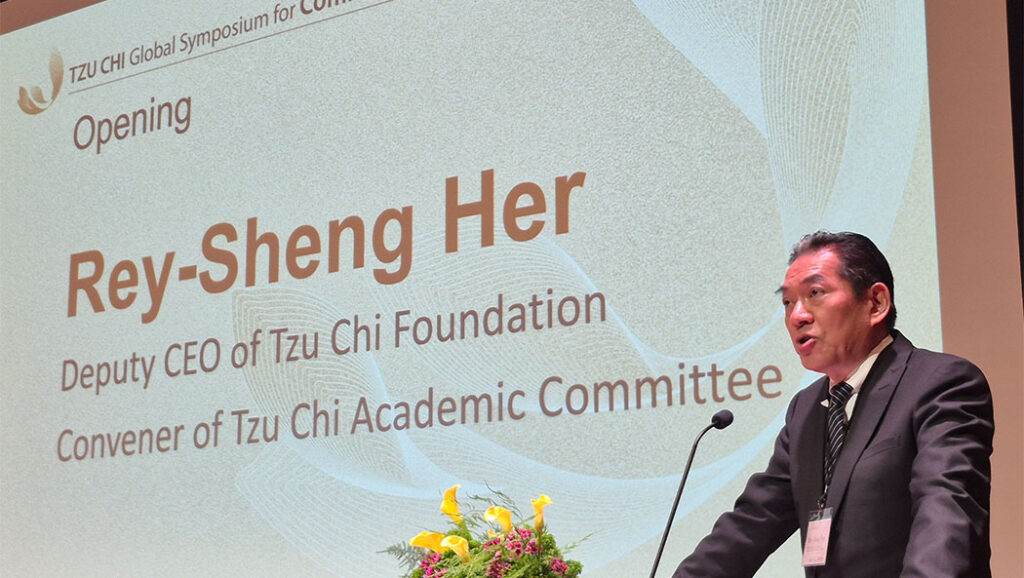
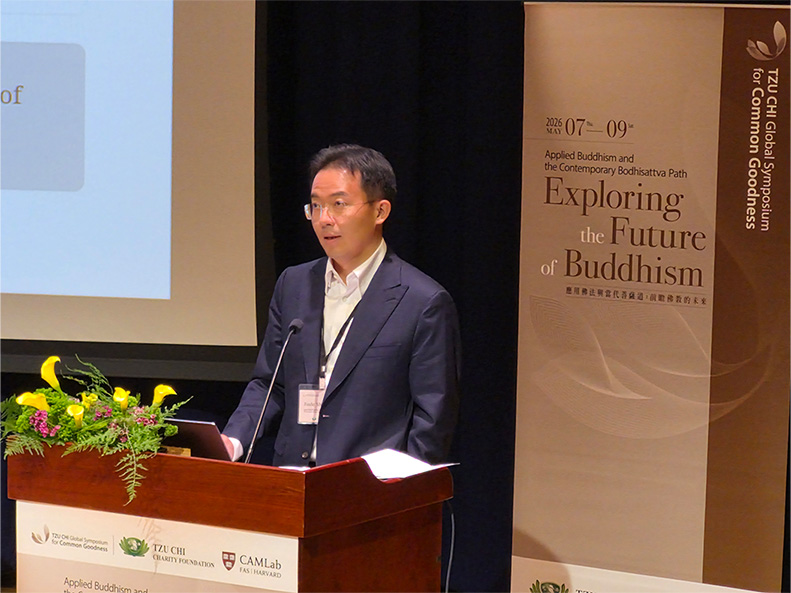
In his opening remarks, Rey-Sheng Her, Deputy CEO of BTCCF and Convener of the Tzu Chi Academic Committee, gave voice to the urgency of that inquiry. “We are living in an era of deep division, tension, and opposition. In such a time, we enjoy a prosperous material life, and yet we also face immense conflict and uncertainty between cultures, between rich and poor, and between humanity and the environment and technology,” he said. “As a Buddhist community and as scholars of Buddhism, can we offer light to this chaotic time? Can we bring spiritual nourishment and peace to an uncertain and anxious world?”
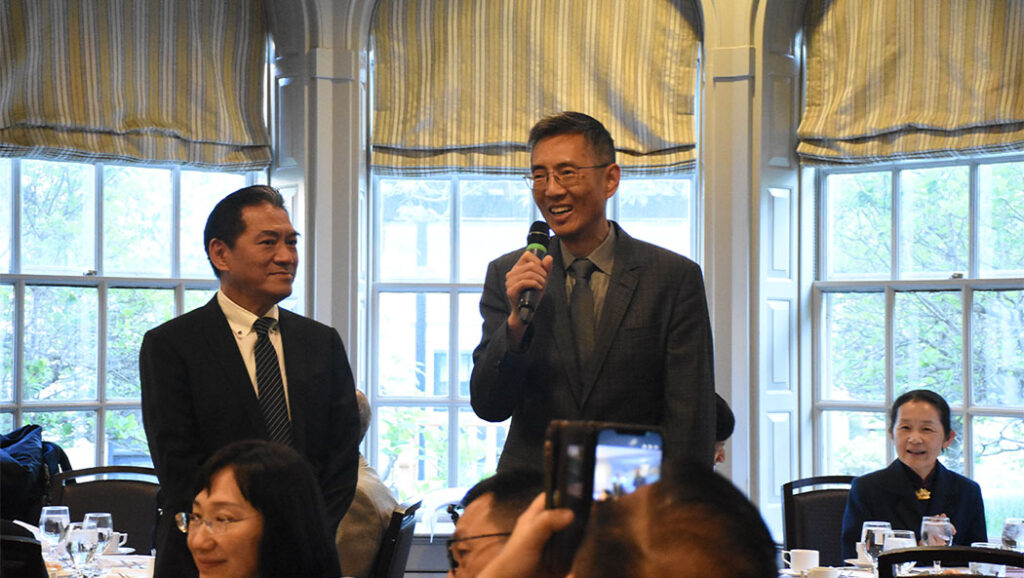
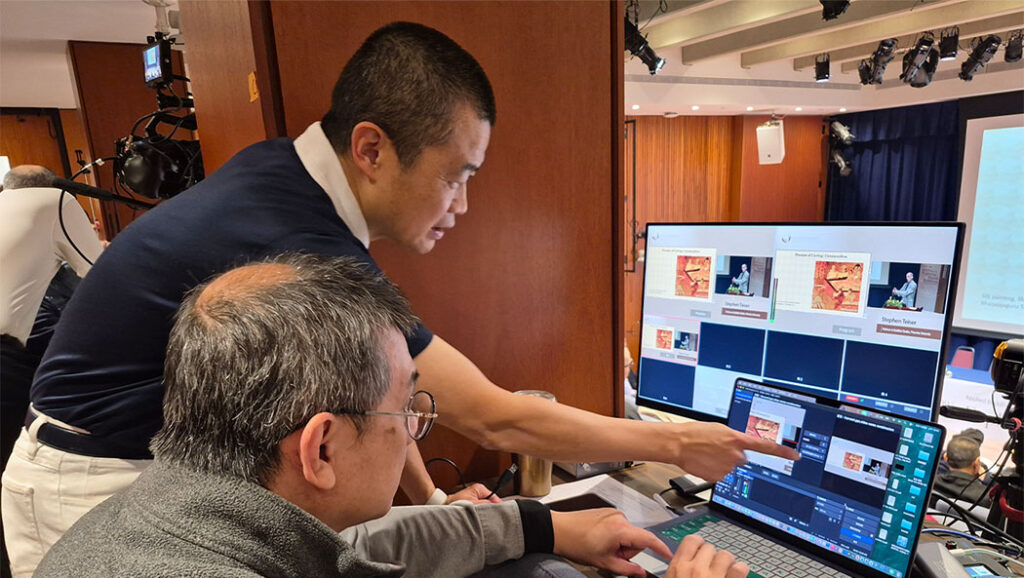
The collaboration between BTCCF and CAMLab offered a particularly fitting framework for beginning to address those questions. Stephen Teiser, D.T. Suzuki Professor in Buddhist Studies at Princeton University, pointed out that the two institutions are bringing “past and present into a very productive, philosophical, and practical relationship,” grounded in “a spirit of free, independent, open, academic inquiry.” He also highlighted their interdisciplinary approach, which recognizes the integrity of the humanities as a discipline and integrates subjects such as mythology, art, performance, media studies, philosophy, politics, education, health care, gender, race, and social class.
SHARE
At the same time, the symposium’s focus on applied Buddhism raised a larger question of why Buddhist traditions remain relevant to the present and future. “There are many ways to learn from Buddhism and Buddhist traditions in service of our lives in the 21st century. Scholarship devoted to this expresses a principled commitment to think not only about what Buddhism and Buddhist traditions have been, but also about what they can be,” noted Parimal Patil, Professor of Religion and Indian Philosophy at Harvard University. Such work matters, he added, because “Buddhism and Buddhist traditions are filled with alternative possibilities, blueprints, and resources for understanding and living in our world today.”
With that expansive frame in place, the symposium turned first, through a series of keynote addresses, scholarly papers, and roundtable discussions, to the meaning of applied Buddhism itself – particularly the Bodhisattva path, within which one seeks awakening not for oneself alone, but for the liberation and well-being of all sentient beings – as something that can be understood not only as a doctrine or ideal, but as a lived response to suffering, illness, social division, and urgent ethical demands.


Situating Applied Buddhism
In his keynote address, “Contemporary Interpretations of Buddhism: The Significance of Applied Buddhism,” Rey-Sheng Her approached the subject through a broad historical lens. “All religions must respond to the needs of their time in order to flourish and sustain their development, and Buddhism is no exception,” he said. Looking across history, he reflected on how Buddhism has flourished, declined, or renewed itself in relation to the needs of different societies, and how it might remain rooted in its core teachings while responding to the conditions of the present.
For Her, that response requires bringing Buddhist wisdom into present-day social structures and realities. “In recent years, the Tzu Chi School of Buddhism expanded beyond charity, medicine, education, humanistic culture, and environmental protection, to include initiatives in goodness in economy, goodness in governance, tech for good, and spiritual care. This effort aims to bring Buddhist virtues and values into professional fields, integrate them into daily life, and embed them more deeply across all levels of society,” he explained.
Her then situated this expansion within the urgent conflicts facing humanity. “We are concerned with the six major conflicts facing the human world: conflict between humanity and the environment, conflict between humanity and technology, conflict between rich and poor, and conflict between races, religions, and nations. How Buddhist thought can respond to and address these issues has become a vital area of research and practice in contemporary applied Buddhism,” he emphasized. “Unleashing Buddhist compassion and wisdom for human peace, prosperity, and common goodness is the common challenge for Buddhist scholars and practitioners worldwide.”
The goal, then, is not a departure from Buddhist tradition, but an effort to carry its wisdom and compassion into broader fields of human concern. The purpose of such engagement, Her stated, remains service rather than self-expansion. “When religion is engaged with the world, it transcends self-centeredness, prioritizing the salvation and relief of sentient beings over its own expansion.”
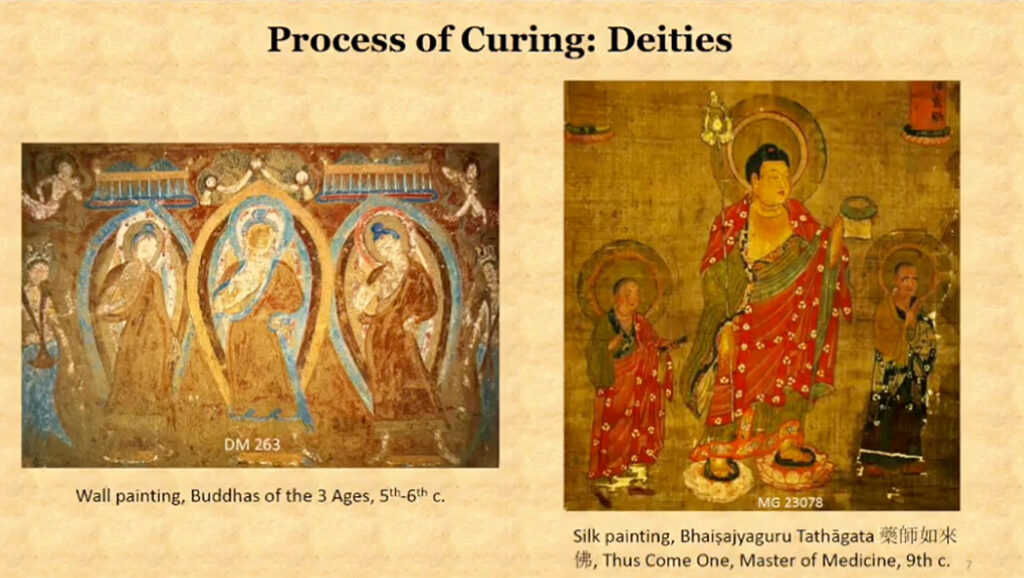
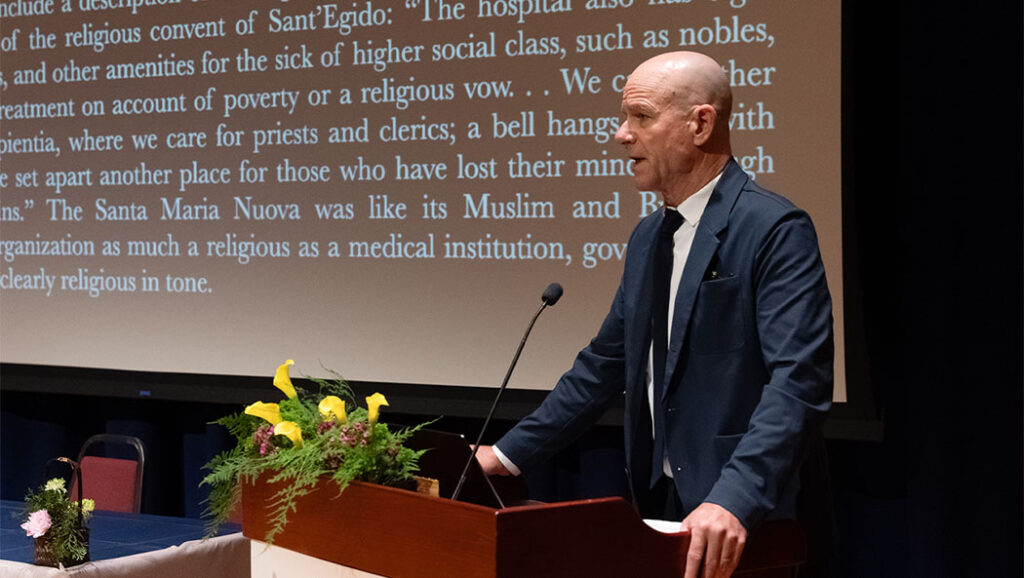
The symposium’s second keynote address, Stephen Teiser’s “Buddhist Responses to Epidemics: Past, Present, and Future,” offered one concrete case of applied Buddhism in relation to illness and epidemic disease. He began with Tzu Chi’s role in helping bring COVID-19 vaccines to Taiwan in 2021, then turned to premodern Chinese Buddhist sources to ask how Buddhist healing has changed across time and what continuities remain.
By juxtaposing the vaccine effort with ancient Chinese materials such as written sutras and paintings, Teiser invited listeners to consider both continuity and change. “There are similarities, but there are also significant differences,” he said. Drawing from healing liturgies, ritual texts, and visual depictions, he showed that Buddhist curing was a layered process involving deities, ritual communities, medicine, sutra chanting, monastic participation, and karmic relationships linking the sick person, their family, past adversaries, and all sentient beings.
His keynote returned these historical examples to questions facing Buddhism today, including whether modern forms of Buddhism change how the act of giving is understood in the context of medicine and care. “Should we reverse the direction of donation and think of the recipients not as recipients, but as the real donors? Are doctors the ones truly receiving the benefit from their patients?” Teiser asked. In raising these questions, he brought the history of Buddhist healing into conversation with the present field of applied Buddhism, where illness becomes a field for rethinking giving, receiving, benefit, and care.
From there, the symposium moved from applied Buddhism as a response to illness and social need toward the deeper philosophical and ethical questions that shape the Bodhisattva path itself. The next panel examined how Buddhist teachings on skillful means, equality, Buddha nature, and future-oriented devotion might inform lived practice.
Philosophical and Ethical Foundations of the Bodhisattva Path
Jonathan C. Gold, Professor of Religion and Director of the Center for Culture, Society and Religion at Princeton University, opened the panel with “Upāya Without Closure: Coercion, Trauma, and the Contemporary Bodhisattva Path,” turning to the difficult terrain of social and political life. Bringing Buddhist moral psychology into dialogue with systems shaped by law, surveillance, borders, punishment, trauma, and fear, he asked, “What ought to count as effective action for a bodhisattva?”
Gold stated that Buddhist concepts such as no-self, emptiness, impermanence, and dependent origination can illuminate not only individual experience, but also social roles, identities, and institutions. Social structures, in this view, are not fixed by nature; they are formed through causes and conditions, and therefore can be studied, challenged, and changed. Yet they can also become what Gold called “karmic infrastructures,” preserving fear-based patterns of perception and response across institutions. “Chronic threat produces narrowed perception. Narrowed perception generates a demand for certainty. Certainty is stabilized through authority and force, and these structures in turn reproduce the very conditions of insecurity that sustain the cycle,” he explained.
Against that tendency, Gold proposed “upāya without closure,” a form of skillful means suited to compromised social and political conditions. Rather than seeking a pure position outside institutions, the Bodhisattva path requires acting within them while remaining alert to the ways force, fear, emergency, or even care itself can harden into certainty. “The contemporary bodhisattva path then is not a path of purity, but of disciplined non-reification,” he said. “It’s a commitment to remain responsive within conditions that can never be fully mastered while resisting the conversion of provisional judgments into unquestionable truths.”
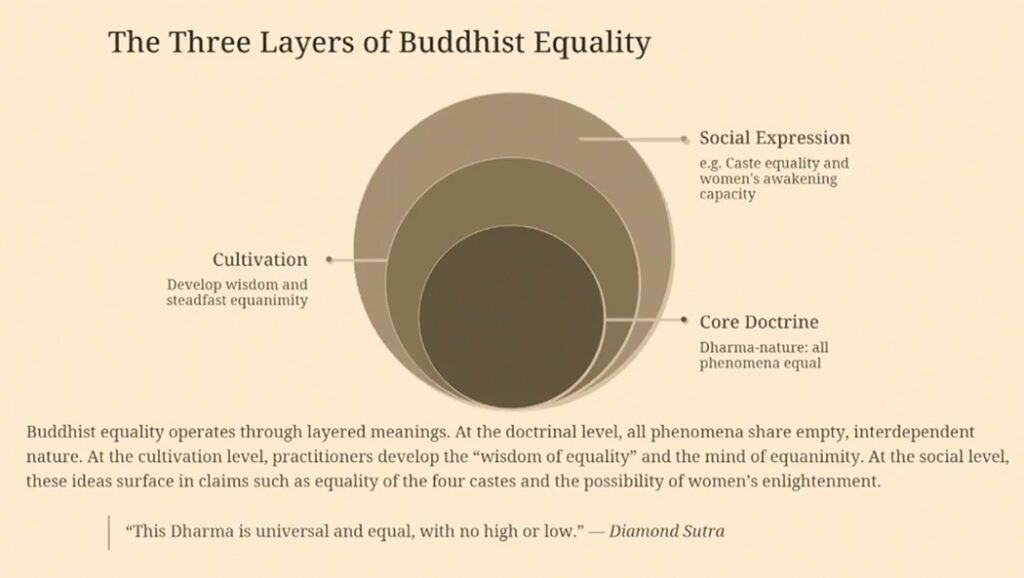
In “All Dharmas Are Equal, with No Distinction of High or Low: The Historical Connotations and Contemporary Significance of the Buddhist View on Equality,” Jiade Shao, Associate Professor in the School of Philosophy at Nanjing University, juxtaposed the Buddhist view of equality with rights-based understandings of the term. “Natural questions arise: Has Buddhism promoted social equality in its historical development? Another question is, what are the similarities and differences between the Buddhist view of equality and modern Western concepts of equality? What can Buddhism offer to the pursuit of equality today?”
SHARE
To answer these questions, Shao emphasized that Buddhist equality begins with inner cultivation rather than external sameness. “Early Buddhist equality is closer to an inner discipline of equality than to a modern doctrine of externally distributed rights,” he said. Rather than simply erasing difference, this view includes calmness, equanimity, and the capacity to endure or transcend differences without being bound by them. It also rests on the Buddhist recognition that all sentient beings share the capacity for nirvana or awakening, grounded not in human rationality alone, but in the shared capacity to feel suffering.
Its broader value, Shao explained, lies in widening the discussion beyond legal rights and material distribution. Buddhist equality can complement modern frameworks by addressing the inner spiritual dimensions of equality, including the work of overcoming envy and jealousy, while also expanding the discussion beyond human-centered claims to include ecological concern and the relationships humans hold with other living beings and nature.
Wen-liang Zhang, Professor in the School of Philosophy at Renmin University of China, turned to Tathāgatagarbha, or Buddha-nature thought, as another foundation for understanding the Bodhisattva path in modern practice. In “Tathāgatagarbha Thought and the Contemporary Bodhisattva Path,” Zhang traced how this lineage of Mahāyāna thought, which holds that all sentient beings possess innate wisdom, became especially influential in Chinese Buddhism and was reinterpreted through schools such as the Three Stages School, Chan, and Pure Land.
Zhang located the significance of Buddha-nature thought in its understanding of the shared nature of Buddhas and sentient beings. Because all beings possess the potential for awakening, liberation is not only something bestowed by the Buddha upon those who suffer, but something sentient beings help bring forth in one another. “The relationship between the Buddha and sentient beings is not a unidirectional one – from Buddha, the savior, to sentient beings, the saved – but rather a reciprocal one where Buddha is sentient beings and sentient beings are Buddha, with sentient beings simultaneously being those who are saved and those who provide salvation.”
This reciprocal understanding gives the Bodhisattva path a deeply practical dimension, placing awakening not beyond ordinary beings, but within the love and action they bring to others. “As long as every individual gives rise to the Bodhi heart, is willing to offer their love, and puts this into action by saving others, they are a Bodhisattva; they are a Buddha.” Zhang saw Tzu Chi’s philosophy and practice as a contemporary expression of Tathāgatagarbha thought precisely because of its emphasis on “great love, equality, and the value of action.”
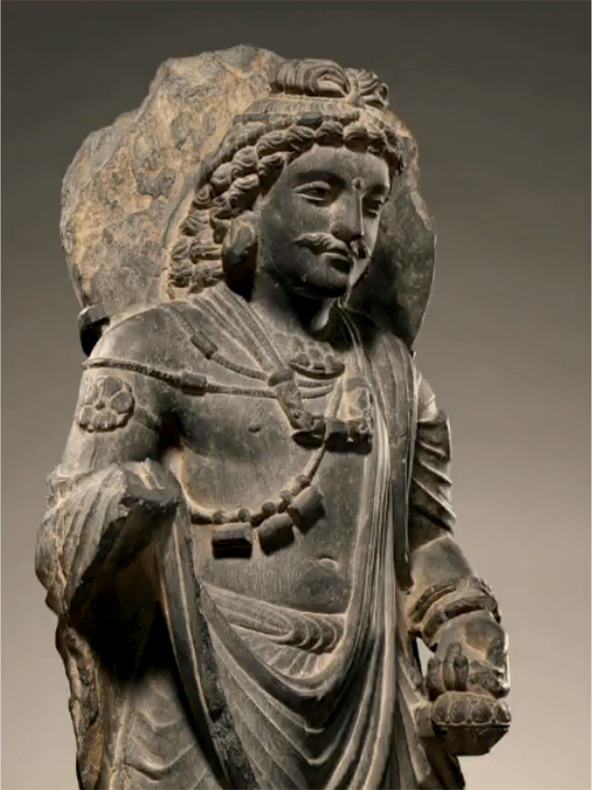
Yinggang Sun, Professor in the School of History at Zhejiang University, approached the Bodhisattva path through archaeological evidence from Gandhara, an ancient Buddhist region that is now part of Pakistan and Afghanistan. In “The Maitreya Bodhisattva Faith in Gandhara and Its Influence on East Asian Civilization,” Sun traced how images, coins, inscriptions, and colossal statues connected to Maitreya, the Future Buddha, reflected the rise of Bodhisattva devotion and its movement along the Silk Road into China, Korea, and Japan.

In Sun’s account, Gandhara was more than a center of Buddhist art. “It can be said that Buddhism underwent a comprehensive and revolutionary transformation in Gandhara.” These developments included written sutras, new images of the Buddha, the rise of Bodhisattva beliefs, and ideas later understood as part of the emergence of Mahāyāna Buddhism.
That transformation, Sun explained, helped shift Buddhism toward a broader vision of liberation. “In the Mahayana Buddhism that arose in Gandhara, the core belief and ideal shifted from pursuing individual self-salvation to advocating the salvation of all sentient beings.” In this context, his paper returned the Bodhisattva path to one of its historical turning points, showing how the ideal of helping others moved across regions, images, and civilizations before becoming central to East Asian Buddhism.


⊚ Reflections on the Presentations
In their commentary on the panel’s presentations, Lina Verchery and Justin R. Ritzinger considered how philosophical and historical inquiry might inform the Bodhisattva path in practice. Verchery, Senior Lecturer in the Study of Religion at Victoria University of Wellington, saw a common thread running through the papers in what she called the question of “moral aspiration.” Drawing on the work of Ruth Levitas, a scholar of utopian thought, she described aspiration as arising from the gap between the ideal and the actual. Each presented paper, she observed, approached that gap in a different way, asking how Buddhist moral ideals can move from doctrinal or philosophical form into real-world application.
For Verchery, this gap was not simply a problem to be solved, but part of the very structure of the Bodhisattva path. Citing Levitas, she reflected on the phrase “not yet,” with its double sense of future possibility and present incompletion. In that space between the ideal and the actual, she found an echo of the session’s larger themes, from Gold’s refusal of ethical closure, to Shao’s view of equality as including difference, Zhang’s emphasis on the potentiality of sentient beings, and Sun’s presentation of Maitreya as both Bodhisattva and Future Buddha. “When we ask ourselves in the coming days if we know what the contemporary Bodhisattva path and the future of Buddhism look like, perhaps we, too, can answer, ‘not yet,’” she concluded.
Ritzinger, Associate Professor of Religious Studies at the University of Miami, pressed the discussion toward practice, asking how philosophical and historical insights might be translated into practical action. “Religion offers not only a set of profound ideas, which obviously it does, but also ways of ingraining those in life worlds,” he said. Turning to Tzu Chi as an example, Ritzinger observed, “What makes Tzu Chi important and powerful is in part, of course, the ideas, which are wonderful, but what really gives it its traction is its ability to ingrain that in habitus,” meaning the embodied habits, emotions, and ways of life that sustain action. His comment brought the discussion back to the question of how Buddhist ideas can become symbols and lived forms capable of motivating and sustaining the Bodhisattva path into the future.
Ritzinger also returned to Wen-liang Zhang’s discussion of Tathāgatagarbha thought, finding in it a vision of what he called “a kind of Bodhisattva collective.” Rather than imagining Buddhist communities only through vertical relationships between practitioners, masters, Bodhisattvas, and Buddhas, Zhang’s account opened a more horizontal possibility, in which sentient beings help guide one another toward awakening. Yet that possibility also raised difficult questions. “If I and someone else, similarly deluded as I, are trying to form that, how do we guide ourselves into awakening?” Ritzinger asked. “How do we avoid a blind leading the blind situation, and also what might be gained and lost by shifting from that vertical to horizontal orientation?”
From there, the symposium carried this concern with embodied practice into questions of health, healing, ethical care, and the relationships that bind humans to other living beings and the natural world.
SHARE:
One ripple of kindness.
Thousands of lives touched.