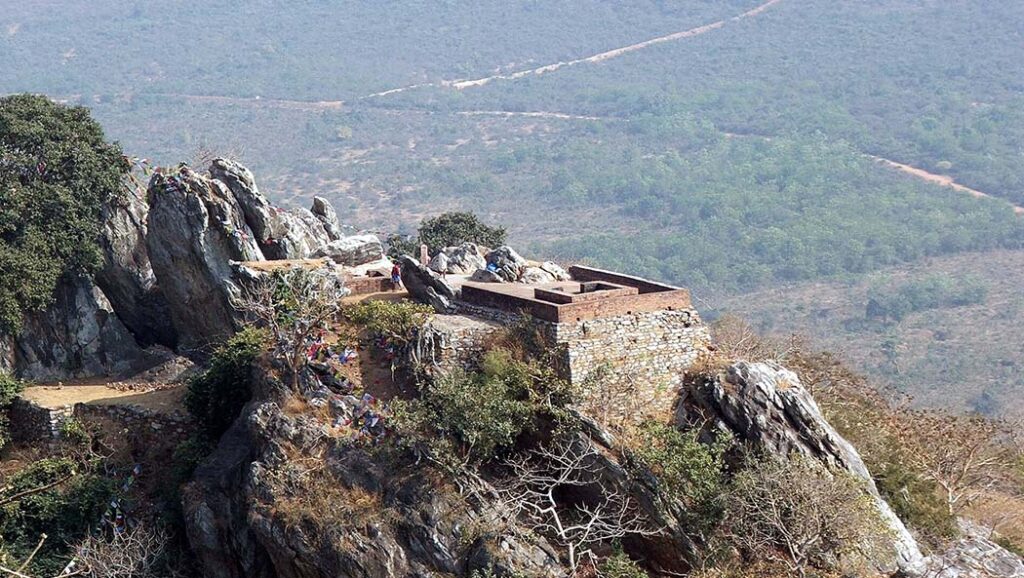
Located near Rajgir in the Indian state of Bihar, Vulture Peak, or Gṛdhrakūṭa, is one of the most important sites where the Buddha taught and is associated with major Mahāyāna texts such as the Lotus Sutra. Beyond its historical role, it has long symbolized an enduring place of teaching and transmission, one in which the Dharma is understood not as confined to a single place or moment, but as something that transcends time and space.
In the exhibition, that larger horizon is paired with Tzu Chi’s steadfast commitment to putting compassion into action wherever suffering appears. The Bodhisattva path becomes a living practice carried forward whenever people respond to the needs of the world. Thus, Journey to Enlightenment concludes not with an ending, but with an invitation for visitors to consider how they, too, might carry that spirit forward.
Vulture Peak near Rajgir, India, remains a pilgrimage site long associated with the Buddha’s teachings. Photo/Harvard FAS CAMLab
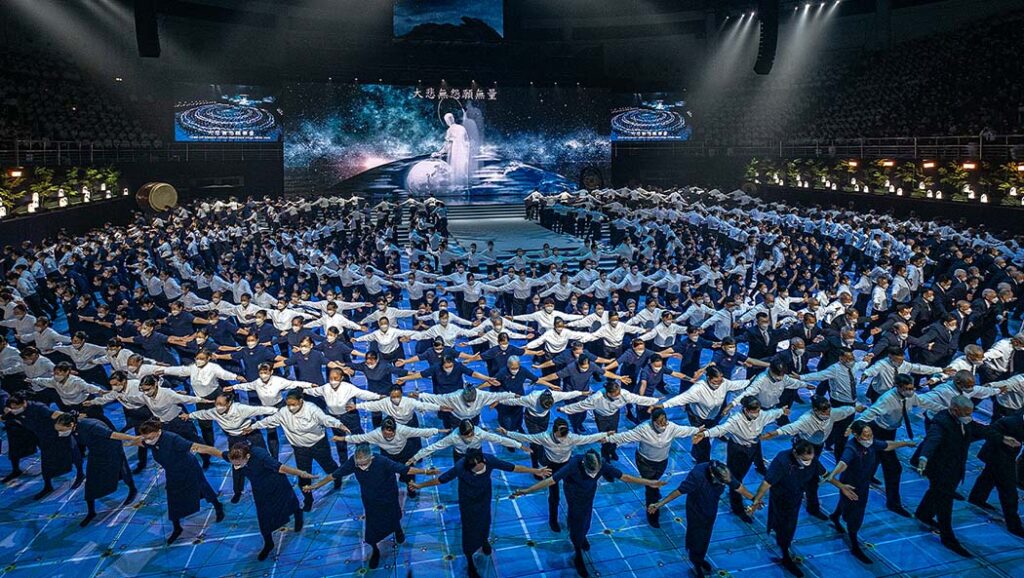
Tzu Chi volunteers perform an adaptation of the Sutra of Infinite Meanings, embodying the Dharma through collective practice. Photo/Buddhist Tzu Chi Foundation
SHARE
A Complex Production Process
Journey to Enlightenment’s expansive, layered vision required an intricate process of research, design, and production, beginning with an assessment of the Buddhist sites and artifacts it draws from. Spanning more than 2,500 years of history, they reflect the values, aesthetic ideals, and devotional imagination of the eras that produced them, yet many have also been weathered by time, damaged by conflict, or fragmented through looting and dispersal.
As Rey-Sheng Her noted, the reasons for that damage are varied. “A lot of Buddha caves or Bodhisattva caves are located in a geologically very unstable area. The wind, the rain might wear out those statues of stone. War is also crucial, leading to the looting and destruction of those Buddha statues. So there is a geological reason and also a political reason. And the most important reason is people lose faith. That’s the main reason why in a lot of places, the Buddha statues have been abandoned or destroyed.”
Bringing the sites and artifacts into the exhibition required more than documentation. It meant finding ways to recover and reconstruct them so they could once again be experienced as meaningful environments rather than as scattered remains. “In a typical CAMLab project on Buddhist cultural heritage sites, we usually start from a digitization of the entire site. We integrate 3D scans, photogrammetry, aerial footage, all this new technology in documenting these sites, and we translate this data into a high-resolution 3D model,” Chenchen Lu explained. “However, usually these sites are damaged. So we have to rely on Harvard’s extensive resources in historical and archaeological archives to do more architectural modeling and reconstruct the original conditions of the site when it was first built.”
Lu pointed to the Xiangtangshan caves as one of the exhibition’s most demanding reconstruction efforts. Because the site was heavily damaged in the early 20th century, many sculptural elements were cut away and dispersed into museum collections around the world. Reconstructing it digitally therefore meant working on two fronts at once: documenting the caves in their present condition, and collaborating with museums and scholars to locate, digitize, and virtually reunite missing heads and fragments with the site they once belonged to. “It’s almost like we are diving into the ocean of the museum collections. Many scholars have been contributing to this effort across the world.”
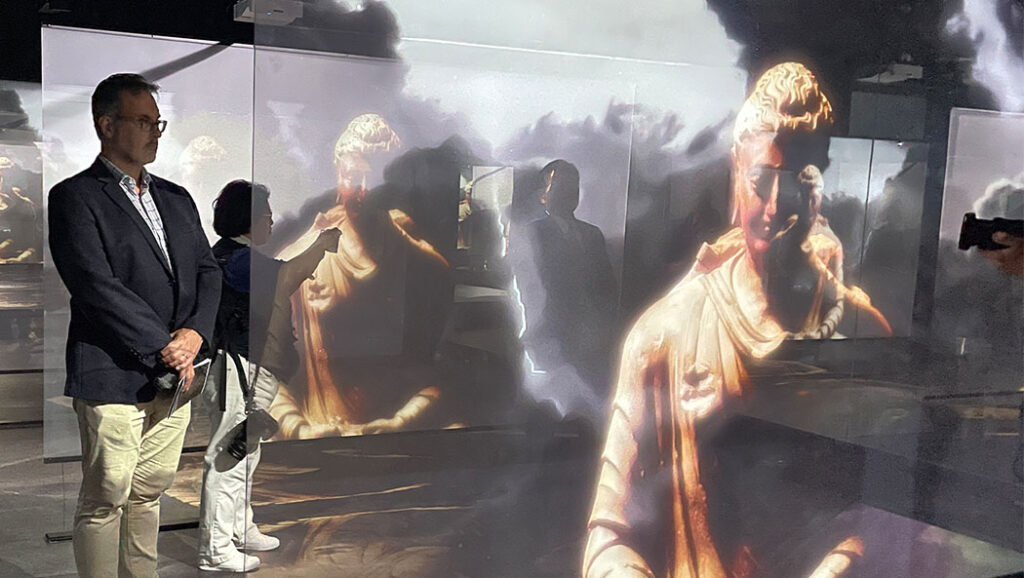
Eugene Wang added that the goal went beyond recovering appearances. “Our interest is not merely to restore the look of the damaged caves and the fragmented parts of the Buddha bodies. Our goal is to reconstruct the imaginary space that these Buddha figures or other art forms try to evoke. We are trying to create an experience that is spiritually elevated, aesthetically engaging. It’s a way of getting people to a state of mind.”
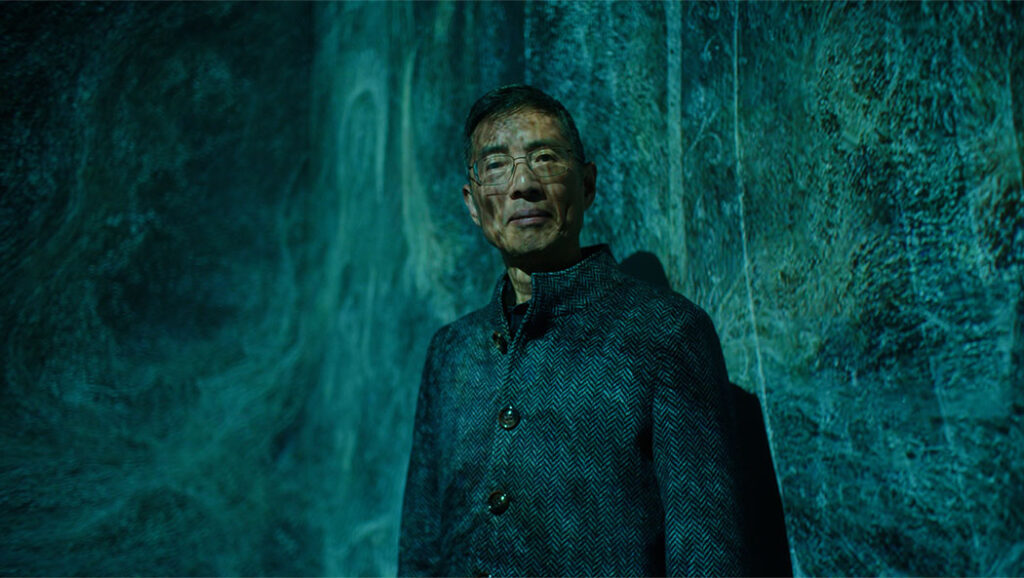
Eugene Wang stands within the projected imagery of Journey to Enlightenment, which gives form to his vision for the exhibition. Photo/Tzu Chi USA Video Team
⊚ From Reconstruction to Shaping an Experience
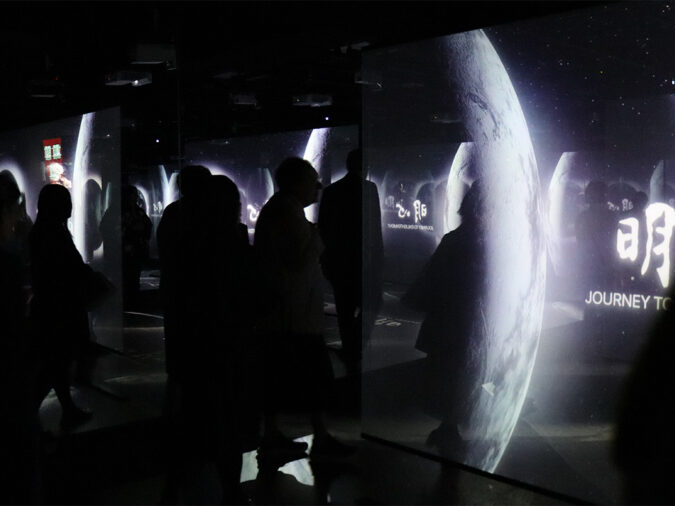
With the 3D models in place, the next step was a collaborative brainstorming process between researchers and designers. “We have to design how to tell the story of this site,” Chenchen Lu said. “We have the 3D digitization database of the site, and now we are basically creating an experience. That involves creating a storyboard. Then we move on to visual and audio production. We work very closely with our interdisciplinary team to render out each clip, and this is usually a back-and-forth process. It is really through multiple iterations of brainstorming, testing, and polishing that we finally arrive at the multimedia exhibition that creates an immersive, multi-sensory experience for the audience to invite them into that site immersively through new technology to experience the story and core values behind it.”
ChaiYee Leow, Research Associate on the project, emphasized that the exhibition rests on generations of prior effort. The Buddhist sites it draws from didn’t simply survive unchanged, but have been excavated, documented, reconstructed, and protected by archaeologists, scholars, and monastics. That long process made the exhibition possible while also leaving the team with an enormous body of material to choose from. “If we need to narrow down the materials we show to the public and not overwhelm people, we have to choose the best of the best,” Leow said. From Borobudur alone, there were roughly 460 relief panels, but only about ten could be included in the exhibition.
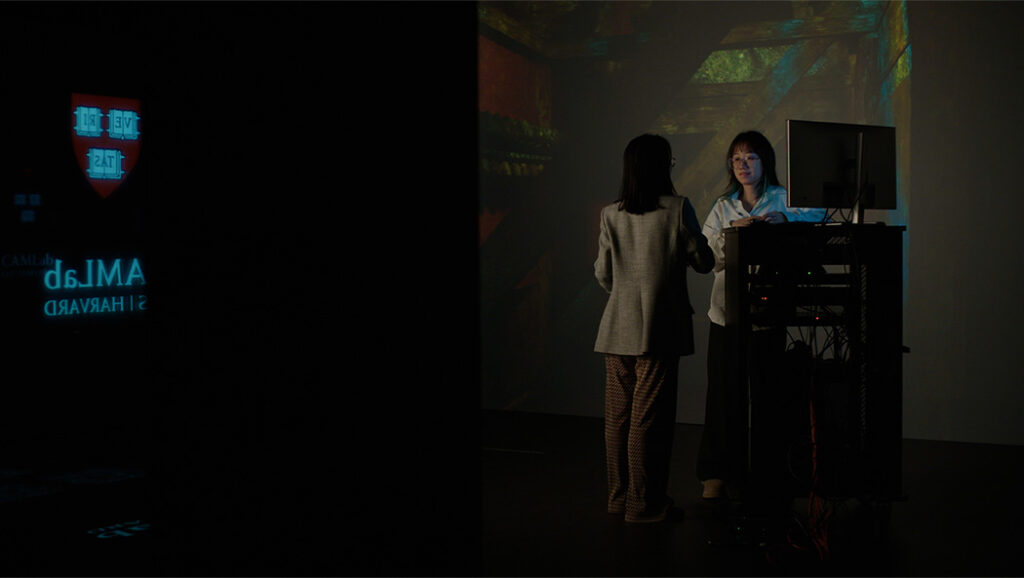
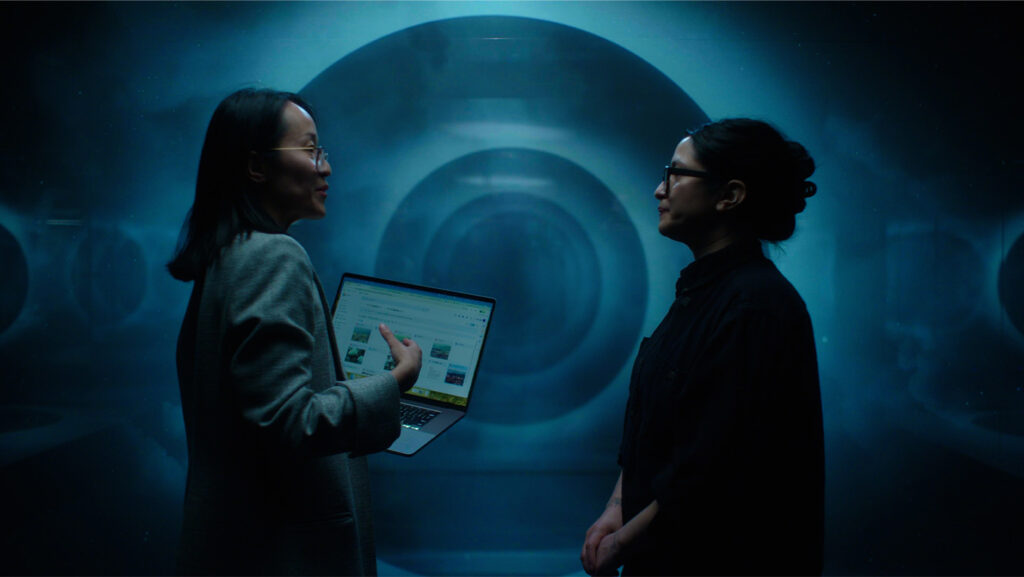
Technician and Designer Lilith Ren (right) confers with Chenchen Lu during the highly technical production process of bringing Journey to Enlightenment to life. Photo/Tzu Chi USA Video Team
Lilith Ren, Technician and Designer on the project, described it as technically complex, requiring constant testing, troubleshooting, and adaptation across multiple media formats, software systems, and installation setups. “My background is really as a digital artist, so that very technical stuff was new territory for me to explore. But I think it was also super rewarding to actually put my work onto the screens.” Without a background in Buddhist history, Ren also faced a steep learning curve in the subject matter and had to build her understanding of the Lotus Sutra from the ground up, relying on CAMLab’s researchers and academic resources to help shape the narrative.
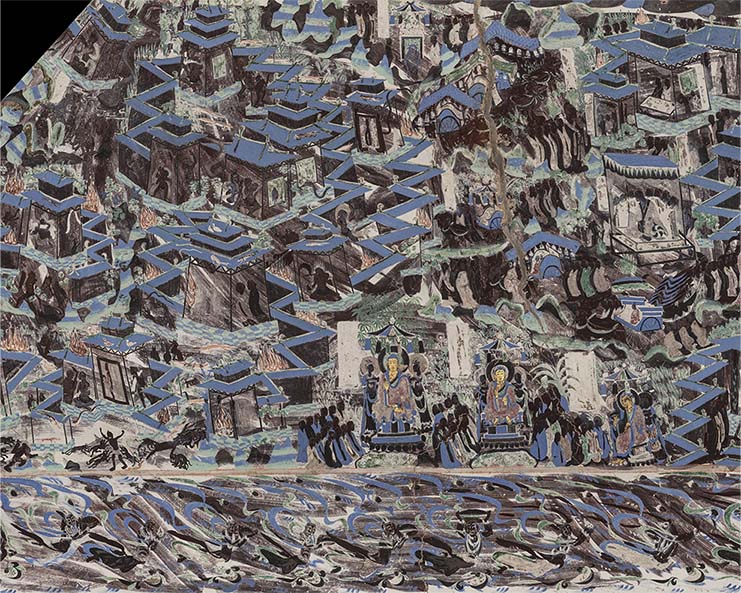
As one example, Ren described reworking the Burning House parable from the Lotus Sutra into a more linear, immersive sequence. Drawing on cave painting imagery and guidance from CAMLab researchers, she isolated key elements in the story, then used light, motion, and environmental effects to convey the danger of beings trapped in a burning house and the promise of rescue. In Buddhist terms, the parable warns of living blindly amid suffering while showing how the Buddha guides beings toward liberation through skillful means.
A digital image based on Dunhuang Mogao Cave 420 reveals part of CAMLab’s process of translating the Burning House parable from the Lotus Sutra into an immersive exhibition sequence. Photo/Harvard FAS CAMLab
Ren also reflected on why Buddhist narratives still matter in the present, suggesting that contemporary methods can help make them newly accessible to modern audiences. For her, the enduring value lies in the spirit carried within those stories, even as each generation encounters them differently. “Those stories won’t fade out. They never did. They rebloom, because each time we approach them, we bring new meanings based on the world or the century we live in.”
⊚ Engaging Contemporary Audiences
Jess Rivera, Visual Designer on the Journey to Enlightenment production team, described her work as “converting traditional media into new media generative artworks.” The challenge lay in transforming historical material through contemporary techniques such as creative coding and AI-driven processes, opening new ways for audiences to encounter it. The effort, from recovering the stories to reimagining them through new media, was ultimately in service of creating a compelling audience experience.
Visual Designer Jess Rivera (right) and Chenchen Lu discuss details during the Journey to Enlightenment production process. Photo/Tzu Chi USA Video Team
Eugene Wang pointed out that the exhibition was designed to reach audiences across cultures and generations. “It is a universal language that we’re speaking. It’s sight and sound, and it doesn’t involve verbal translation. It’s a structure of experience that we’re presenting to our audience. For anyone who comes in, so long as they can follow that flow experientially, then we’ve done our job. Then the exhibition will be successful.”
Wang hoped that this approach would resonate especially with younger audiences, which he saw as important to Tzu Chi’s future. “If we don’t do something very meaningful and really also speak their language, share the same kind of wavelength that they have, then we might lose them. It is ultimately about attracting the future. So to some extent, one might say that this is looking back at history, but in the meantime, it’s also looking forward.”
That concern for future generations also shaped how Powen Yen, CEO of the Buddhist Tzu Chi Charity Foundation, understood the partnership behind Journey to Enlightenment. “Through our collaboration with Harvard University’s CAMLab, we have employed advanced technology to preserve these invaluable Buddhist historical relics. In doing so, we created an enduring preservation of history, enabling future generations not only to behold these precious cultural legacies, but also to more fully comprehend the original intent of the Buddha’s teachings.”
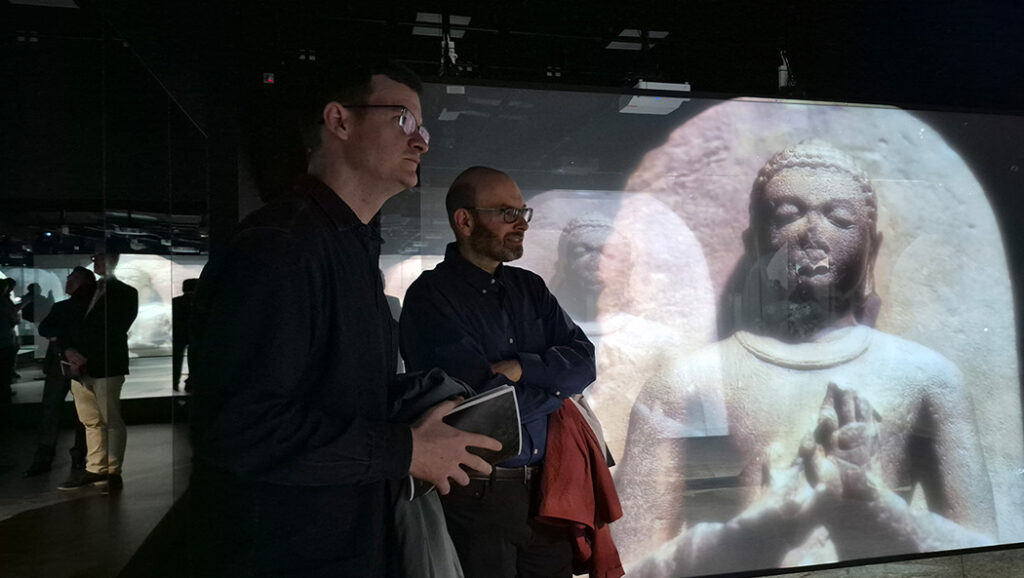
Guests contemplate Buddhist teachings through the sites featured in Journey to Enlightenment during the exhibition preview on May 6, 2026. Photo/Wendy Tsai
Moreover, Journey to Enlightenment places Tzu Chi within the full span of Buddhist history. “It is only 60 years old, but it connects to the deeper tradition of Buddhism. This tradition goes back 2,500 years,” Chenchen Lu said. She also pointed out that the sites presented span South Asia, East Asia, and Southeast Asia. “We hope this diverse and global Buddhist art also reflects Tzu Chi’s global scale, and the spirit that brings together Buddhists from different corners of the world so that we can all work together to continue the Dharma tradition.”
In that broader frame, the exhibition shows the Tzu Chi School of Buddhism as a socially engaged form of practice. “Master Cheng Yen brings Tzu Chi volunteers to carry the Buddhist spirit and altruism into the real world,” Rey-Sheng Her said. “In ancient times, divinity was embedded in architecture; nowadays the divinity of Buddhism is embedded in the secular world. That is Tzu Chi’s very important practice.”
The Exhibition’s Journey Begins
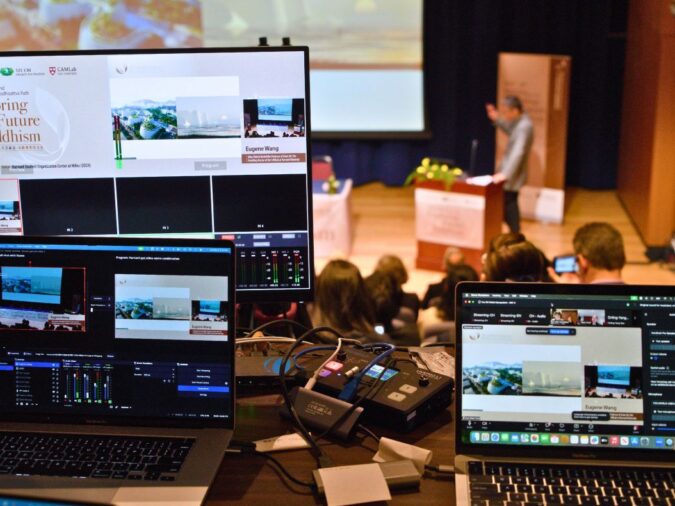
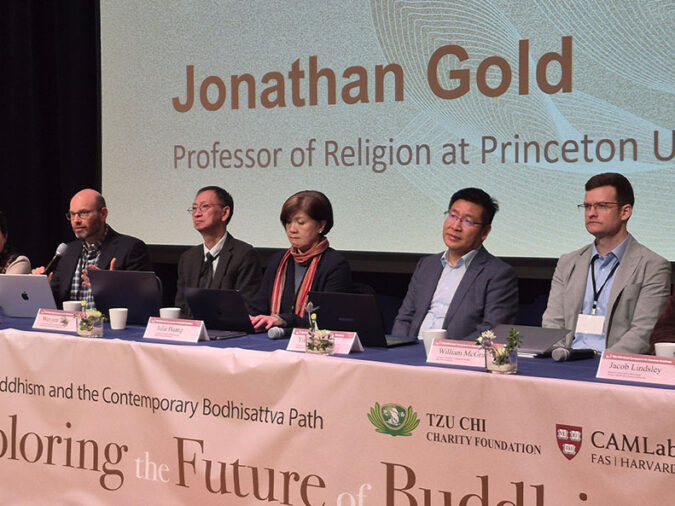
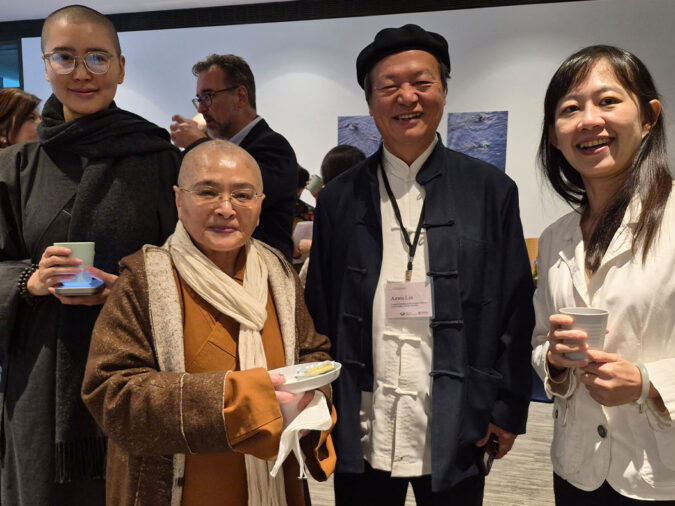
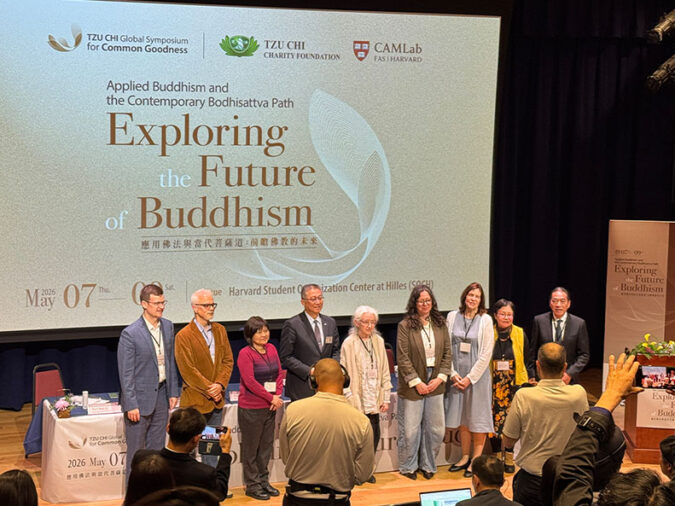
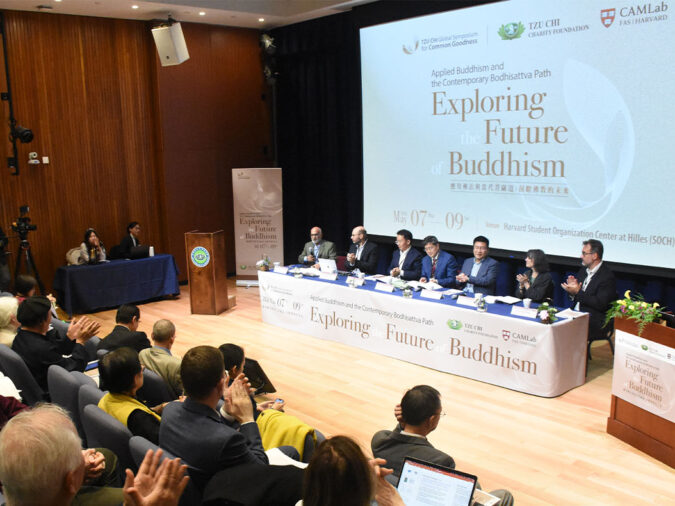
While Journey to Enlightenment opened to the public on May 9, 2026, participants in the Tzu Chi Global Symposium for Common Goodness were able to preview it on May 6 and were later invited to an opening ceremony and dinner on May 8. “Today is a very meaningful day,” Chenchen Lu remarked at the opening event. “We reached a milestone. And also, we feel like this is the beginning of the journey.” Indeed, it was, as symposium participants became the exhibition’s first viewers and began to share their responses.
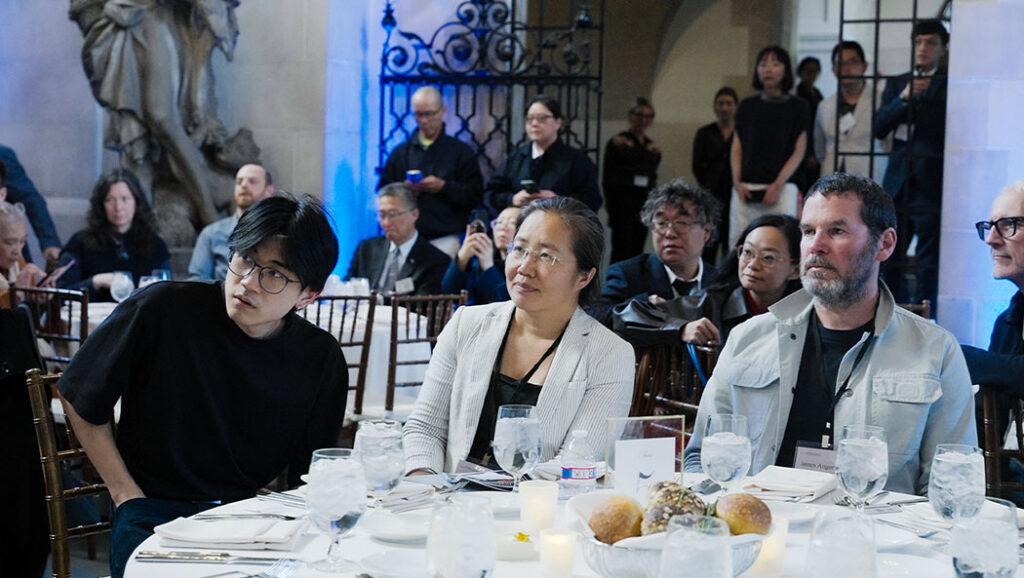
Participants in the 2026 Tzu Chi Global Symposium for Common Goodness listen to remarks at a May 8 gathering marking the opening of Journey to Enlightenment. Photo/Daniel Ferrara
William A. McGrath, Assistant Professor of Buddhist Studies at New York University, was struck by the immersive environment and the collective attention it fostered. “There’s a certain reverence that comes when I’m in a room, particularly with a group of other people, and we’re experiencing this together,” he said. “There’s no fast-forward button, there’s no pause button. I get a text message, I ignore the message, because I’m here in the presence of these Buddha images, experiencing something that otherwise I would be unable to. I think making a physical space – a physical practice space, we might even say – out of this exhibition, transforms it into something utterly more meaningful.”
William McGrath (left), Assistant Professor of Buddhist Studies at New York University, recognizes the shared sense of reverence fostered by Journey to Enlightenment. Photo/Wendy Tsai
Justin R. Ritzinger, Associate Professor of Religious Studies at the University of Miami, also reflected on how the exhibition’s immersive approach to Buddhist storytelling opened a new kind of experience. “You have images from different angles. You’re sort of moving through space, or being drawn through, and it does an interesting job of evoking certain feelings,” he described. “I’m somebody who is very textual. I live and die by the word and not by the image, and so when I read about things like Buddhist visualization practices, it’s impressive, but it’s very foreign to me. I think that being drawn into something that is immersive in this way is probably the closest that I’m going to be able to come to that kind of a visualization practice.”
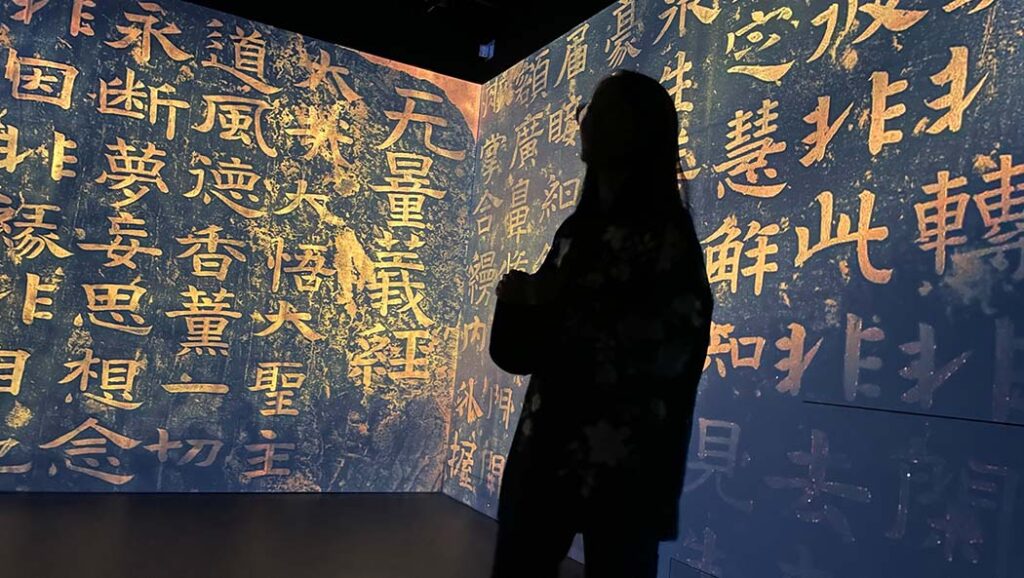
Ritzinger was especially struck by the section associated with engravings from the Buddhist canon, particularly the Sutra of Infinite Meanings, a foundational text for Tzu Chi. “It was a real chance to both see it and hear it, because it’s being chanted at the same time.”
Justin Ritzinger (left), Associate Professor of Religious Studies at the University of Miami, appreciates Journey to Enlightenment’s multimedia storytelling. Photo/Jennifer Chien
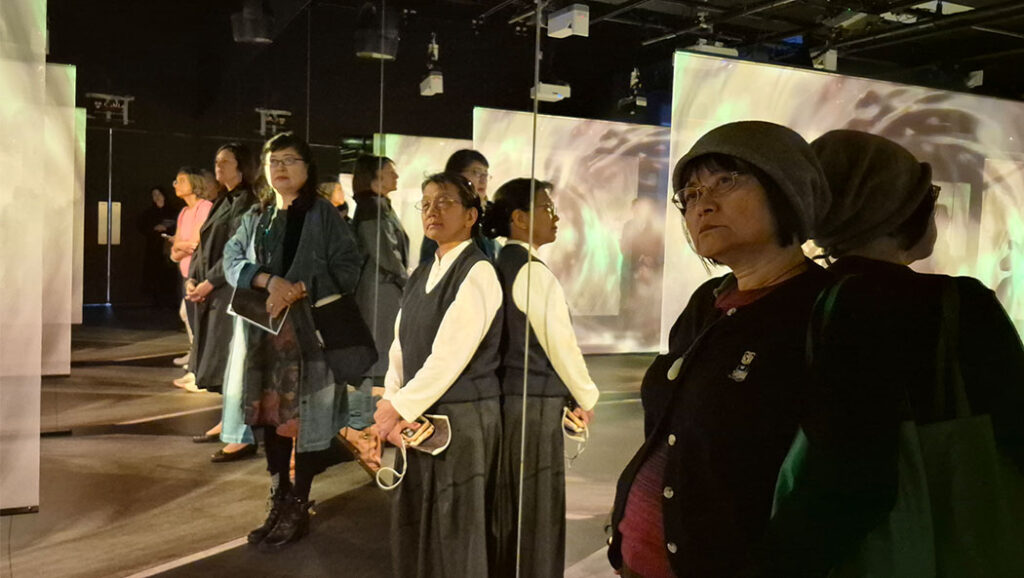
A visitor experiences the Sutra of Infinite Meanings section of Journey to Enlightenment, which combines visual and auditory elements to present sacred scripture. Photo/Jennifer Chien
McGrath drew deeper meaning from noticing that many Buddha statues at one of the sites featured in the exhibition were missing their heads. “In a way, there’s something very poetic there. It speaks to the state of Buddhism in the world today to a certain degree. In some ways, it has been decapitated. The heads are kept in these museums throughout the world. And what I see Tzu Chi doing is recapitating Buddhism, reconnecting Buddhism in ways that are truly profound.”
Yen likewise understood the exhibition’s images not only as works of art, but as vessels of Buddhist meaning, practice, and transmission.
The Buddha images we behold today are, in truth, creations of later generations shaped by their understanding and realization of the Buddhist scriptures, as well as their contemplative imagination of the Buddha’s form. From these murals and sculptures, what we truly apprehend is the boundless wisdom and compassion of the Buddha. Their significance transcends mere aesthetic appreciation; they serve as a source of spiritual awakening and a medium of compassionate education. This, indeed, reflects the One Great Cause for which the Buddha appeared in this world.
Following its U.S. debut at Harvard, where it remains on view through August 2026, Journey to Enlightenment opened on May 10 at the Jing Si Abode in Hualien, Taiwan, the spiritual home of the Buddhist Tzu Chi Foundation and the residence of Dharma Master Cheng Yen. It remains on view there through December 15, 2026. It will also be presented at the National Science and Technology Museum in Kaohsiung, where it will be on view from August 1 to November 1, 2026.
SHARE:
One dollar a day. One ripple of kindness. Thousands of lives touched.