Many Tzu Chi projects in Nepal focus on women’s empowerment, addressing persistent systemic and cultural gender inequality across political representation, economic opportunity, poverty, and access to health care and education. By investing in women, Tzu Chi uplifts entire families and communities, as women often reinvest in their children’s education, nutrition, and overall well-being. A key strategy has been providing vocational training, and Tzu Chi has launched several programs to that end.
A Sewing and Tailoring Program
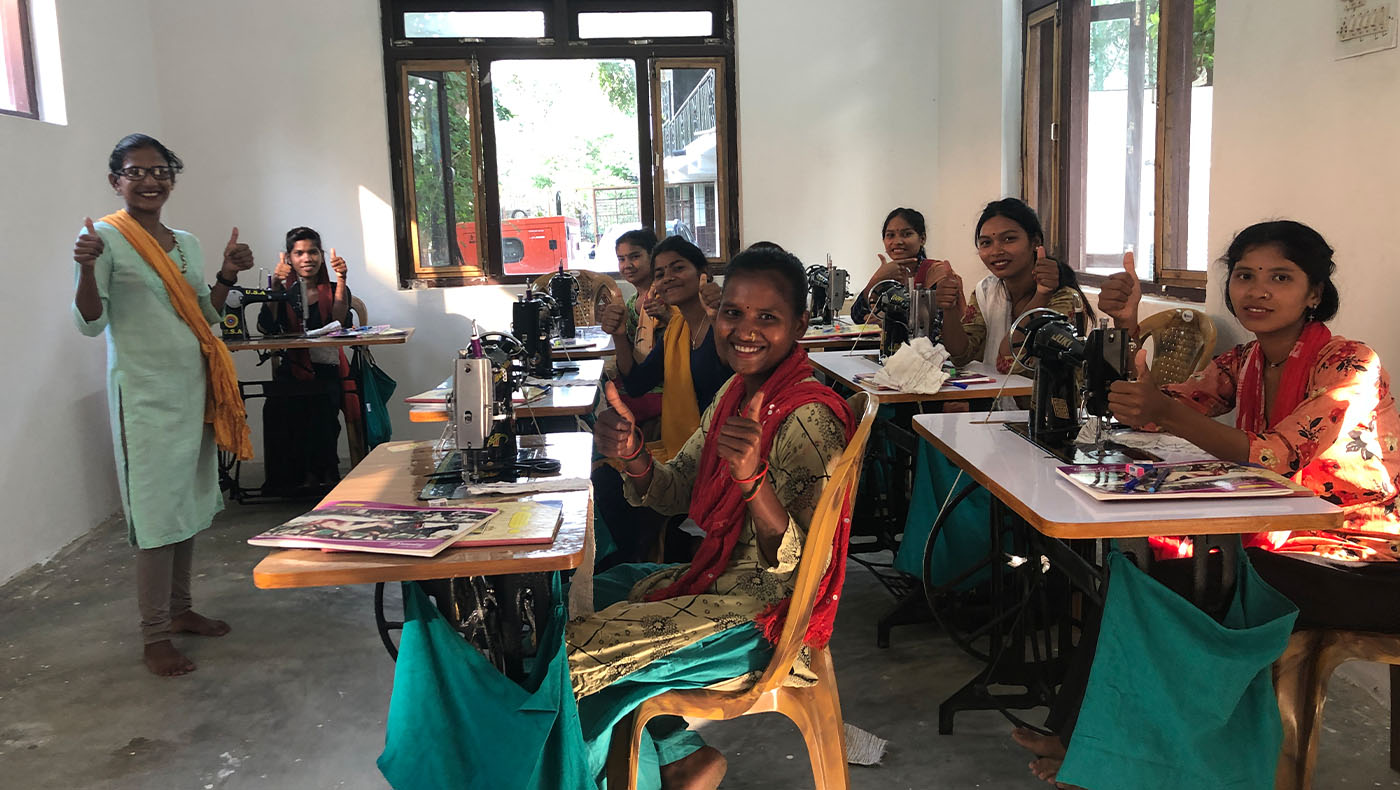
In Lumbini, job opportunities are scarce, particularly for women who often stay home due to traditional gender roles. To address this, Tzu Chi launched its Sewing and Tailoring Program on October 17, 2022, in a space adjacent to its Lumbini office. The program’s classes gradually progress from basic to advanced levels, providing women from nearby villages with vocational skills and a pathway to economic independence. By April 2023, there were 19 students enrolled.
Students in Tzu Chi’s Sewing and Tailoring Program are eager to learn, greatly appreciative of this vocational training opportunity. Photo/Unish Khyaju
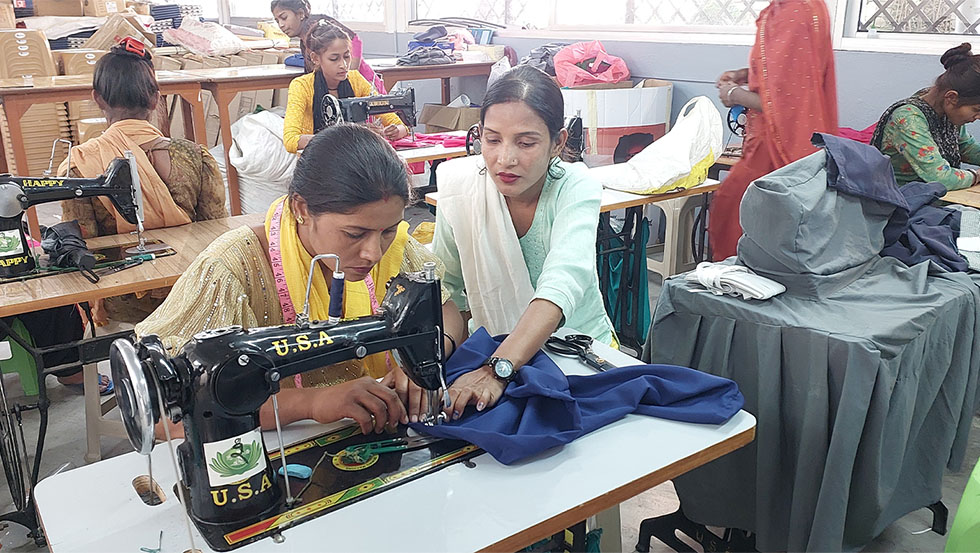
The program holds deep personal meaning for instructor Puja Khadka, who comes from a remote rural area. She supported herself through university with sewing and now shares her story to empower others. “Learning to sew changed my life, and I have not had to ask my family for money since then. Sewing skills can be used for a lifetime,” she says, knowing firsthand that these classes are about more than thread and fabric; they’re about rebuilding confidence and helping women craft new narratives for themselves and their families. Her students’ responses reflect this impact.
Among them was Anita Bhooj, a mother of two who married at 16, out of respect for her parents’ wishes. “When I first came here, I didn’t even know how to use sewing scissors, but now I can follow the teacher’s instructions to draw clothes patterns on the fabric and cut them out,” she said proudly. Bhooj also shared a future she once thought was out of reach: “After learning how to make clothes, I can sew for my mother-in-law, parents, husband, and children. I can also help my neighbors and earn some income. If I have the opportunity in the future, I hope to open a small sewing shop.”
Teacher Puja Khadka (front right) guides Anita Bhooj as she learns new skills at her sewing machine. Photo/Buddhist Tzu Chi Foundation
Another student, Poojia Dhawal, 18, who left school after 10th grade and is awaiting marriage, also hopes to open a tailoring shop to help support her family. “In addition to learning sewing, I also want to learn how to make handicrafts such as dolls,” she said. For each student, the training sparked a new sense of direction, one shaped by possibility and self-reliance.
As the first advanced class approached graduation in May 2023, Tzu Chi gifted sewing machines to help the women become self-sufficient. Volunteers also conducted home visits to assess whether students had adequate space for sewing, only to find that many lived in cramped or poorly lit homes unsuitable for such work.
This discovery inspired the idea of creating a shared sewing space. The initiative quickly took shape when the family of a Lumbini resident who had previously helped Tzu Chi sew masks during the pandemic offered a room free of charge. Volunteers then sourced additional machines, laying the ground for a community workshop.
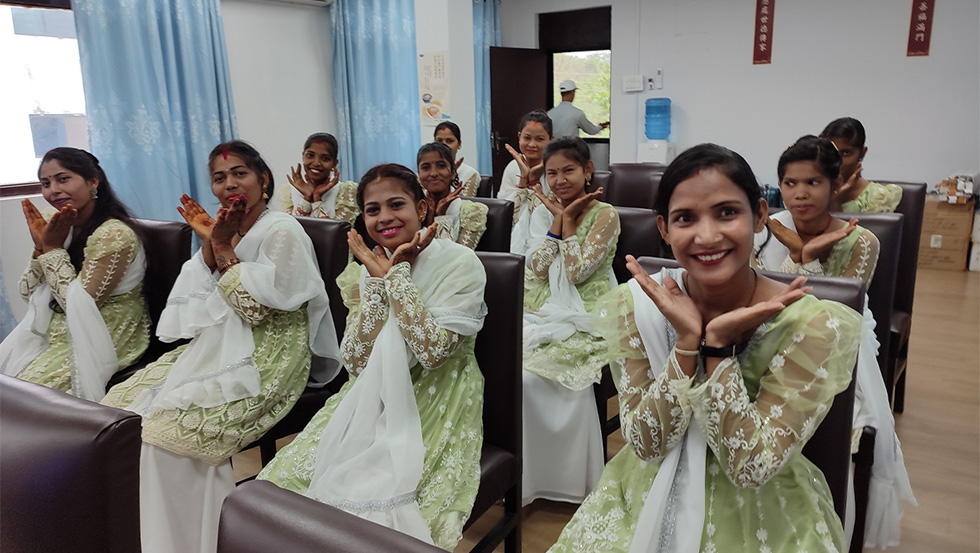
At their graduation ceremony, the first ten graduates of the Sewing and Tailoring Program beamed with pride, all wearing the matching outfits they had made themselves.
During the graduation ceremony of the first advanced sewing class on May 25, 2023, instructor Puja Khadka (right) and the ten graduates proudly wear the outfits they crafted themselves. Photo/Lihsin Li
A Soap Making Program
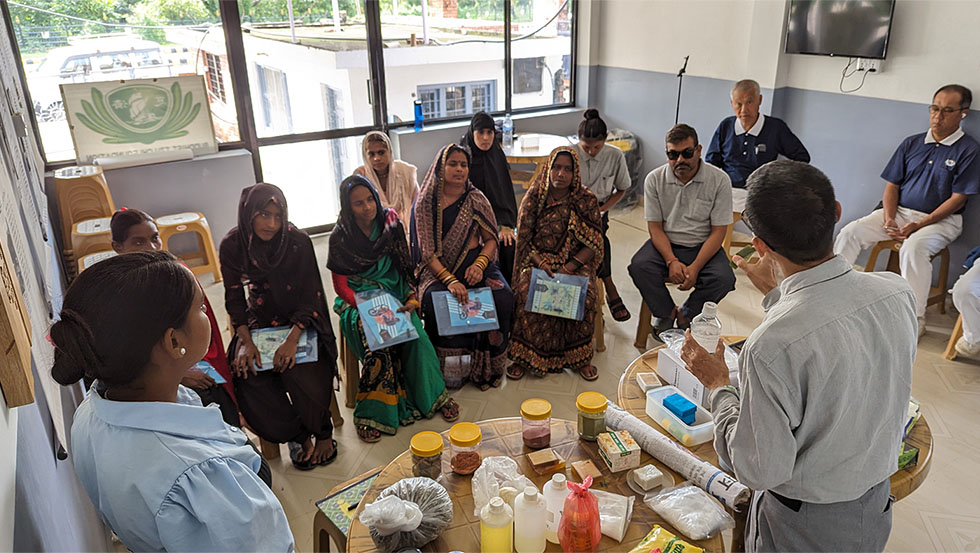
On August 21, 2023, Tzu Chi launched a ten-day Soap Making Program. Held at the Tzu Chi office in Lumbini and led by professional instructors, the course taught ten women how to produce handmade soap using both hot and cold processes, valuable skills that could help them generate income and support their families.
To select participants, volunteers conducted home visits to assess living conditions, the women’s interest in the program, and their basic numeracy skills. While some had never attended school, they expressed strong motivation to learn. “I don’t know how to do maths, but my children will teach me,” one said. “It doesn’t matter if you don’t know how; you can still come,” a Tzu Chi volunteer replied with encouragement.
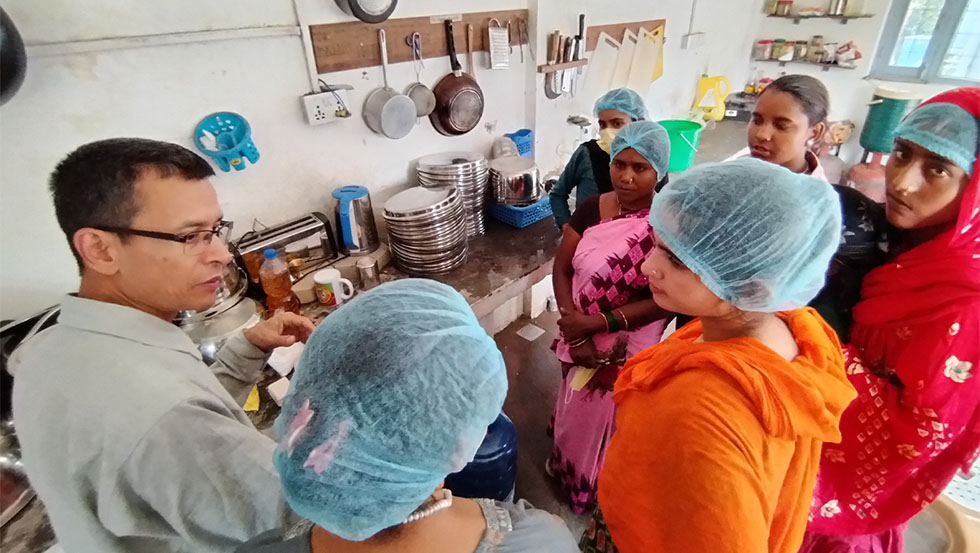
Professional teachers hired by Tzu Chi to conduct the ten-day vocational training course introduce various soap-making ingredients. Photo/Wenting Yang
During the course, the women explored how to use locally available ingredients, such as neem, an herb derived from the neem tree that grows abundantly in the region and has antibacterial properties. Other options included saffron powder, which adds color and promotes skin healing, and rose powder.
By the sixth day, the trainees were working side by side – mixing, cutting, drying, and packaging soap – and produced over 120 bars in a single day. In hot process soap making, they had learned the importance of hygiene during production, including hand washing, using face masks and hairnets, and maintaining a clean workspace to preserve the soap’s purity. In cold process soap making, they used sodium hydroxide, which can cause burns if touched directly, so gloves were required for safety.
Already wearing hairnets to maintain hygiene during production, the class readies to learn both hot and cold process soap making skills. Photo/Huiwan Huang
Tzu Chi volunteers envisioned the program not only as a livelihood opportunity, but also as a way for participants to uplift others. “We also hope that the trainees will turn their craft into a love and seize the opportunity to give while learning,” one said. That spirit was already taking shape: More than 160 bars of handmade soap produced during the course were included in the Lumbini office’s Charity Day distributions on September 2.
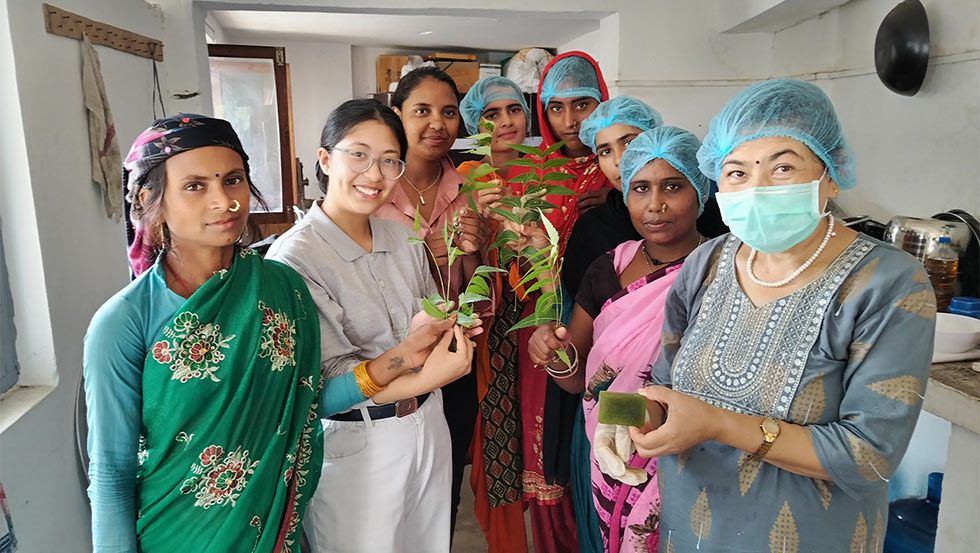
Shakya Subani (second left), the community volunteer leading the Soap Making Program project, and trainees display a soap bar alongside neem leaves used as an ingredient for their antibacterial properties. Photo/Huiwan Huang
A Knitting Work Program
Tzu Chi also introduced a Knitting Work Program in villages across Lumbini Province in 2023, beginning in Manaora and later expanding to Khambhe. Through the initiative, women, some from extremely poor or marginalized backgrounds, could earn wages by making wool hats for Tzu Chi’s winter distributions. In fact, the hats would initially benefit families affected by the magnitude 5.6 earthquake that struck western Nepal on November 3, 2023.
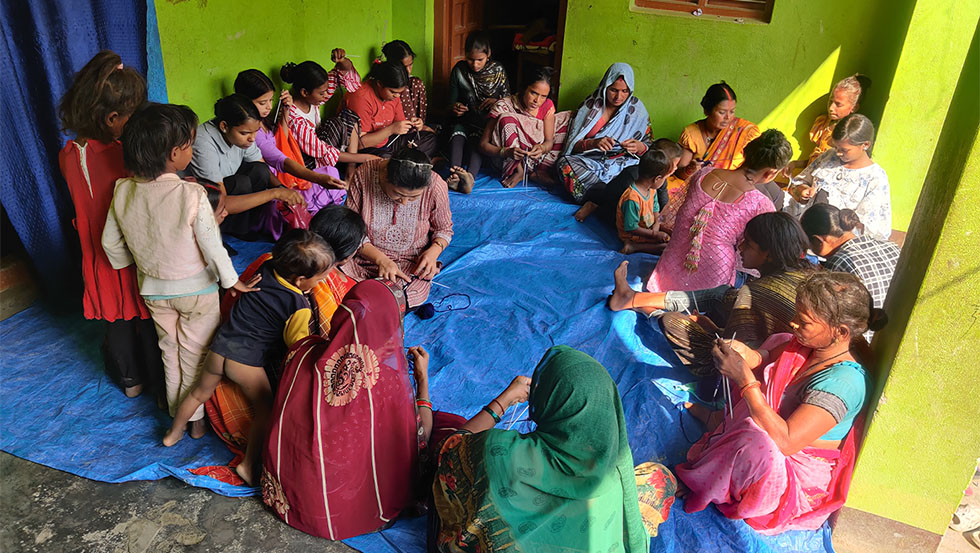
Village women learn how to knit wool hats for Tzu Chi’s winter distributions and disaster relief, earning wages while participating in this Knitting Work Program. Photo/Raj Kumar
By December 21 in Manaora, 67 women were already engaged in the program, with new groups continuing to join. When training sessions launched in Khambhe, 52 women participated, and interest was growing in other villages, signaling strong potential for expansion.
Each participant used her earnings to meet urgent household needs. Since it was wheat planting season, Urmila gave her husband the money to buy gasoline for the irrigation pump and fertilizer. “I can now contribute to the household expenses. I no longer need to worry about being poor and constantly seeking others’ charity,” she said gratefully.
Another participant, Anokha Gosai, used her income to begin repaying debts from her daughter’s dowry. Others used their wages for health expenses. “Since my health is not good, with the money I can buy medicine from the pharmacy,” one woman shared.
During visits to the villages, Tzu Chi volunteers encountered members of the local begging community who initially resisted the idea of work. But the team remained committed to offering alternatives to inherited roles. “These are the very people we aim to transform, to break the cycle of generations being beggars, to free them from the shackles of hereditary caste systems. We need to be uninvited teachers, even in the face of rejection and hesitation, and press forward without retreat,” explained Tzu Chi volunteer Houncheang Ng.
These empowering vocational training and income-earning programs reflect Master Cheng Yen’s Jing Si Aphorism: “The more you do and learn, the more you can do and gain.” Beyond livelihood, they foster solidarity, confidence, and purpose within the villages.
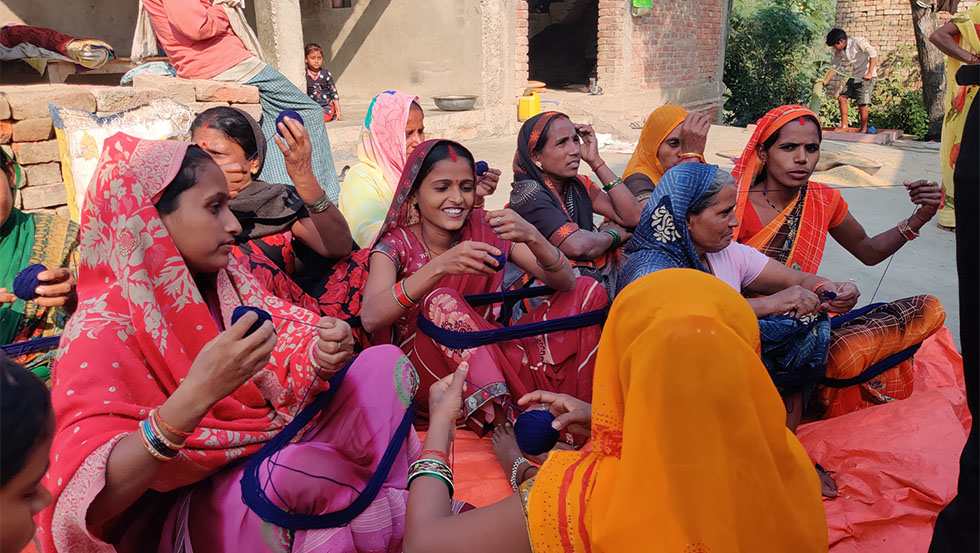
“Being able to knit woolen hats is the happiest part of my day because it allows me to be with everyone,” one Knitting Work Program participant said, highlighting the joyful social aspect of the activity. Photo/Raj Kumar
From livelihood programs and access to health care to educational support for girls, Tzu Chi’s work in Nepal consistently emphasizes women’s empowerment. These efforts align with Goal 5: Gender Equality of the United Nations Sustainable Development Goals (SDGs), adopted in 2015.
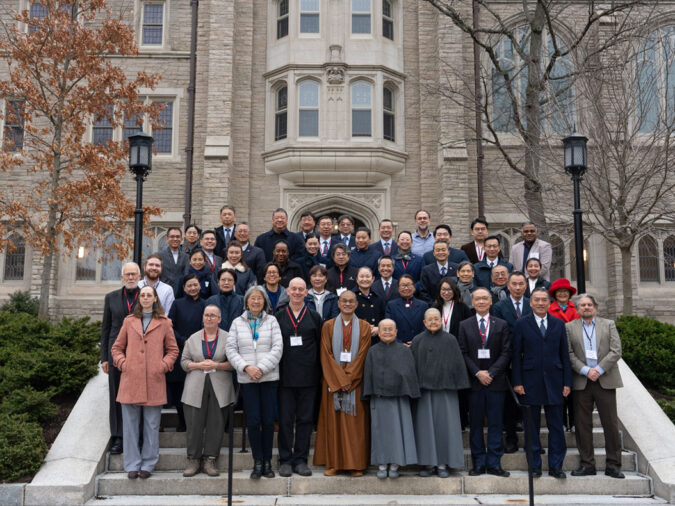
As an NGO in Special Consultative Status with the United Nations Economic and Social Council since 2010, the Buddhist Tzu Chi Foundation highlighted its women-centered initiatives in both Nepal and India during the 69th Commission on the Status of Women (CSW69), held in New York City in March 2025.