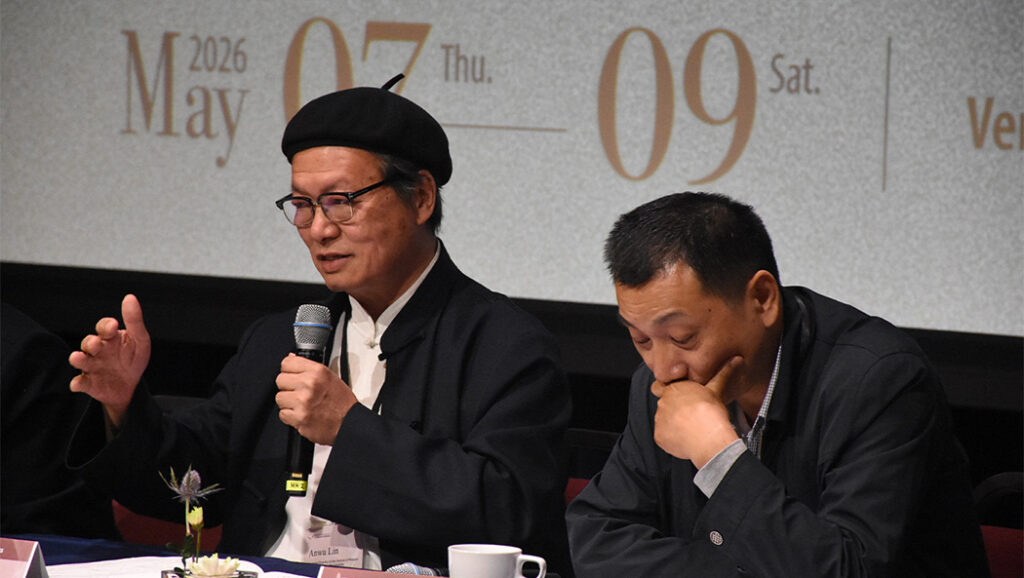
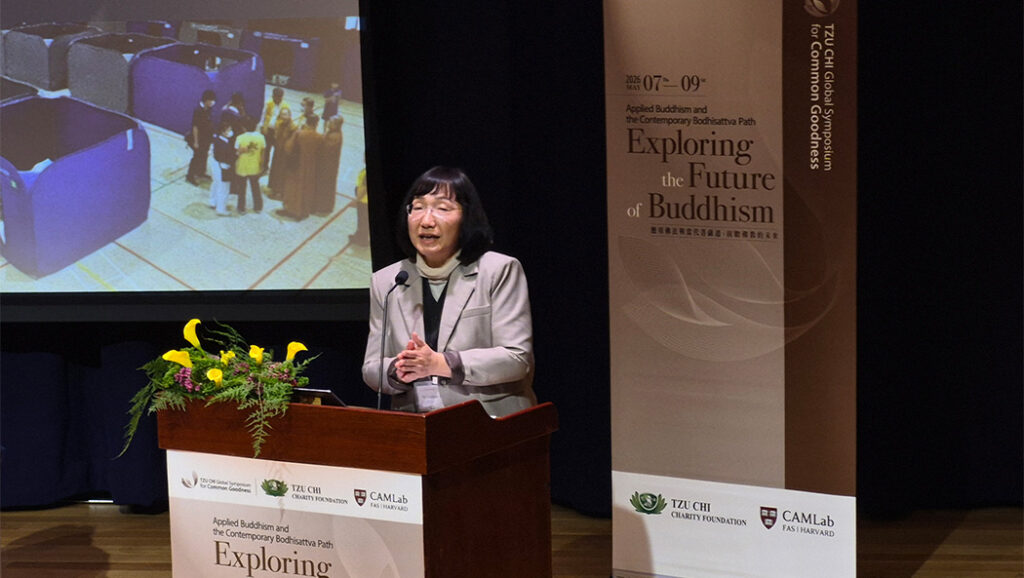
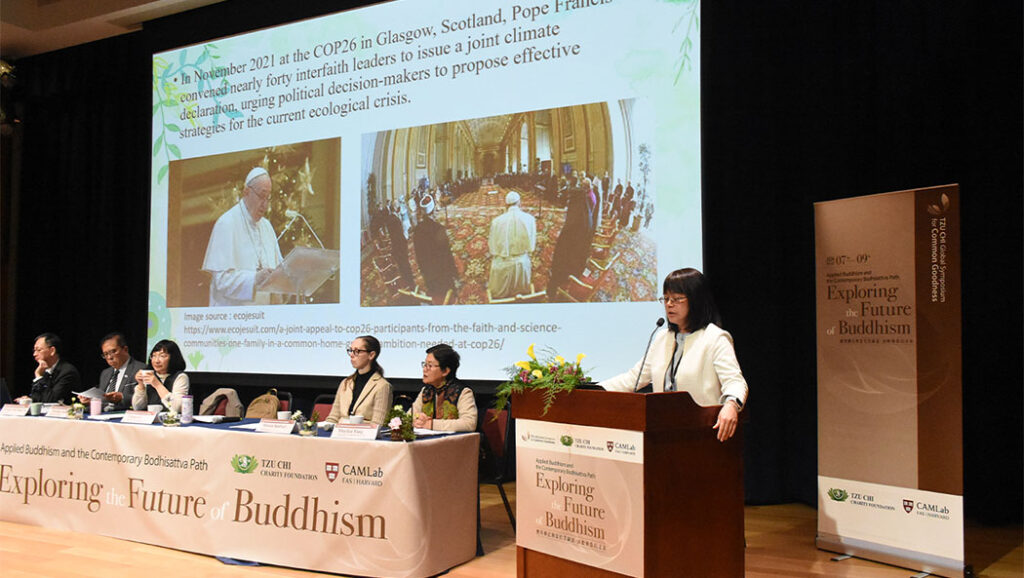
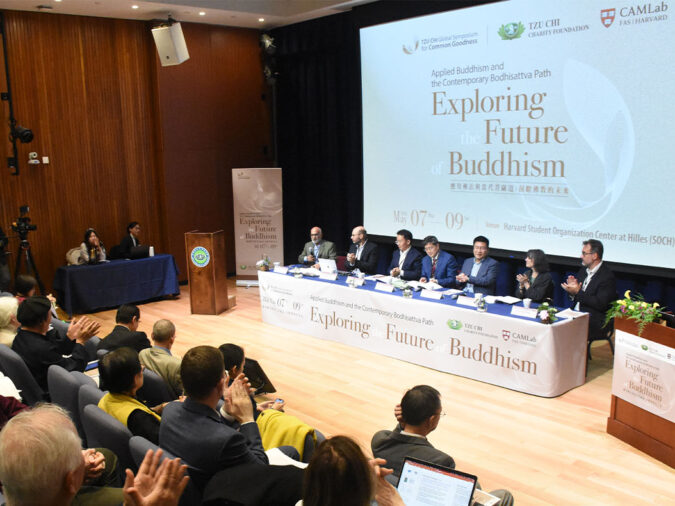
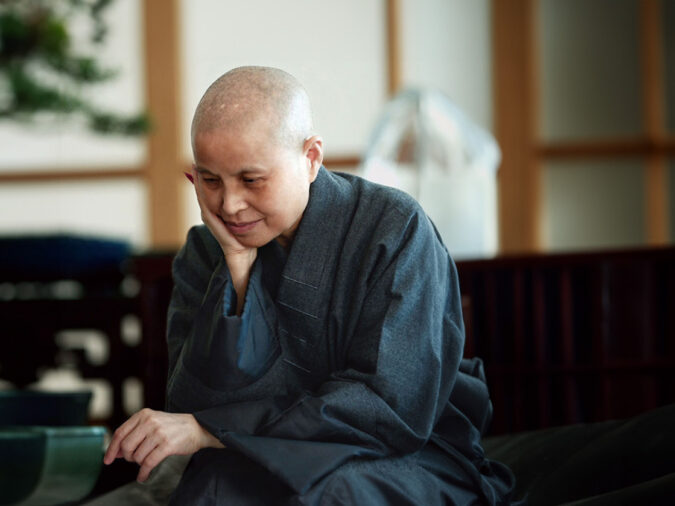
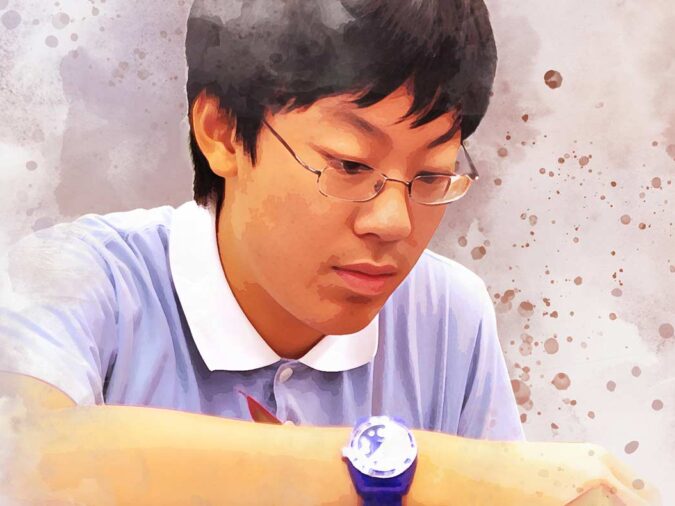
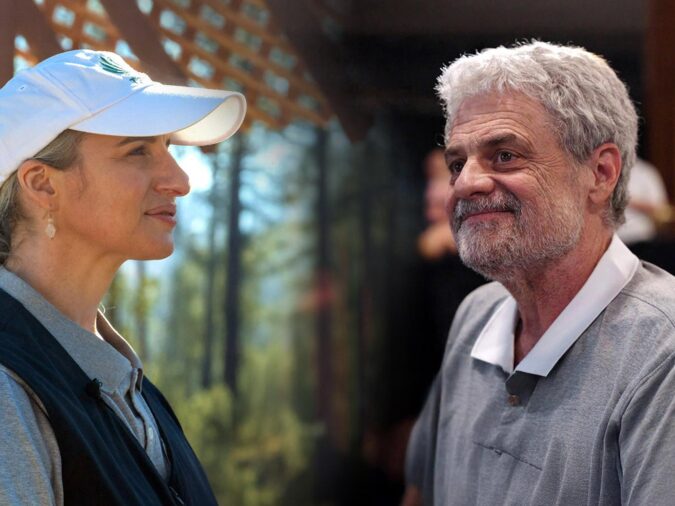
Having traveled from Taiwan to the United States for the 2026 Tzu Chi Global Symposium for Common Goodness at Harvard University, presenters Anwu Lin (second right) and Pei-Ying Lin (right) exchange ideas with monastics between sessions on May 8, when panels focus on Venerable Dharma Master Cheng Yen’s philosophy and leadership. Photo/Wendy Tsai
SHARE
I have often heard Dharma Master Cheng Yen teach that many classical sutras begin with the phrase, ‘Thus have I heard.’ In our time, under her guidance, the living sutra should be expressed as, ‘Thus have I done.’ Only by truly practicing the Bodhisattva path can we fulfill the profound meaning of bringing the Dharma into everyday life and manifesting as Bodhisattvas in this world.
At the heart of Venerable Dharma Master Cheng Yen’s teachings, and the Tzu Chi School of Buddhism and Jing Si Dharma Lineage she established, ancient Buddhist teachings are not only studied or recited, but applied through active service that relieves suffering, protects the environment, and responds to the needs of our time. This second article in the series covering the 2026 Tzu Chi Global Symposium for Common Goodness at Harvard University in Cambridge, Massachusetts, follows the panels and discussions centered on the theme “Venerable Cheng Yen’s Philosophy and Leadership,” tracing how her teachings continue to shape Buddhist thought, humanitarian action, religious community, and visions of Buddhism’s future.
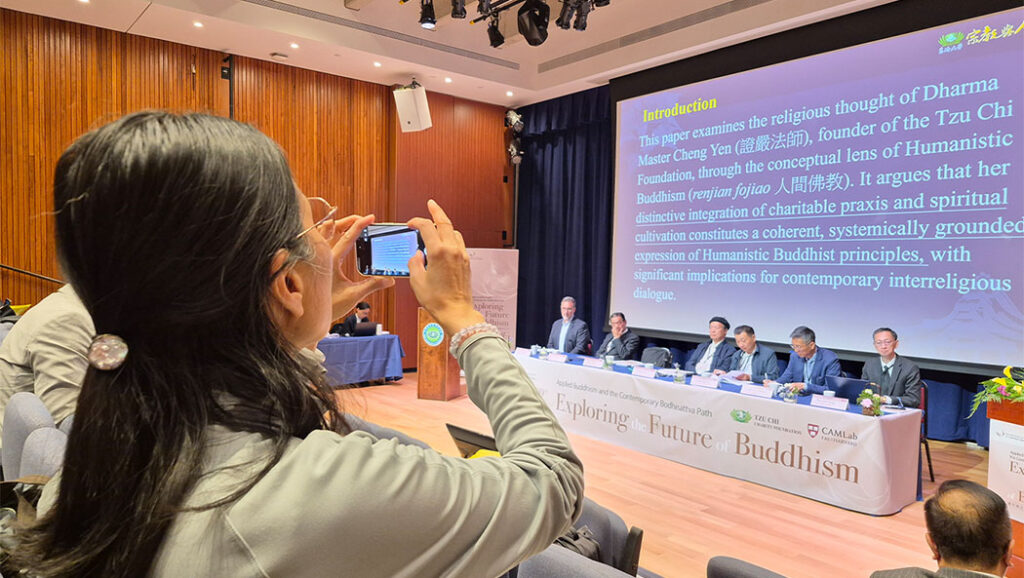
Participants follow presentations on Dharma Master Cheng Yen’s philosophy and leadership closely, with some photographing slides to study later. Photo/Wendy Tsai
The Lotus Sutra and the Thought of Master Cheng Yen
Rey-Sheng Her, Deputy CEO of the Buddhist Tzu Chi Charity Foundation and Convener of the Tzu Chi Academic Committee, opened the first panel with “The Vijñapti-Mātratā Thought of Dharma Master Cheng Yen.” His talk explored how Master Cheng Yen understands Vijñapti-mātratā, or Consciousness-Only thought, as a path for transforming defilement into purity and consciousness into wisdom.
Rather than treating this Buddhist framework as a matter of inner reflection alone, Her showed how Master Cheng Yen brings it into the Bodhisattva path, where consciousness is purified through action that benefits sentient beings in the human realm. In this view, goodness is not merely moral intention, but a necessary beginning that must be guided by principle in order to become a path of transformation.
Doing good is part of being in the human world, so the human world is good for practice. As for evil, we must be proper and disciplined, and not allow ourselves to be defiled by evil. Goodness is what one should naturally do. ‘At birth, human nature is inherently good’ – one is originally meant to do good. But doing good alone is still not enough; this is goodness mixed with impurity, because we still do not understand principle. Because principle is not yet understood, it is easy to be led astray by temptation.
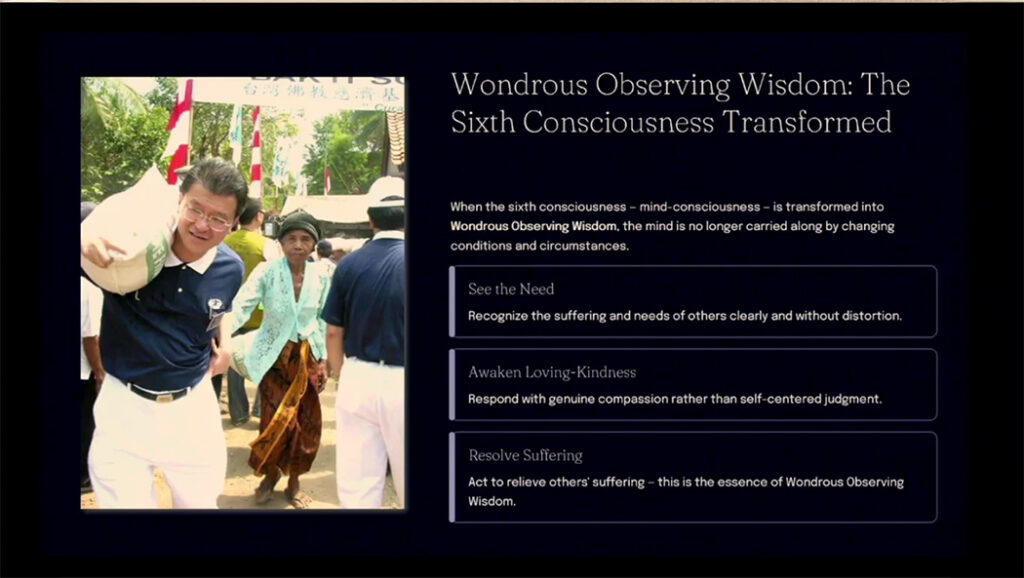
Rey-Sheng Her shows how Dharma Master Cheng Yen interprets the transformation of the sixth consciousness into Wondrous Observing Wisdom as a path from perceiving suffering to relieving it through compassionate action. Presentation Slide/Rey-Sheng Her
Her then moved carefully through the Consciousness-Only framework, outlining its eight layers. The first five consciousnesses correspond to the senses; the sixth, or mind-consciousness, interprets what the senses perceive; the seventh is associated with the sense of self; and the eighth, or storehouse consciousness, holds karmic seeds. In Master Cheng Yen’s interpretation, these layers can be transformed into wisdom through Bodhisattva practice.
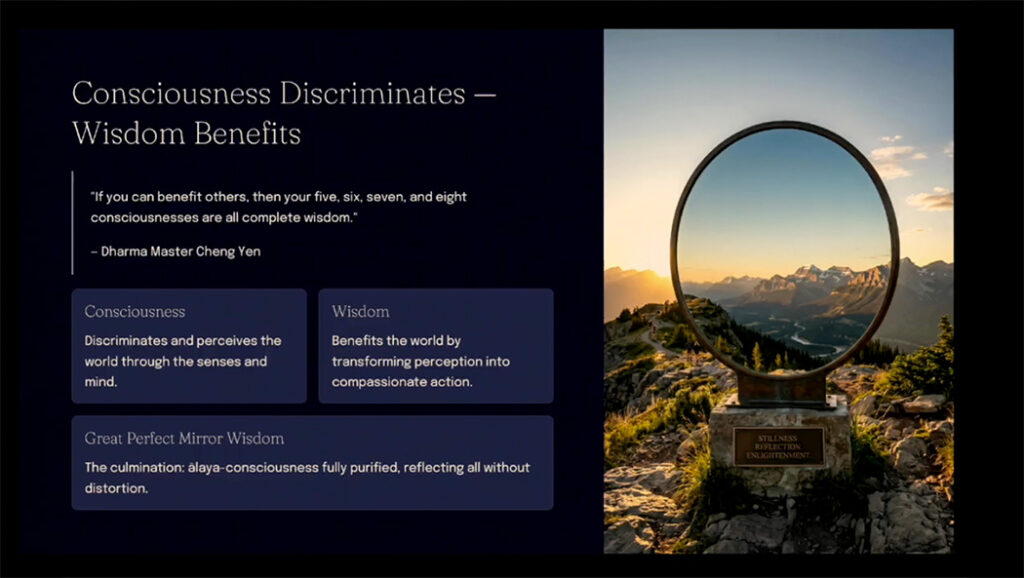
“Use your five consciousnesses to benefit others, not to attach to the defilements of the secular world. The eye beholds the suffering of beings. The ear hears the voices of beings. The nose perceives the conditions of beings. The mouth speaks wondrous and wholesome words, and the body performs good deeds to benefit sentient beings. In our sixth consciousness, our mind-consciousness, we inspire, help, and put things into practice,” Her explained. “Dharma Master Cheng Yen uses Consciousness-Only philosophy to explain the practice of benefiting others, and her exposition is very complete. Consciousness can discriminate in this world, but wisdom can benefit this world.”
Rey-Sheng Her outlines the progression toward Great Perfect Mirror Wisdom in Dharma Master Cheng Yen’s interpretation of Consciousness-Only thought as a path from defilement to purity and from consciousness to wisdom. Presentation Slide/Rey-Sheng Her
In “From Humanistic Buddhism to the Perspective of Religion of Dharma Master Cheng Yen,” Chien-Te Lin, Professor and Director of the Institute of Religion and Humanities at Tzu Chi University, approached Master Cheng Yen’s religious perspective through the tradition of Humanistic Buddhism. He traced this inheritance from Venerable Yin Shun, Master Cheng Yen’s spiritual mentor, who gave her the directive to work “for Buddhism and for all sentient beings.”
“From Dharma Master Cheng Yen’s point of view, charity is a kind of skillful means. The major consideration is mental purification, and wisdom cultivation is the ultimate target,” Lin explained. In this sense, giving becomes a path of mutual transformation between giver and recipient, and compassionate service an entry point into deeper spiritual cultivation.
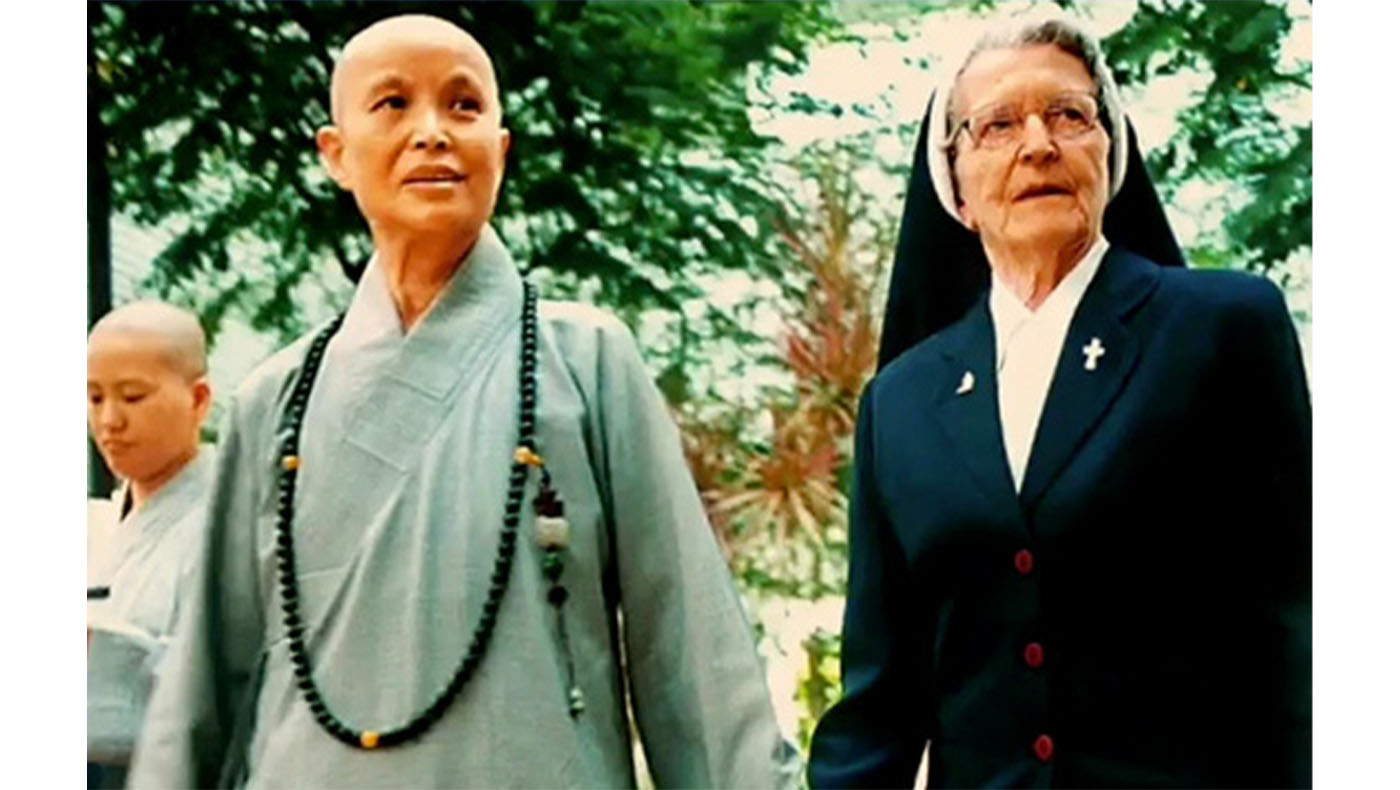
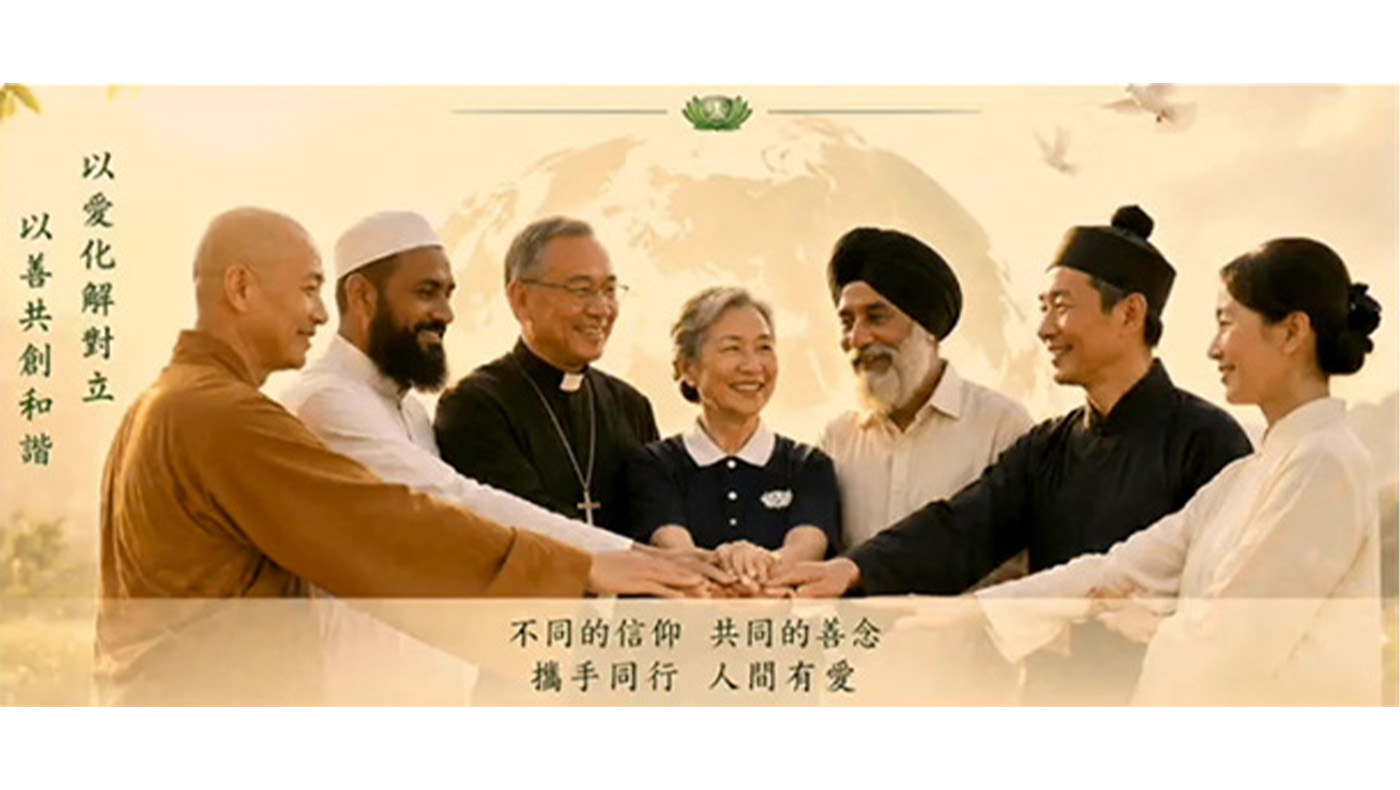
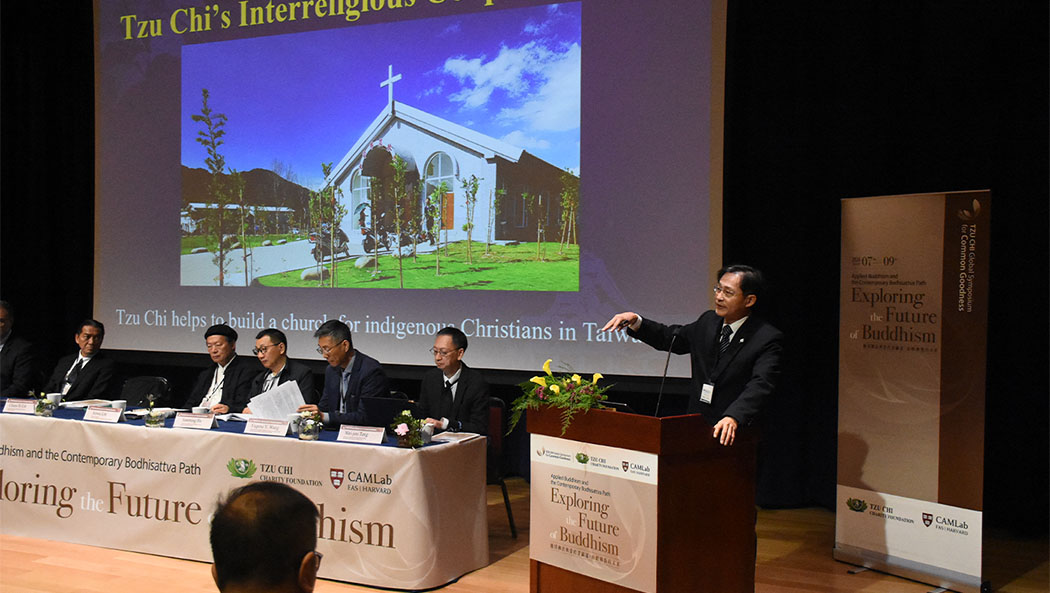
That understanding of religion also opens Tzu Chi’s work to people of different faiths. Drawing on examples of Catholic, Muslim, and other religious leaders and practitioners who have worked with Tzu Chi, Lin showed how Great Love becomes a shared moral ground rather than a boundary marker. Because Master Cheng Yen understands religion in terms of life’s guiding purpose and education for living, this cooperation is not incidental to Tzu Chi’s identity, but part of its understanding of religious practice. “There’s no difference among religions. When we have an open heart, all religions are the same. But when our minds are narrow, they appear different,” Lin said, citing Master Cheng Yen’s teaching.
Chien-Te Lin shows how Master Cheng Yen’s understanding of religion opens Tzu Chi’s charitable practice to interfaith collaboration and shared service. Presentation Slides/Chien-Te Lin
Chien-Te Lin shows how Master Cheng Yen’s understanding of religion opens Tzu Chi’s charitable practice to interfaith collaboration and shared service. Presentation Slides/Chien-Te Lin
Chien-Te Lin presents “From Humanistic Buddhism to the Perspective of Religion of Dharma Master Cheng Yen.” Photo/Wendy Tsai
Anwu Lin, Professor Emeritus at Tzu Chi University in Hualien, Taiwan, presented “The Integration of Non-Arising and Ever-Renewing Life: Tzu Chi’s Practical Interpretation of the Sutra of Infinite Meanings – An Approach via the Three-State Theory of Being and the Synthesis of Confucianism and Buddhism.” He examined Tzu Chi’s practice through the three states in the theory, namely Source, Manifestation, and Actualization, while also considering how its approach brings together Buddhist and Confucian ideals.
At the center of his presentation was the eight-line verse from the Sutra of Infinite Meanings that Master Cheng Yen frequently refers to in her teachings:
With minds tranquil and clear, vows vast as the universe, they remain unwavering for countless kalpas. Infinite Dharma doors readily appear before them. They attain great wisdom and completely understand all Dharma.
Lin presented this verse as a complete sequence of spiritual cultivation. In his framework, the Jing Si Dharma Lineage embodies the realization of the Source, the Tzu Chi School of Buddhism represents the Actualization of practical resolve, and Tzu Chi’s Four Missions demonstrate the Manifestation of infinite Dharma doors, allowing compassion to be expressed concretely while guiding practitioners toward great wisdom and understanding of all Dharma.
Lin also explored how Tzu Chi brings Buddhist compassion together with Confucian moral responsibility. Rather than limiting care to family, community, or kinship ties, Tzu Chi extends that care outward through unconditional loving-kindness. “Tzu Chi provides a comprehensive path from ‘mental cultivation’ to ‘social praxis,’ and from ‘individual awakening’ to ‘collective healing,’ ultimately advancing toward this ideal of Great Love.” In this way, he linked Tzu Chi’s practice back to the Sutra of Infinite Meanings, presenting its missions as a contemporary way to cultivate goodness and nurture awakening through compassionate action.
Anwu Lin (left) participates in the discussions following the panel, with fellow presenter Jianming He seated beside him. Photo/Wendy Tsai
In “The Buddhist Nature and Universality of the Tzu Chi School of Buddhism Established by Dharma Master Cheng Yen Based on the Lotus Sutra,” Jianming He, Professor of Buddhism and Religious Theories at the School of Philosophy, Renmin University of China, traced Master Cheng Yen’s deep connection with the Lotus Sutra, from the beginning of her Buddhist practice to her understanding of the text as the spiritual foundation and action guide for Tzu Chi’s missions.
In Master Cheng Yen’s own account, her connection with the Lotus Sutra grew out of her search for how to fulfill the instruction she received from her mentor, Venerable Yin Shun, to work “for Buddhism and for all sentient beings.” Jianming He quoted her directly. “With so many texts in the Buddhist canon, which direction should I take? I chose the Lotus Sutra. The principles of the Lotus Sutra are truly profound, yet the logic within it perfectly aligns with the concept of Bodhisattvas going amongst the people.” That recognition laid the foundation for Master Cheng Yen’s philosophy and leadership. “From the very beginning, I felt that to lead people on the Bodhisattva path, I should not preach overly profound theories to them; they just need to walk the path and do the work.”
He also turned to the distinctive character of the Tzu Chi community, which he described as “simultaneously a sangha, a religious order, and a social organization.” Its guiding principle of “inner cultivation of sincerity, integrity, faith, and honesty,” combined with its “external practice of loving-kindness, compassion, joy, and equanimity,” links personal purification with doing good in the world. Through this structure, Tzu Chi remains grounded in Buddhist practice while offering values that can resonate across Buddhist lineages as well as different religions, cultures, and societies.
⊚ Reflections on the Presentations
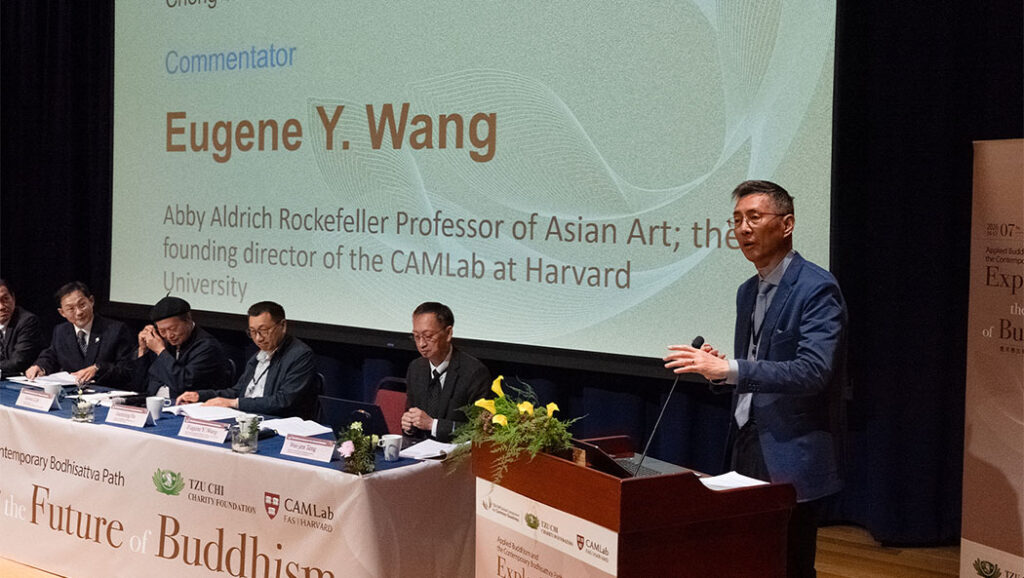
Following the presentations, the commentators offered reflections on the larger implications of the papers. Eugene Yuejin Wang, Abby Aldrich Rockefeller Professor of Asian Art at Harvard University and Founder and Director of the Cognitive Aesthetic Media Lab in Harvard’s Faculty of Arts and Sciences, responded by shifting the discussion from Master Cheng Yen as a philosopher to her significance as an extraordinary reader of the Lotus Sutra.
Following the panel on “The Lotus Sutra and the Thought of Master Cheng Yen,” Eugene Yuejin Wang offers commentary on the broader implications of the presentations. Photo/Daniel Ferrara
“Many people read through the Lotus Sutra. But Master Cheng Yen probably mattered more in human history than other readers, because we all know what happened decades and decades later, what the Tzu Chi Foundation has blossomed into, what organization it has become, and what… the kind of whole world that it built,” Wang said. His point was not simply that Master Cheng Yen interpreted the Lotus Sutra, but that her reading generated a living world of response, practice, and dialogue. Through her, the scripture became a catalyst for action far beyond the page.
Wang pointed to the residents of a Hansen’s disease community who heard Master Cheng Yen’s call to help build a hospital in Hualien and began donating their own savings. “The key there is that Master Cheng Yen instilled in them a sense of dignity. I think that was one of the keys, the human dignity that such giving could restore in people,” he said. In this example, the meaning of the Lotus Sutra was not exhausted by doctrine, cosmology, or the stories within the text, but emerged through what it enabled people to do in the world. “It’s not that the text gets translated into actions. It’s more like the text gives certain cues. You act on certain cues and go on to do something extraordinary.”
Weijen Teng, Professor and Dean of the Department of Buddhist Studies at Dharma Drum Institute of Liberal Arts, returned to a broader question running through the four papers: How can engaged Buddhism remain spiritually grounded while responding concretely to suffering in the world? He cautioned against reducing Buddhism to a secular humanistic ethic, while also avoiding a metaphysics too distant from lived suffering. Master Cheng Yen’s achievement, Teng observed, was that she had already embodied an answer before scholarship had fully developed the vocabulary to describe it.
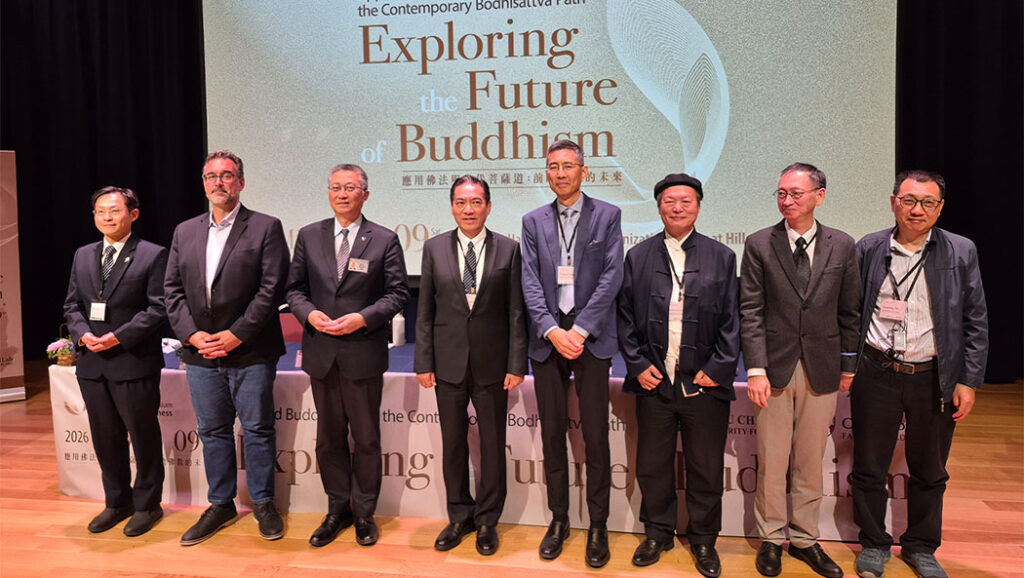
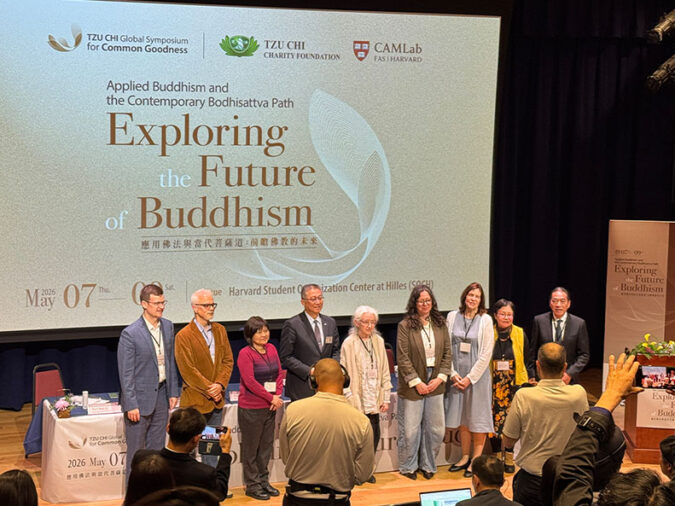
Freeman Su, Executive Director of Tzu Chi USA’s Northeast Region, joins the moderator, presenters, and commentators for a group photo following the panel “The Lotus Sutra and the Thought of Master Cheng Yen.” From left: Chien-Te Lin, Justin Ritzinger, Freeman Su, Rey-Sheng Her, Eugene Wang, Anwu Lin, Wei-jen Teng, and Jianming He. Photo/Wendy Tsai
The next group of presentations moved from the philosophical grounding of Tzu Chi’s practice to its humanitarian reach in the world, with speakers considering how Tzu Chi’s work reshapes ideas of security, compassion, ecological responsibility, and volunteer formation through a Buddhist practice of service.
Global Humanitarianism and Engaged Buddhism
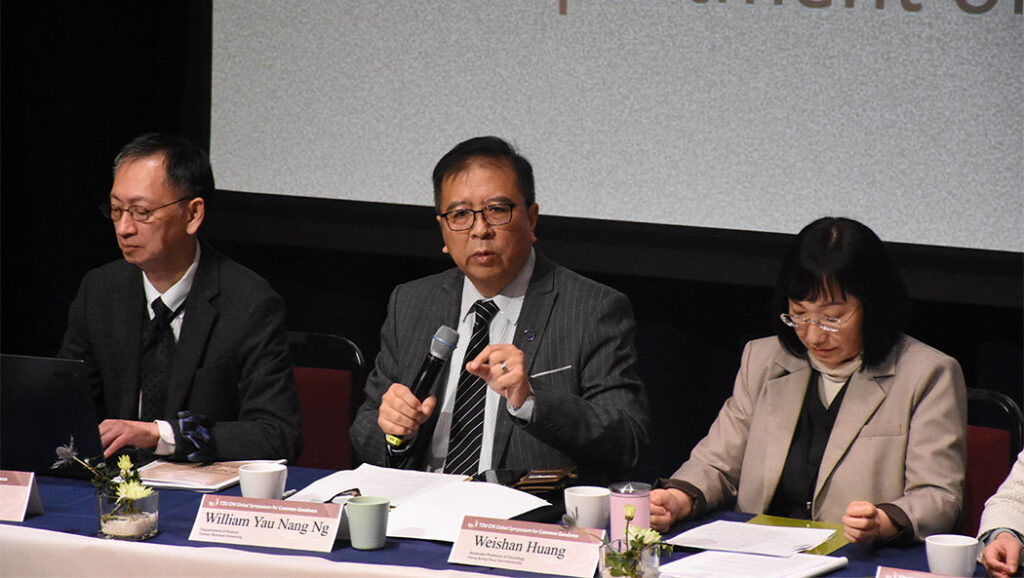
William Yau Nang Ng, of the Department of History at National Taiwan Normal University, opened the panel with “Rethinking Human Security, Response, Relationality, and the Case of Tzu Chi,” turning the discussion toward Tzu Chi’s humanitarian practice. Beginning with the framework of human security, which shifts attention from state security to the vulnerability, dignity, and survival of human beings, Ng presented Tzu Chi as more than a functional non-governmental actor within global humanitarian systems. Rather, he proposed the concept of “Tzu Chi–style service Buddhism,” a form of religiously grounded service that brings physical care, emotional support, and spiritual reassurance together.
William Yau Nang Ng presents “Rethinking Human Security, Response, Relationality, and the Case of Tzu Chi.” Photo/Wendy Tsai
Ng illustrated this through Tzu Chi’s work after the 2004 tsunami in Aceh, Indonesia. Some local villagers initially took part in rebuilding efforts as paid workers, but later returned without payment. “Yesterday we worked for you. Today, we work together,” one villager shared.” For Ng, that movement from receiving help to joining in service revealed how humanitarian response can become relational and transformative. “Relationship happens over time and those who once receive help may begin to help others. In this moment, from being helped to helping, dignity is not only protected but gradually restored and strengthened.”
In Ng’s view, this is how Tzu Chi expands the usual language of human security. Service is not only intervention or provision, but “a relational practice of care, accompaniment, and empowerment.” He distinguished between the “common good,” understood in terms of institutional protections necessary for public life, and “common goodness,” an ethical condition generated through ongoing relationships of response. “Compassion is not only something we affirm, it is something we do,” he said. “And it is through doing, through repeated acts of response that relationships are strengthened and dignity gradually restored.”
Weishan Huang, of the Department of Sociology at Hong Kong Shue Yan University, focused on the material and organizational dimensions of relief work in “Infrastructuring Compassion: The Moral Economy of Tzu Chi’s Humanitarian Relief.” Her study looked at how Buddhist compassion becomes practical disaster response through volunteers, professional staff, technologies, documentation, relief supplies, and organizational protocols.
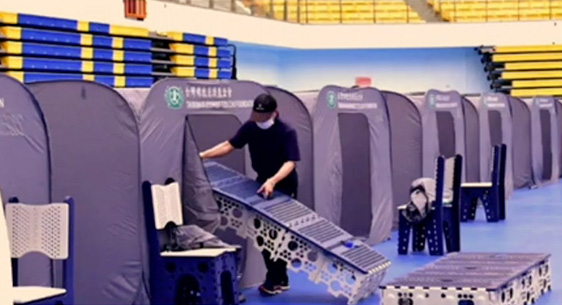
Huang illustrated this through the development of Tzu Chi’s pop-up bed for disaster survivors. After seeing a relief photo of a blind mother sitting on the ground beside floodwater after a disaster, Master Cheng Yen instructed Tzu Chi’s engineering staff to design a bed that could be quickly produced, transported, assembled, and used safely in disaster zones, setting in motion a complex “infrastructuring” process.
Weishan Huang uses Tzu Chi’s pop-up bed to show how compassion can take material form through design, logistics, and disaster relief. Presentation Slide/Weishan Huang
Weishan Huang presents “Infrastructuring Compassion: The Moral Economy of Tzu Chi’s Humanitarian Relief.” Photo/Wendy Tsai
“The concept of ‘infrastructuring’ emphasizes that the pop-up bed innovation is not simply a technical fix but the outcome of a complicated network: compassion, engineers, materials, time, transportation, and survivors all co-produce the infrastructure. Compassion is translated into material form through the network, showing that humanitarian infrastructure is a relational achievement rather than a static artifact,” she explained. Relief blankets made from recycled PET bottles, instant rice, water filters, and temporary beds are therefore not only functional objects, but part of a wider moral economy of care, one in which compassion is embedded in systems of relief rather than expressed only as feeling or intention.
Yining Liu, Assistant Professor in the Humanities and Social Sciences Cluster at Dharma Drum Institute of Liberal Arts, addressed Tzu Chi’s environmental advocacy in “Eco-Bodhisattvas in the Anthropocene: Generational, Gendered, and Transnational Dimensions of Tzu Chi’s Climate Activism.” Placing Tzu Chi within broader conversations on religion, ecology, and climate change, Liu asked how Buddhist organizations can respond to the ecological crisis not only through ideas, but through public action.
Yining Liu presents “Eco-Bodhisattvas in the Anthropocene: Generational, Gendered, and Transnational Dimensions of Tzu Chi’s Climate Activism.” Photo/Wendy Tsai
Liu’s case study centered on Tzu Chi’s expanding transnational climate action network. Since Tzu Chi began its environmental mission in Taiwan in 1992, its work has grown from localized recycling infrastructure and resource recovery into global advocacy connected with the United Nations Sustainable Development Goals, the United Nations Framework Convention on Climate Change, and the annual Conference of the Parties, known as COP. Within that network, Liu highlighted women’s leadership and youth participation as two important channels through which Tzu Chi carries ecological commitments across generations, communities, and international platforms.
Seen this way, Tzu Chi’s work is not only environmental outreach, but a form of Buddhist public engagement in the age of climate change. “The religious discourse and environmental practices underlying Tzu Chi’s United Nations ecological advocacy serve as a significant case study for understanding how Buddhism addresses climate change and responds to the Anthropocene. Furthermore, they highlight the ‘ecological turn’ within Asian Buddhism and the distinctive characteristics of Anthropocene Buddhism,” Liu noted.
Yining Liu presents “Eco-Bodhisattvas in the Anthropocene: Generational, Gendered, and Transnational Dimensions of Tzu Chi’s Climate Activism.” Photo/Wendy Tsai
Jiangang Zhu, of the Department of Sociology at Zhejiang University, examined Tzu Chi’s volunteer formation in mainland China in “Tzu Chi Volunteers in Mainland China: Humanistic Buddhism, Moral Discipline, and the Making of Volunteer Spirit.” Focusing particularly on Guangzhou, Zhu asked why people in a highly urbanized, market-oriented, and individualized society continue to devote themselves to long-term voluntary service.
Zhu located the answer in the way Tzu Chi forms volunteers within an organized moral community. “Tzu Chi is not a loose network of helpers who occasionally come together for good deeds. It is an organized moral community. Volunteers are drawn into a dense web of relationships, stages of advancement, collective activities, and shared symbols,” he explained. “Through these mechanisms, volunteers gradually come to identify themselves as ‘Tzu Chi people,’ a shared identity that strengthens organizational recognition, emotional attachment, and collective belonging.”
Zhu described this identity formation, which encompasses discipline, moral edification, and repeated practice, in concrete terms. “Volunteers learn how to speak, how to move, how to dress, how to regulate emotion, and how to conduct themselves in public and collective settings. These are not random details. They are technologies of formation,” he said. Volunteer spirit, in this sense, is not confined to formal service events, but becomes part of everyday conduct, a way of turning charitable work into self-cultivation and social belonging.
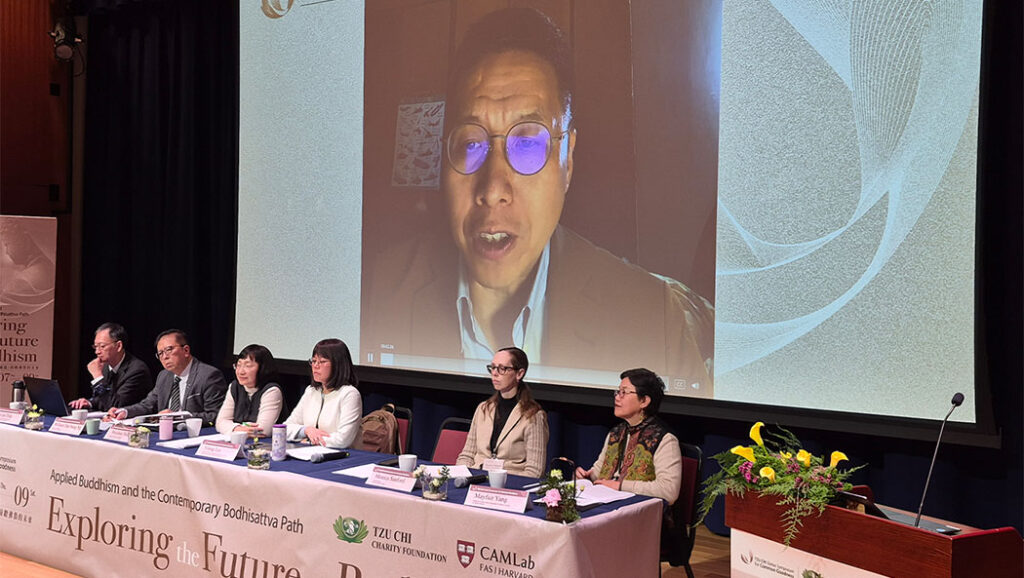
Jiangang Zhu presents “Tzu Chi Volunteers in Mainland China: Humanistic Buddhism, Moral Discipline, and the Making of Volunteer Spirit” via prerecorded video. Photo/Wendy Tsai
⊚ Reflections on the Presentations
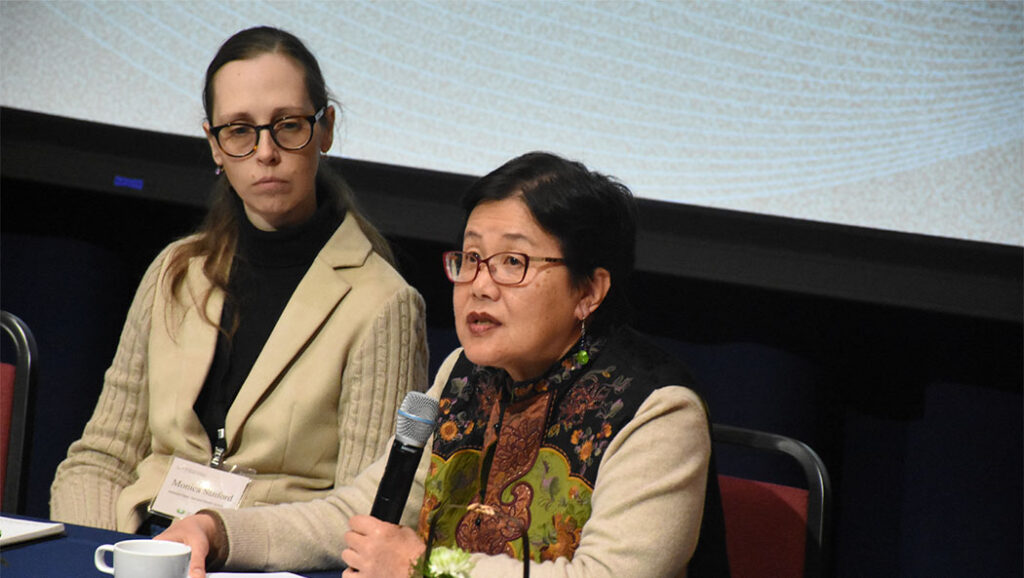
Following the presentations, commentators Monica Sanford, Assistant Dean at Harvard Divinity School, and Mayfair Yang, Professor of East Asian Languages and Cultural Studies at the University of California, Santa Barbara, drew out broader questions raised by the papers.
Sanford returned to the theme of relationship, reflecting on how modern convenience can weaken the reciprocal ties through which people once helped one another directly. “One of the things that Tzu Chi does is it restructures, it kind of restitches the fabric of society through re-establishing relationality.” She also raised a translation question central to the section, asking how karuṇā can be rendered as compassion without losing its action-oriented force. “From the Buddhist perspective, I’ve always understood karuṇā to be very deeply embedded in the idea of action just as Master Cheng Yen describes it. For there to be karuṇā there must be a willingness and an ability to take action to alleviate suffering.”
Yang placed the discussion within larger questions of secular institutions, state power, environmental crisis, and the material systems through which values take form. Huang’s presentation, in particular, led her to consider how Buddhist ethics can shape even the design of disaster relief products. “The material things that are produced are actually in accordance with the ideals and ideas of Buddhist philosophy.” In that sense, infrastructure need not stand in opposition to environmental concern when it is shaped by Buddhist ethics and care.
Commentators Mayfair Yang (right) and Monica Sanford (left) continue the discussion following the panel presentations. Photo/Wendy Tsai
Together, these reflections extended the discussion of engaged Buddhism from humanitarian response to the networks, materials, and relationships through which compassion becomes practice. The next group of presentations turned inward toward Tzu Chi’s formation as a religious community, asking how a shared path of cultivation is created and sustained.